
 Google AI
 ChatGPT
 Perplexity
The money is moving again. Commercial lending rose 112% last year. Banks are re-entering the market. But they still bring a lot of baggage. If you are tired of a banker asking for your personal tax returns every five minutes, you need a better path. That path is CMBS financing. At MultifamilyLender.Net, we have seen 30 years of underwriting shifts. We know the “bank drama” hurts your ability to scale. We act as a super broker and correspondent lender to help you bypass that pain. This guide shows you how to grab those non-recourse millions and keep your personal assets safe.
Why is CMBS better than CMBS loans vs bank loans?
Most investors start with a local bank. It feels safe until it isn’t. Bank loans are relationship-based. That sounds nice, but it means they own you. If the property fails, the bank can come for your house, your car, and your kids’ college fund. This is the “recourse” trap.

CMBS stands for Commercial Mortgage-Backed Securities. When you compare CMBS loans to bank loans, the biggest advantage is the non-recourse structure. The loan is based on the property’s performance, not just your signature. If the deal goes south, the lender takes the property. They don’t take your personal life into account.
Banks also have a ceiling. They can only lend so much to one person. CMBS lenders don’t have that limit. They bundle your loan with others and sell it as a bond to big investors. This opens up a massive pool of cash. You can get higher leverage, often up to 80% LTV. Banks usually stop at 65% or 70%.
What is CMBS financing for commercial real estate, and how does it work?
You might hear people call these “conduit loans.” Think of a conduit as a pipe. This pipe moves money from global bond markets to your apartment building. A CMBS lender initiates the process. They give you the cash and then move your loan into a trust.
Large institutions buy pieces of this trust. These pieces are called tranches. Some tranches are low risk and pay a low interest rate. Others are high-risk “B-pieces” that pay a lot. Because the risk is spread out, you get access to millions that a single bank couldn’t handle.
When you ask about CMBS financing for commercial real estate, you are really asking for freedom. You are trading a personal relationship for a standardized process. It is professional. It is math-based. And it is built for people who want to own many units without the personal risk.
You might get interested to read about How Private Bridge Loans Solve Maturing CMBS Debt for Multifamily Owners
CMBS Financing: How to qualify for CMBS financing in 2026?
You don’t need a perfect personal life to get these loans. You need a property that makes money. The underwriting focuses on “Net Operating Income” (NOI). This is the money left after all the bills are paid, but before you pay the mortgage.
Lenders use two big numbers to judge you. The first is the Debt Service Coverage Ratio (DSCR). Most multifamily CMBS deals need a 1.25x DSCR. This means the building makes 25% more than the loan payment. It provides a cushion for the bondholders.
The second number is the Debt Yield. This is the NOI divided by the loan amount. In 2026, lenders want to see a Debt Yield between 8.5% and 10%. If your building is in a great spot like Dallas or Miami, you might get better terms. If it is a struggling office building, the math gets much harder.
CMBS Loan Requirements: The 2026 Checklist
| Requirement | 2026 Benchmark | Why it matters |
| Minimum Loan | $2,000,000 | Legal fees are too high for tiny loans. |
| Minimum Net Worth | 25% of the loan | Shows you have the strength to manage the asset. |
| Liquidity | 5% of the loan | You need cash in the bank for rainy days. |
| Occupancy | 85% – 90% | The building must be “stabilized” to enter the pool. |
| Property Type | Diversified | Multifamily is the golden child right now. |
Are you weighing the advantages and disadvantages of CMBS loans?
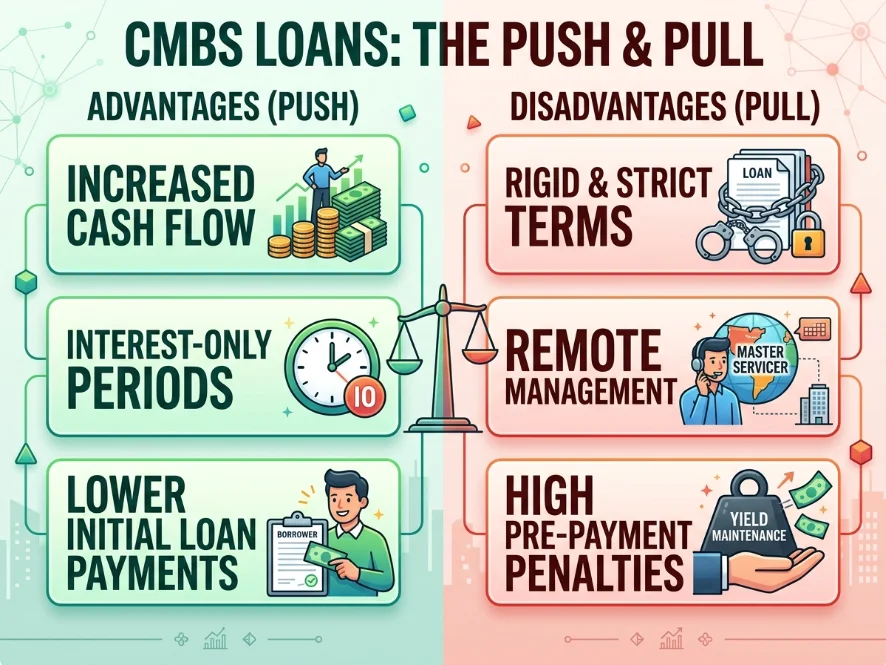
Every choice has a “push and pull.” The pleasure of CMBS is the cash flow. Many of these loans offer “interest-only” (IO) periods. Some last the entire term of the loan. This means you don’t pay down the principal. You pay interest. Your monthly check gets much bigger.
But there is a “pain” side too. CMBS is rigid. The loan documents are thick and hard to change. If you want to change a major tenant or do a big renovation, you can’t just call your local banker. You have to deal with a “master servicer” who lives in a different state.
You also have to deal with CMBS financing pre-payment penalties. These are not simple fees. They use a process called yield maintenance or CMBS loan defeasance. These penalties protect the bondholders’ profit. They make it very expensive to pay off the loan early.
What are CMBS loan rates today?
Rates move every day. Most fixed-rate commercial loans are priced off the 10-Year Treasury yield. Right now, that yield is around 4.27%. The lender adds a “spread” to that. For a solid multifamily deal, the spread might be 200 to 250 basis points.
If the Treasury is at 4.27% and your spread is 200 bps, your rate is 6.27%. This is simple math that drives the whole market. In early 2026, CMBS loan rates typically range from 5.83% to 7.78%.
These rates are often lower than bank rates. Why? Because the money comes from big investors who are hungry for yield. They will take a lower rate if the risk is low. If you have a stabilized apartment building, you are the low-risk bet they want.
Is CMBS financing for multifamily properties right for your portfolio?
We work with everyone from first-time investors to huge firms. We help people with CMBS financing for multifamily properties across all sizes:
- Multifamily (1-4 units): CMBS is usually too large for a single 4-unit building. But we can help you cross-collateralize a portfolio of these to hit the $2 million minimum.
- Multifamily (5-20 units): This is the sweet spot. You get institutional-grade debt for a mid-sized asset.
- Multifamily (21-40+ units): At this scale, you need a professional servicer. CMBS provides the long-term, fixed-rate stability you need to hold the asset for 10 years.
We also assist with ground-up construction and rebuilds. You can use a bridge loan for the construction phase, then use CMBS as your “exit” once the building is complete. This is how you build a legacy without risking your personal bank account.
How does the CMBS loan defeasance process actually work?
If you want to sell your building before the loan is up, you will hit a wall. That wall is the pre-payment penalty. Most CMBS loans use defeasance. In this process, you don’t actually pay off the debt. You replace the property with a basket of U.S. Treasury bonds.
These bonds give the bondholders the same cash flow the property would have. This “unhooks” your property from the loan. Now you can sell it or refinance it. It is a complex legal dance. You will need a consultant to help you calculate the costs.
The cost depends on interest rates. If rates go up, defense usually costs less. Since the 10-Year Treasury has stabilized around 4.2% recently, the “future outlook” is better for sellers than it was a few years ago.
What are the CMBS financing default consequences?
No one plans to fail, but you must know the risks. If your building’s income drops too low, things change fast. A “cash trap” might trigger. This means the lender takes all the rent money. They pay the bills and the mortgage first. You only get the leftovers if you hit certain goals.
If you fully default, you deal with a “special servicer.” Their job is to protect the bondholders. They are not your friends. They don’t want to “extend and pretend” as a bank might. They will move toward foreclosure quickly if they think it’s the best way to get the money back.
Currently, the multifamily delinquency rate is around 7.15%. This is a cycle-high. Most of the stress is in big markets like New York, New Jersey, and Houston. If you are in those areas, your underwriting needs to be bulletproof.
Who are the best CMBS financing companies to watch?
You need to know who is moving the most money. In 2025 and 2026, the rankings are clear. Trimont is at the top of the list for servicing, managing over $680 billion in assets. Wells Fargo and JPMorgan Chase are the kings of starting these loans.
If you are looking for the best CMBS financing companies, you should also consider Eastdil Secured and Morgan Stanley. These firms have the scale to get the biggest deals done. But remember, they are looking for the “cleanest” deals. If your deal has some hair on it, you need a correspondent lender like us to help tell your story.
What are the current CMBS market trends in 2026?

We are facing a “wall of maturities.” Over $100 billion in CMBS loans are coming due this year. Many of these loans started when property values were at an all-time high. Now, interest rates are higher. This creates a massive need for refinancing.
Morningstar reports that over half of these maturing loans might struggle to repay on time. This isn’t a crisis, but it is a “recalibration.” It means lenders are becoming more selective. They want higher-quality buildings. They want better sponsors.
There is also a weird trend called the “DOGE” effect. A Yale study found that federal lease cancellations by the Department of Government Efficiency caused a 4% drop in some CMBS bond prices. If your building relies on a government tenant, big investors are now looking at you as a higher risk. You need to diversify your tenant base to stay safe.
A special note for brokers and referrals
We value the brokerage community. Whether you are a veteran or just starting, we offer referral programs that work for you. You don’t have to be an expert in understanding CMBS financing terms to make money. You need to find the deal.
Know more details about 7 Benefits of Joining the Best Commercial Loan Referral Program
We can help your clients with:
- Bridge Loans: For properties that aren’t quite ready for CMBS.
- Hard Money: When you need to move in days, not months.
- DSCR Loans: For smaller investors with 1-4 units.
- USDA and SBA Loans: For rural areas or owner-occupied deals.
- FHA/HUD: For long-term holders who want 35-year terms.
When you partner with a “super broker,” you give your clients more options. You become a true financial consultant. You move away from just “selling a loan” and start building a portfolio.
Should you dive into CMBS today?
The “bank drama” isn’t going away. Regulation is getting tighter. Banks are being told to hold more cash and take fewer risks. This makes them even more annoying to deal with. CMBS is the professional alternative.
It gives you the millions you need to scale. It protects your personal life. It rewards you for running a tight ship and keeping your building full. If you can handle the rigidity, the cash flow benefits are huge.
The 2026 market is full of opportunity. With $100 billion in loans coming due, many owners will be forced to sell or refinance. If you are ready with non-recourse capital, you can pick up great assets while others are stuck in “bank drama.”
Don’t wait for the banker to call you. Take control of your debt. At Multifamily Lender, we have 30 years of expertise to get you across the finish line. We know the math. We know the lenders. And we know how to make your next big deal happen. CMBS financing is the key to your next level of growth. Let’s schedule an appointment with us.
FAQs
Can I transfer my CMBS loan?
Yes. Most CMBS loans allow you to transfer the debt to a new buyer when you sell your property. This makes the asset more attractive. You will likely pay a small fee to the servicer for the hand-off.
Can foreign nationals access CMBS financing?
Yes. Foreign investors can secure these loans for U.S. commercial properties. You usually must set up a U.S. entity, such as an LLC. Lenders will also require you to keep a specific amount of cash in a U.S. bank.
Do these loans hit personal credit?
No. Lenders typically do not report CMBS debt to personal credit bureaus because the loan is for a business entity. Your score stays clean unless you trigger a “bad boy” carve-out or default on a personal guarantee.
Is CMBS debt okay for 1031?
Yes. You can use CMBS financing as part of a 1031 exchange to defer your taxes. It works well with Delaware Statutory Trusts. This helps you move from one investment into a larger property without a huge tax bill.
Will CMBS loans fund new construction?
No. This financing is only for properties that are already built and fully occupied. You should use a bridge or construction loan first. Once your building is stable and generating income, you switch to CMBS debt.