 Google AI
 ChatGPT
 Perplexity
Financing an apartment building is nothing like financing a single-family rental. Lenders underwrite the property’s income first and the borrower second, loan programs branch off into government-backed, agency, bank, and private-capital tracks, and a single misjudged debt service coverage ratio can turn a promising deal into a declined application. This guide walks through every piece of that process — from the mechanics of how multifamily loans work to the fine print of HUD 221(d)(4) and Fannie Mae DUS execution — so you can walk into a lender conversation prepared.
Multifamily Lender works with investors, developers, and syndicators across the country to structure financing for properties ranging from five-unit walk-ups to 300-unit garden communities. Everything below reflects how these loans are actually underwritten and closed today.
In this guide: What multifamily loans are · How they’re sized · Benefits · Property types · Full requirements checklist · Every major loan program (HUD, Fannie Mae, Freddie Mac, CMBS, bridge, bank) · Property analysis fundamentals · Investment strategies · Step-by-step application process · Comparison tables · Common mistakes · Due diligence checklist · 20 FAQs
What Are Multifamily Loans?
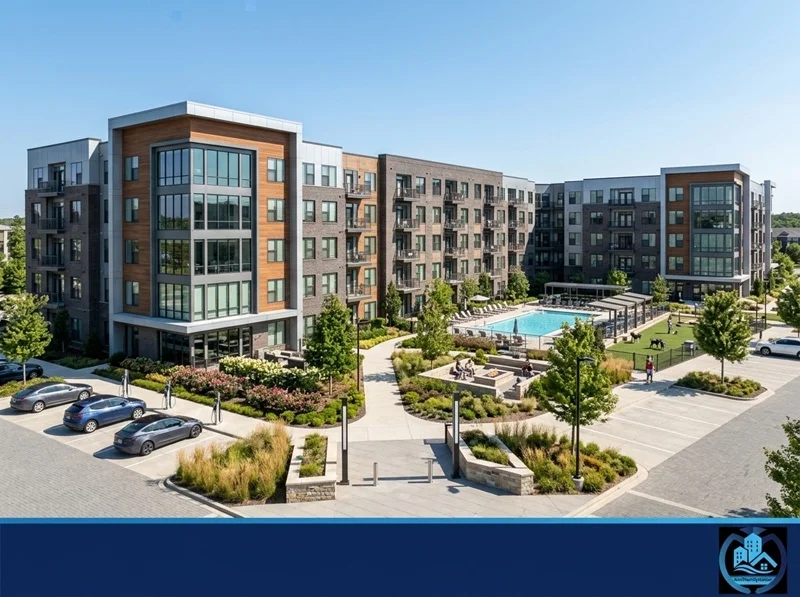
Multifamily loans are commercial mortgages used to purchase, refinance, or construct residential properties containing five or more rental units. Anything from four units down is treated as residential real estate and financed with conventional or FHA residential mortgages; once a property crosses the five-unit threshold, it moves into commercial underwriting, where the loan is sized primarily around the property’s net operating income rather than the borrower’s personal income alone.
This distinction matters more than most first-time buyers expect. A residential loan looks at your W-2s and personal debt-to-income ratio. A multifamily loan looks at the rent roll, the trailing twelve months of operating statements, occupancy history, and market rent comparables — and only then layers in the borrower’s net worth, liquidity, and experience.
Multifamily financing is available through a wide range of capital sources: government-insured HUD programs, the government-sponsored enterprises (Fannie Mae and Freddie Mac), traditional banks and credit unions, CMBS conduits, and private bridge lenders. Each source has a different risk appetite, pricing structure, and ideal use case, which is why matching the right program to the right deal is often the single biggest lever an investor can pull on returns.
How Multifamily Loans Work
At its core, a multifamily loan is sized using three interlocking metrics: loan-to-value (LTV), debt service coverage ratio (DSCR), and debt yield. A lender calculates the maximum loan amount under each test and then uses whichever produces the lowest number — this is called the “sizing constraint.”
Here’s a simplified example. Say a 40-unit apartment community generates $600,000 in net operating income (NOI) annually and is valued at $8,000,000:
- LTV test (75% max): $8,000,000 × 0.75 = $6,000,000
- DSCR test (1.25x minimum, at a 6.5% rate, 30-year amortization): roughly $6,450,000
- Debt yield test (9% minimum): $600,000 ÷ 0.09 = $6,666,667
In this scenario, the LTV test is the binding constraint, so the maximum loan amount would be capped around $6,000,000 even though the DSCR and debt yield tests would technically support more leverage. Understanding which test governs your deal lets you negotiate more effectively and avoid surprises at term sheet stage.
Multifamily loans also differ from residential mortgages in structure. Many carry interest-only periods, prepayment penalties (yield maintenance or defeasance on agency and CMBS loans), and balloon maturities rather than fully amortizing 30-year terms. Reading the term sheet carefully — not just the headline rate — is essential.
Benefits of Multifamily Financing
- Income-based underwriting means strong property performance can offset a less-than-perfect personal financial profile.
- Economies of scale — one loan, one closing, one set of due diligence costs covers dozens or hundreds of units, versus financing single-family rentals one at a time.
- Forced appreciation through value-add renovations directly increases NOI, which directly increases property value under the income approach to valuation — a lever investors don’t have with owner-occupied real estate.
- Non-recourse options on agency, HUD, and CMBS executions limit personal liability to specific “bad boy” carve-outs.
- Long-term fixed-rate options through HUD and agency programs provide 30-35 year terms with rate certainty rarely available in commercial real estate.
- Assumability — many agency and HUD loans can be assumed by a qualified buyer, which can be a meaningful selling point when it comes time to exit.
Types of Multifamily Properties
Duplex vs. Triplex vs. Fourplex vs. Apartment Buildings
| Property Type | Units | Financing Category | Typical Lender |
|---|---|---|---|
| Duplex | 2 | Residential | Conventional / FHA residential |
| Triplex | 3 | Residential | Conventional / FHA residential |
| Fourplex | 4 | Residential | Conventional / FHA residential |
| Apartment Building | 5+ | Commercial Multifamily | Agency, HUD, bank, CMBS, bridge |
Properties with five or more units are appraised using the income capitalization approach rather than comparable sales, and financed under commercial multifamily programs — this is the dividing line that determines which loan programs, down payment requirements, and underwriting standards apply.
Beyond the unit-count distinction, multifamily assets are generally grouped by class:
- Class A — newer construction (typically under 10-15 years old), premium finishes, strong amenity packages, located in high-demand submarkets.
- Class B — well-maintained older properties, moderate amenities, solid but not top-tier locations — often the sweet spot for value-add investors.
- Class C — older properties (often 30+ years), fewer amenities, deferred maintenance common, located in secondary or tertiary submarkets.
- Class D — significant deferred maintenance and/or challenged locations, typically requiring heavy capital investment or specialized turnaround financing.
Property class affects everything from the interest rate offered to which programs are even available — HUD and agency lenders, for example, are generally more conservative on Class C and D assets than banks or bridge lenders.
Multifamily Loan Requirements
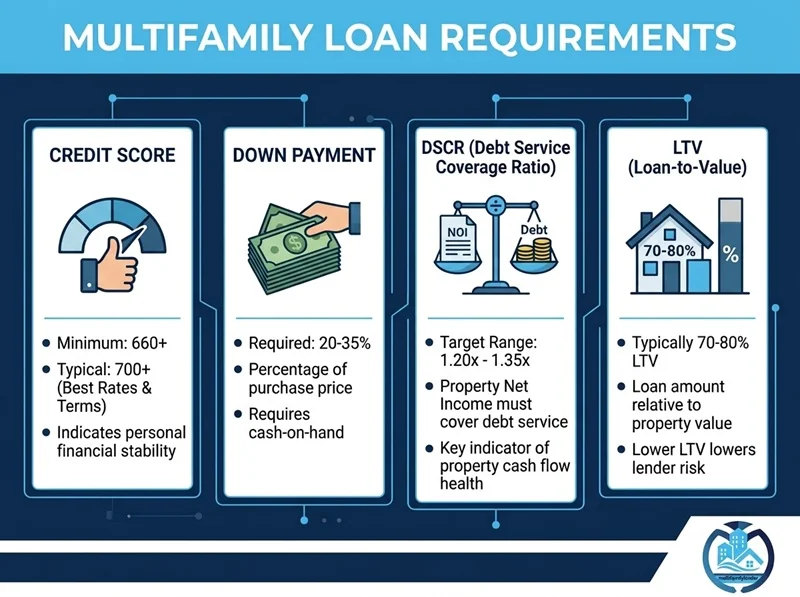
Credit Score Requirements
Most commercial multifamily lenders look for a minimum credit score in the 660-680 range for bank and bridge financing, and 680-700+ for agency and HUD executions. Higher scores don’t just improve approval odds — they typically translate into better pricing, since credit profile is one input into the lender’s risk-based rate sheet.
Down Payment Requirements
Down payments (or required equity) typically range from 20% to 35% of purchase price, depending on the program:
- Agency and HUD purchase loans: often 20-25% down (75-80% LTV)
- Bank loans: often 25-30% down (70-75% LTV)
- Bridge loans: often 25-35% down (65-75% LTV), sometimes higher due to renovation budgets
Debt Service Coverage Ratio (DSCR)
DSCR measures a property’s ability to cover its debt payments from net operating income:
DSCR = Net Operating Income ÷ Annual Debt Service
Most lenders require a minimum DSCR of 1.20x to 1.35x, meaning the property must generate 20-35% more income than what’s needed to cover the mortgage payment. A DSCR below 1.0x means the property doesn’t generate enough income to cover its own debt payments — a red flag that will sink most loan applications regardless of the borrower’s personal financial strength.
Loan-to-Value (LTV)
LTV compares the loan amount to the property’s appraised value or purchase price, whichever is lower. Typical maximum LTVs:
- Acquisition loans: 70-80%
- Refinance loans: 65-75%
- Bridge/value-add loans: 65-75% of as-is value, often up to 80-85% of total project cost including renovation budget
- HUD 221(d)(4) construction: up to 80-85% for market-rate, higher for affordable housing
Debt Yield
Debt yield is a leverage-neutral measure lenders use to stress-test a loan regardless of interest rate:
Debt Yield = Net Operating Income ÷ Loan Amount
Most lenders want to see a minimum debt yield of 8-10%. Unlike DSCR, debt yield doesn’t move with interest rates, which is why it became a standard underwriting check after the 2008-2009 downturn exposed how low rates can mask excessive leverage.
Occupancy Requirements
Most permanent loan programs require 90% physical occupancy for at least 90 days prior to closing, evidencing stabilized performance. Properties below this threshold are typically financed with bridge loans until stabilization is achieved, then refinanced into permanent debt.
Net Worth and Liquidity Requirements
A common industry rule of thumb: borrowers should demonstrate net worth equal to or greater than the loan amount, and post-closing liquidity equal to at least 9-12 months of debt service (often expressed as 5-10% of the loan amount in cash or cash equivalents). These are guidelines, not universal rules — requirements vary meaningfully by lender and program.
Eligible Borrowers
Multifamily loans can be made to individuals, LLCs, LPs, corporations, REITs, and joint ventures. Most agency and institutional lenders require the borrowing entity to be a single-asset, bankruptcy-remote special purpose entity (SPE) — a structure that isolates the property from the borrower’s other liabilities and assets.
Property Eligibility
Eligible collateral generally includes garden-style apartments, mid-rise and high-rise apartment communities, student housing, seniors housing (independent and assisted living), affordable/LIHTC properties, cooperative housing, and manufactured housing communities — each with its own program-specific eligibility rules.
Required Documentation
A typical multifamily loan application package includes:
- Trailing 12-month (T-12) operating statement and current rent roll
- 2-3 years of property tax returns and financial statements
- Personal financial statement and schedule of real estate owned (SREO)
- 2-3 years of personal and business tax returns
- Purchase and sale agreement (for acquisitions)
- Entity formation documents (operating agreement, articles of organization)
- Property condition report, environmental Phase I or Phase II, and appraisal (ordered by lender)
- Insurance certificates and flood determination
Loan Amounts
Multifamily loan amounts range widely — from small balance loans starting around $750,000-$1,000,000 for a 5-10 unit property, up to $100 million or more for large institutional-quality communities. Loan size is driven by the sizing constraints covered above (LTV, DSCR, debt yield) rather than a fixed dollar cap, which is why two properties of similar unit count can qualify for very different loan amounts depending on their income performance.
Interest Rates
Multifamily interest rates are priced off a benchmark index — typically the 10-year Treasury for agency and HUD fixed-rate loans, or SOFR for floating-rate bank and bridge loans — plus a spread that reflects property type, leverage, DSCR, sponsor strength, and loan term. Because these benchmarks move daily, published “as-of-today” rates go stale quickly; borrowers should always confirm current pricing directly with a lender rather than relying on rates quoted in older articles. As a general pattern, HUD-insured loans tend to price at the tightest spreads given the FHA insurance backstop, agency loans price competitively for well-qualified stabilized deals, and bridge loans carry the widest spreads to compensate for shorter terms and higher execution risk.
Loan Terms
Loan term and amortization are often two different numbers in commercial multifamily lending. A loan might carry a 10-year term (when the balance comes due) but a 30-year amortization schedule (how the payment is calculated) — meaning the borrower pays as if the loan were 30 years but must refinance or pay off the remaining balloon balance at year 10. HUD and some agency products are exceptions, offering fully amortizing terms with no balloon payment at all.
Closing Costs
Typical multifamily closing costs include lender origination fees (often 0.5%-1% of loan amount), third-party report costs (appraisal, property condition assessment, Phase I environmental), legal fees for both borrower and lender counsel, title insurance, and — for agency and HUD loans — application and processing fees specific to those programs. All-in closing costs commonly run 2%-4% of the loan amount, though HUD deals can run higher given the additional layers of federal review and required reports.
Fixed vs. Adjustable Rates
Fixed-rate loans lock in a single interest rate for the full term, providing payment certainty that many buy-and-hold investors prioritize. Adjustable-rate loans (often tied to SOFR) fluctuate with the index, which can work in a borrower’s favor in a falling-rate environment but adds payment volatility — a tradeoff typically accepted by value-add investors planning a shorter hold and refinance exit.
Recourse vs. Non-Recourse Loans
Recourse loans hold the borrower personally liable for the full loan balance if the property’s collateral value doesn’t cover a default. Non-recourse loans limit that liability to the property itself, except for specific “bad boy” carve-outs such as fraud, misrepresentation, or voluntary bankruptcy filings. Agency, HUD, and most CMBS executions are structured as non-recourse; bank and some bridge loans are more commonly recourse, particularly for newer sponsors or higher-leverage requests.
Loan Approval Process and Closing Timeline
Approval moves through preliminary sizing, term sheet issuance, third-party due diligence, formal credit underwriting, loan document negotiation, and closing. As detailed further below, the total timeline varies significantly by program — from a few weeks for bridge and bank execution to several months for HUD-insured financing.
Loan Programs Explained
Conventional Multifamily Loans
Offered by banks, credit unions, and life insurance companies. Typically 5, 7, or 10-year terms with 20-30 year amortization, LTVs of 70-75%, and both recourse and non-recourse structures depending on lender and leverage.
HUD 223(f) — Acquisition/Refinance
HUD 223(f) insures loans for the purchase or refinance of existing, stabilized multifamily properties. Highlights include up to 35-year fully amortizing, fixed-rate, non-recourse financing, LTVs up to 83.3% for market-rate (higher for affordable), and some of the lowest fixed rates available in commercial real estate due to the FHA insurance backing. The tradeoff is a longer approval timeline (often 4-8 months) and more extensive documentation, including HUD’s own third-party reports (Market Study, PCNA, Phase I).
HUD 221(d)(4) — New Construction/Substantial Rehab
The 221(d)(4) program finances ground-up construction or substantial rehabilitation, with non-recourse, fixed-rate financing locked at closing for the entire construction and 40-year permanent term — a rare feature that eliminates construction-to-permanent refinancing risk. LTC (loan-to-cost) can reach 85-87% for market-rate deals and higher for affordable housing developments.
Fannie Mae Multifamily Loans (DUS)
Fannie Mae’s Delegated Underwriting and Servicing (DUS) program offers terms from 5-30 years, both fixed and adjustable rates, up to 80% LTV, and specialized products for affordable housing, seniors housing, student housing, and manufactured housing communities. Fannie Mae loans are known for flexible prepayment options, including yield maintenance and declining prepayment premium structures.
Freddie Mac Multifamily Loans
Freddie Mac’s Optigo program offers similar terms to Fannie Mae with its own product suite, including Small Balance Loans (typically $1M-$7.5M) with streamlined underwriting for smaller deals, and Green Advantage pricing incentives for properties meeting energy/water-efficiency criteria.
FHA Multifamily Financing
Encompasses the broader family of FHA-insured multifamily programs beyond 223(f) and 221(d)(4), including 223(a)(7) (streamlined refinance of existing HUD-insured loans) and 232 (financing for seniors housing and healthcare-related facilities).
CMBS Multifamily Loans
Commercial mortgage-backed securities loans are originated by conduit lenders and pooled with other commercial loans, then sold to bond investors. Terms are typically 5, 7, or 10 years with 25-30 year amortization, fixed rates, and non-recourse structures with defeasance or yield maintenance prepayment penalties. CMBS execution can work well for properties or borrowers that don’t fit neatly into agency or HUD boxes.
Bank and Credit Union Multifamily Loans
Local and regional banks and credit unions offer relationship-based multifamily lending with more underwriting flexibility, often at the cost of shorter terms (3-10 years), recourse requirements, and rate resets. These lenders are frequently the best fit for smaller properties, first-time investors, or deals with unique circumstances that don’t fit agency guidelines.
Bridge Loans
Short-term (typically 12-36 months), interest-only financing used for value-add acquisitions, lease-up properties, or situations requiring speed of execution. Bridge loans allow investors to acquire and reposition a property, then refinance into permanent agency, HUD, or CMBS debt once the property stabilizes.
Construction Loans
Finance ground-up multifamily development, typically disbursed in draws tied to construction milestones, with interest-only payments during the build and conversion (or refinance) to permanent financing upon completion and stabilization.
Acquisition, Permanent, and Refinance Loans
- Acquisition financing funds the purchase of an existing property.
- Permanent loans are longer-term, stabilized financing — the end goal for most bridge and construction borrowers.
- Multifamily refinance replaces existing debt, often to lower rate, extend term, or return equity to the sponsor.
- Cash-out refinance allows owners to pull equity out of an appreciated or improved property, frequently used to fund the next acquisition in a portfolio-growth strategy.
Property Analysis Fundamentals
Net Operating Income (NOI)
NOI = Gross Potential Rent − Vacancy Loss + Other Income − Operating Expenses
NOI excludes debt service, capital expenditures, and depreciation — it measures the property’s pure operating performance and is the foundation for both loan sizing and valuation.
Capitalization Rate (Cap Rate)
Cap Rate = NOI ÷ Property Value
If a property generates $500,000 in NOI and trades at a 6% cap rate, its implied value is $500,000 ÷ 0.06 = $8,333,333. Cap rates move inversely with value — compressing cap rates (falling) indicate rising property values in a given market, while expanding cap rates indicate softening values.
Debt Yield
Covered above — a leverage-neutral risk check lenders use alongside LTV and DSCR.
Cash Flow Analysis
Cash flow to the equity investor equals NOI minus debt service minus any capital reserves — this is the metric that actually determines investor distributions, as distinct from NOI or cap rate, which measure the property independent of financing.
Occupancy Rate
Occupancy Rate = Occupied Units ÷ Total Units
Lenders typically want trailing 90-day average occupancy at or above 90% for permanent financing eligibility.
Rent Roll
A detailed unit-by-unit schedule showing current rent, lease start/end dates, and unit mix — one of the first documents any lender or appraiser will request, since it’s the raw data behind NOI.
Operating Expenses
Typically include property taxes, insurance, utilities, repairs and maintenance, management fees, payroll, and reserves for replacement. Lenders will often apply their own expense assumptions (rather than trusting seller-provided figures) to arrive at underwritten NOI.
Property Valuation
Multifamily properties (5+ units) are valued primarily through the income capitalization approach, cross-checked against comparable sales and, less commonly for stabilized assets, the cost approach.
Worked Example: Putting the Metrics Together
Consider a 60-unit garden-style apartment community generating $1,800,000 in gross potential rent, with 5% vacancy loss and $40,000 in other income (laundry, parking, pet fees):
- Effective Gross Income: $1,800,000 − $90,000 (vacancy) + $40,000 (other income) = $1,750,000
- Operating Expenses (taxes, insurance, payroll, maintenance, management, reserves): $700,000
- NOI: $1,750,000 − $700,000 = $1,050,000
At a 5.75% market cap rate, implied value = $1,050,000 ÷ 0.0575 ≈ $18,260,870. At 75% LTV, the maximum loan under the LTV test would be roughly $13,695,652. Running the DSCR test at a 6.25% note rate and 30-year amortization, and the debt yield test at a 9% minimum, would each produce their own maximum loan figures — and, as covered above, the lowest of the three becomes the governing loan amount. This is the exact exercise a lender runs on every deal, and it’s worth running yourself before assuming a certain leverage level going into negotiations.
Break-Even Analysis
Break-Even Occupancy = (Operating Expenses + Debt Service) ÷ Gross Potential Income
This tells you the minimum occupancy needed just to cover expenses and debt payments — a useful stress-test metric before acquiring or refinancing a property.
Investment Strategies
Value-Add Investing
Acquiring underperforming properties, investing capital in unit renovations and common-area improvements, raising rents to market level, and increasing NOI (and therefore value) — often financed with bridge debt during the repositioning phase, then refinanced into permanent agency or HUD financing.
Buy-and-Hold Strategy
Acquiring stabilized properties with long-term fixed-rate debt (often HUD or agency), prioritizing steady cash flow and gradual appreciation over an extended hold period.
Build-to-Rent
Ground-up development of single-family or townhome-style rental communities financed similarly to multifamily construction, an increasingly common strategy given persistent single-family home affordability pressure.
Multifamily Development
Ground-up apartment construction, typically financed with construction loans or HUD 221(d)(4), requires significantly more due diligence (entitlements, zoning, environmental) than acquisition financing.
Portfolio Expansion
Using cash-out refinances and 1031 exchanges to redeploy equity from stabilized assets into additional acquisitions, compounding portfolio growth over time.
Property Repositioning
Changing a property’s market position — through renovation, rebranding, management changes, or amenity additions — to justify higher rents and a lower effective cap rate at exit.
The Application Process, Step by Step

- Pre-qualification — share the deal (or existing property) financials with a lender to get preliminary sizing and program guidance.
- Term sheet / application — lender issues a term sheet outlining proposed rate, term, LTV, and conditions; borrower signs and pays a deposit for third-party reports.
- Due diligence — appraisal, property condition assessment, Phase I environmental, and (for HUD deals) additional agency-specific reports are ordered.
- Underwriting — lender’s underwriter team reviews all financials, verifies NOI, runs sizing tests, and issues formal loan approval subject to conditions.
- Loan documents — closing attorney prepares loan documents; borrower and lender counsel negotiate final terms.
- Closing and funding — loan documents are executed, funds are disbursed, and (for purchases) the transaction closes.
Typical timeline: bank and bridge loans can close in 30-45 days; agency loans typically take 45-75 days; HUD loans typically take 4-8 months given the additional layer of federal review.
Comparison Tables
HUD vs. Conventional Loans
| Feature | HUD (223(f) / 221(d)(4)) | Conventional |
|---|---|---|
| Term | Up to 35-40 years | 5-10 years typical |
| Rate | Fixed, often lowest available | Fixed or variable |
| Recourse | Non-recourse | Often recourse |
| Timeline | 4-8 months | 30-60 days |
| Best for | Long-term hold, stabilized/new construction | Speed, flexibility |
Fannie Mae vs. Freddie Mac
| Feature | Fannie Mae DUS | Freddie Mac Optigo |
|---|---|---|
| Terms | 5-30 years | 5-30 years |
| Small balance products | Yes | Yes (Small Balance Loan) |
| Green incentives | Yes | Yes (Green Advantage) |
| Prepayment options | Yield maintenance / declining premium | Yield maintenance / declining premium |
| Underwriting | Delegated to approved lenders | Delegated to approved lenders |
Bridge Loan vs. Permanent Loan
| Feature | Bridge Loan | Permanent Loan |
|---|---|---|
| Term | 12-36 months | 5-40 years |
| Rate structure | Floating, often interest-only | Fixed or adjustable |
| Use case | Acquisition, lease-up, renovation | Stabilized, long-term hold |
| Speed to close | Fast (2-6 weeks) | Slower (30 days – 8 months) |
Fixed vs. Adjustable Interest Rates
| Feature | Fixed Rate | Adjustable Rate |
|---|---|---|
| Payment predictability | High | Variable |
| Typical use | Long-term hold | Value-add, shorter hold |
| Rate risk | None during term | Borrower bears rate risk |
| Prepayment penalty | Often yield maintenance | Often step-down |
Agency Loans vs. Bank Loans
| Feature | Agency (Fannie/Freddie/HUD) | Bank |
|---|---|---|
| Leverage | Up to 80-87% | Typically 65-75% |
| Recourse | Usually non-recourse | Often recourse |
| Relationship flexibility | Standardized guidelines | More case-by-case flexibility |
| Speed | Moderate to slow | Often faster |
Recourse vs. Non-Recourse Financing
| Feature | Recourse | Non-Recourse |
|---|---|---|
| Personal liability | Full personal guarantee | Limited to carve-outs (fraud, waste, bankruptcy) |
| Typical source | Banks, some bridge lenders | Agency, HUD, CMBS |
| Pricing impact | Sometimes lower rate | Sometimes slightly higher rate |
Common Mistakes and How to Avoid Them
Common Underwriting Mistakes
- Overestimating market rent growth assumptions in pro forma projections
- Underestimating operating expenses, especially insurance and payroll in tight labor markets
- Failing to account for capital reserve requirements in cash flow projections
- Structuring debt with a DSCR cushion too thin to absorb a vacancy spike
Common Reasons Loans Are Declined
- DSCR or debt yield falling below program minimums after lender-adjusted underwriting
- Insufficient post-closing liquidity or net worth relative to loan size
- Property condition issues uncovered during the physical needs assessment
- Title, zoning, or environmental issues surfaced during due diligence
- Borrower credit or background issues discovered during underwriting
Tips to Improve Approval Odds
- Bring a clean, organized T-12 and current rent roll from day one
- Have personal financial statements and SREO prepared before applying
- Build in a realistic expense cushion rather than the seller’s optimistic numbers
- Talk to a lender before you’re under contract, not after
Due Diligence Checklist
- Trailing 12-month operating statement and current rent roll
- Physical inspection of all units and common areas
- Third-party appraisal and property condition assessment
- Phase I environmental site assessment
- Title search and survey review
- Zoning and code compliance verification
- Utility and expense audit
- Tenant estoppel certificates (for larger acquisitions)
- Insurance quote and flood zone determination
- Capital expenditure and reserve plan for the hold period
Questions to Ask a Lender Before Applying
- What sizing constraint (LTV, DSCR, or debt yield) is likely to govern this deal?
- Is the loan recourse or non-recourse, and what are the carve-outs?
- What is the prepayment structure, and what does it cost to exit early?
- What third-party reports are required, and who pays for them upfront?
- What is the realistic closing timeline given current pipeline volume?
Frequently Asked Questions
1. What is considered a multifamily property for loan purposes?
Any residential property with five or more rental units. Properties with one to four units are financed as residential real estate.
2. What credit score do I need for a multifamily loan?
Most programs look for a minimum of 660-680, with agency and HUD programs often preferring 680-700+.
3. How much down payment is required for a multifamily loan?
Typically 20-35% of the purchase price, depending on the loan program and property type.
4. What is DSCR and why does it matter?
Debt Service Coverage Ratio measures a property’s net operating income relative to its debt payments. Most lenders require a minimum of 1.20x-1.35x.
5. Can I get a non-recourse multifamily loan?
Yes — HUD, Fannie Mae, Freddie Mac, and most CMBS loans are structured as non-recourse, subject to standard carve-outs for fraud, waste, or bankruptcy.
6. What’s the difference between HUD 223(f) and HUD 221(d)(4)?
223(f) finances the acquisition or refinance of existing, stabilized properties. 221(d)(4) finances new construction or substantial rehabilitation.
7. How long does it take to close a multifamily loan?
Bank and bridge loans typically close in 30-45 days; agency loans in 45-75 days; HUD loans in 4-8 months.
8. What is debt yield and how is it different from DSCR?
Debt yield divides NOI by loan amount and doesn’t fluctuate with interest rates, making it a leverage-neutral risk check that lenders use alongside DSCR.
9. Can I use a bridge loan to buy a value-add apartment building?
Yes — bridge loans are specifically designed for value-add acquisitions, funding both the purchase and renovation budget, typically refinanced into permanent debt once the property stabilizes.
10. What documentation will I need to apply?
Rent roll, T-12 operating statement, personal financial statements, tax returns, entity documents, and a purchase agreement (for acquisitions).
11. Are Fannie Mae and Freddie Mac loans the same?
They’re similar but have distinct product lines, pricing, and underwriting nuances — both are delegated to approved lender networks rather than originated directly by the agencies.
12. What is a good cap rate for a multifamily property?
Cap rates vary significantly by market and asset class; a lower cap rate generally reflects a higher-value, lower-risk market, while a higher cap rate can reflect either higher risk or a value-add opportunity.
13. Can first-time investors get multifamily financing?
Yes, though experience requirements vary by lender and loan size — banks and smaller balance agency loans tend to be more accessible to first-time multifamily buyers.
14. What happens if occupancy drops below the required threshold?
Properties below the required occupancy for permanent financing typically need bridge financing until stabilization is achieved.
15. What is a cash-out refinance and when does it make sense?
A cash-out refinance replaces existing debt with a larger loan, returning the difference in cash to the owner — commonly used after a successful value-add renovation increases NOI and property value.
16. Do multifamily loans have prepayment penalties?
Most fixed-rate agency, HUD, and CMBS loans carry prepayment penalties (yield maintenance, defeasance, or step-down structures); bank and bridge loans vary by lender.
17. What’s the minimum loan amount for agency multifamily financing?
Small balance loan programs from Fannie Mae and Freddie Mac typically start around $1 million, making agency execution accessible for smaller apartment properties.
18. Can I finance a mixed-use property with a multifamily loan?
Depending on the commercial component’s share of income, mixed-use properties may qualify under multifamily programs or may require commercial mortgage financing instead — this is evaluated case by case.
19. What is the difference between acquisition and permanent financing?
Acquisition financing funds the purchase of a property, often short- to medium-term, while permanent financing refers to longer-term, stabilized debt — often the end goal after a value-add or construction phase.
20. How do I know which loan program is right for my deal?
The right program depends on property condition, occupancy, hold period, leverage needs, and recourse preference — speaking with a lender early in the process is the most reliable way to match the deal to the right execution.
Ready to Finance Your Next Multifamily Property?
Loan approval always depends on lender underwriting standards, borrower qualifications, property performance, and overall financial strength — there is no such thing as guaranteed approval or guaranteed funding in commercial real estate lending. What Multifamily Lender can do is help you understand which programs fit your deal and connect you with financing built around your property’s actual numbers.
Contact us today at (855) 367-9900 or visit multifamilylender.net to discuss financing for your apartment building acquisition, refinance, or construction project.