
 Google AI
 ChatGPT
 Perplexity
Over $1.5 trillion in commercial real estate debt is set to mature between 2025 and 2027, and multifamily properties make up a meaningful share of that pipeline. MBA’s latest survey of loan maturity volumes puts 2026 maturities at roughly $875 billion, a 9% pullback from the $957 billion that matured in 2025, with about 13% of that total backed by multifamily properties.
At the same time, Harvard University’s Joint Center for Housing Studies reports that a record 22.7 million American renter households now spend over 30% of their income on rent. More than 12 million of those households pay over half their monthly paychecks just to keep a roof over their heads.
New apartment construction has cooled from its post-pandemic highs, though the picture is uneven. NAHB’s tracking of Census data shows multifamily starts falling to some of their lowest quarterly levels in over a decade during parts of 2025 before ticking back up into early 2026. If you own or plan to buy apartment buildings, this is your moment.
Property owners who wait will face high interest rates and tight local bank limits. Smart investors are locking in long-term, government-backed loans right now.
Finding the best agency lenders for apartments gives you the money you need to grow your wealth while protecting your personal assets.
At MultifamilyLender.Net, we bring 30 years of underwriting experience to your corner. We are a correspondent and table lender. We work directly with a private network of over 200 real estate investors and lenders.
We do not fund primary homes or personal residences. We only finance commercial, income-generating investment properties.
Whether you buy a 5-unit building, a 40-unit complex, or a 200-unit portfolio, we help you secure the lowest rates and safest loan terms through programs like our Fannie Mae, Freddie Mac, and FHA/HUD loan options.
We also offer exclusive and non-exclusive referral programs for commercial brokers nationwide.
Here is everything you need to know to find the best agency lender, compare loan options, and close your deal fast.
What Makes a Fannie Mae vs Freddie Mac Apartment Lenders Comparison Crucial for Your Profits?
When you finance an apartment property, you have many loan choices. You can go to a local bank, an insurance company, or a debt fund.
Most seasoned investors choose agency loans.
An agency loan is a commercial mortgage backed by government-sponsored enterprises. The two main agencies are Fannie Mae and Freddie Mac. A third key agency is the U.S. Department of Housing and Urban Development, known as HUD or the FHA. Both Fannie Mae and Freddie Mac have operated under conservatorship overseen by the Federal Housing Finance Agency since 2008, and FHFA sets an annual cap on how much multifamily business each GSE can write. For 2026, that cap was set at $88 billion per Enterprise, or $176 billion combined, with at least half required to go toward mission-driven affordable housing.
These agencies do not write loans directly to you at a counter. Instead, they work through approved mortgage lenders.
A direct Fannie Mae vs Freddie Mac apartment lenders comparison shows how these two capital sources work differently.
Fannie Mae uses the Delegated Underwriting and Servicing program. This is known as the DUS platform. Under this system, Fannie Mae gives the lender full authority to approve and close your loan. The lender does not have to ask Fannie Mae for permission on standard deals.
In return, the lender shares the risk of loss with Fannie Mae if a loan goes bad. This risk-sharing model strongly motivates DUS lenders to close your deal quickly and smoothly.
Freddie Mac uses a different setup called the Optigo network. Freddie Mac Optigo lenders originate your loan, but Freddie Mac reviews the credit file directly before closing.
Freddie Mac bundles these loans into bonds called K-Deals and sells them to Wall Street investors. This securitization setup allows Freddie Mac to offer very low interest rates on standard, stabilized apartment buildings. This deep, liquid capital market, backed in large part by government-supported lending programs like these, helps explain why multifamily debt has stayed more accessible than office or retail debt through the current cycle.
| Feature | Fannie Mae DUS Program | Freddie Mac Optigo Program | HUD / FHA MAP Program |
| Credit Decision | Fully delegated to approved lender | Direct credit review by Freddie Mac | Direct review by HUD field office |
| Risk Structure | Lender shares credit loss risk | Securitized into K-Deals | 100% federal mortgage insurance |
| Standard Loan Terms | 5, 7, 10, 12, 15, or 30 years | 5, 7, 10, or 15 years | 35 years (buy/refi) or 40 years (build) |
| Amortization | Up to 30 years | Up to 30 years | Up to 35 to 40 years |
| Max Loan-to-Value (LTV) | Up to 80% LTV | Up to 80% LTV | Up to 85% to 90% LTV/LTC |
| Min Debt Coverage (DSCR) | 1.25x market rate (1.20x affordable) | 1.25x standard (1.20x targeted) | 1.176x market (1.11x to 1.15x affordable) |
| Recourse Type | Non-recourse with standard carve-outs | Non-recourse with standard carve-outs | Non-recourse with standard carve-outs |
| Closing Timeline | 45 to 60 days | 45 to 60 days | 120 to 240 days |
| Rate Lock Stage | At underwriting commitment | Early application or index lock | At HUD firm commitment |
| Prepayment Structure | Yield maintenance or defeasance | Step-down penalty or defeasance | 10-year declining step-down (10% to 1%) |
How to Navigate the Guide to Fannie Mae DUS Apartment Financing
If you want speed, flexible terms, and dependable funding, our guide to Fannie Mae DUS apartment financing gives you the blueprint.
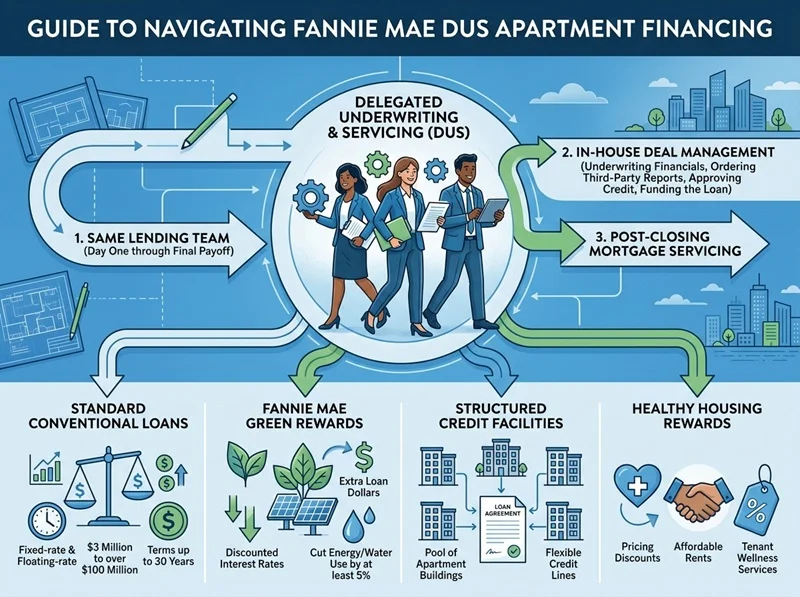
Fannie Mae DUS loans work well for stabilized apartment properties with 5+ units.
Because Fannie Mae lenders hold delegated authority, they handle every part of your deal in-house. They underwrite your financials, order third-party reports, approve the credit, and fund the loan. They also service your mortgage after it closes.
You deal with the same lending team from day one through final payoff.
Fannie Mae provides several specialized loan programs:
Standard Conventional Loans: Fixed-rate and floating-rate loans from $3 million to over $100 million with terms up to 30 years.
Fannie Mae Green Rewards: Gives you discounted interest rates and extra loan dollars if you cut your building’s energy or water use by at least 5%.
Structured Credit Facilities: Flexible credit lines for investors who want to finance large pools of apartment buildings under one loan agreement.
Healthy Housing Rewards: Offers pricing discounts if your property provides affordable rents and tenant wellness services.
Top Industry Players: Best Fannie Mae Lenders for Multifamily Apartments
You must work with an approved DUS lender to get Fannie Mae financing.
The best Fannie Mae lenders for multifamily apartments maintain proven track records, fast execution speeds, and large balance sheets:
Walker & Dunlop: Ranked the #1 Fannie Mae DUS lender by loan volume for the seventh consecutive year, delivering fast closings on conventional purchases and refinances.
Berkadia Commercial Mortgage: A joint venture between Berkshire Hathaway and Jefferies Financial Group that consistently ranks among the largest Fannie Mae originators in America.
CBRE Multifamily Capital: A powerhouse lending division that uses its massive commercial brokerage network to fund large apartment transactions.
Wells Fargo Multifamily Capital: A major national bank platform that executes large Fannie Mae credit facilities for institutional apartment owners.
Greystone: A top-tier agency lender that excels in bridge loans and smooth exits into permanent Fannie Mae debt.
Newmark: A leading capital markets group that handles large apartment building acquisitions and joint venture refinances.
Why Choose Freddie Mac Optigo Lenders for Apartment Building Acquisition and Small Loans?
If you are buying a stabilized property, Freddie Mac Optigo lenders for apartment building acquisition offer some of the most aggressive pricing in the commercial real estate market.
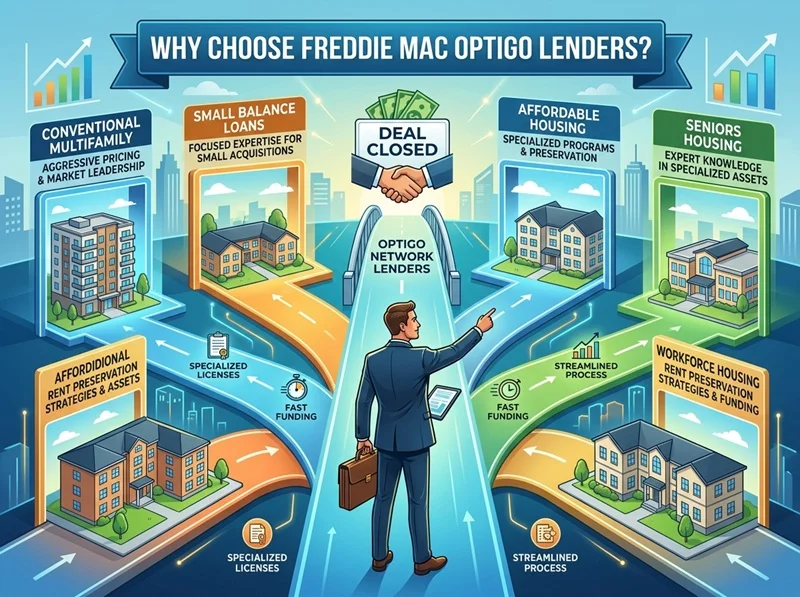
Freddie Mac sets up its Optigo network with specialized lender licenses. Each lender focuses on specific loan sizes and property types.
Freddie Mac’s top originators lead distinct categories:
Overall Volume and Targeted Affordable Leader: Berkadia Commercial Mortgage.
Conventional Multifamily Leader: JLL Real Estate Capital.
Small Balance Loan Leader: CBRE Multifamily Capital.
Seniors Housing Leader: Wells Fargo.
Workforce Housing Rent Preservation Leader: Arbor Commercial Funding.
The Freddie Mac Small Balance Loan Program for Apartments
If you buy or refinance an apartment building with 5 to 50 units, you do not need to settle for restrictive local bank terms. Read our full Freddie Mac multifamily loan rates guide for a deeper look at current pricing.
The Freddie Mac Small Balance Loan program for apartments is built specifically for loans between $1 million and $7.5 million. In top-tier cities, this limit can reach up to $10 million.
Over 92% of Freddie Mac small balance loans fund mission-driven workforce housing. That means you can qualify for lower interest rates if your rents are affordable to working families in your area.
Here is what makes this program a favorite among private real estate investors:
High Leverage: You can borrow up to 80% of the property value for purchases and 75% for refinances.
Long-Term Payoff: Enjoy 30-year amortization schedules that keep your monthly payments low.
Interest-Only Options: You can get partial-term or full-term interest-only periods to increase your monthly cash flow.
Flexible Prepayment: Choose simple step-down prepayment penalties, like 5-4-3-2-1%, instead of expensive yield maintenance formulas.
Early Rate Lock: Freddie Mac lets you hold your interest rate right when you sign your loan application.
Finding Top Agency Lenders for Small Apartment Building Loans
Small apartment buildings require dedicated underwriting teams that can process loans quickly. Before you apply, it helps to walk through a private commercial loan underwriting checklist, so your file is ready on day one.
The top agency lenders for small apartment building loans include CBRE, Berkadia, and Arbor Commercial Funding.
These lenders maintain specialized small-loan desks that close deals within 45 days.
| Small Loan Parameters | Freddie Mac Small Balance Loan (SBL) | Fannie Mae Small Loan Program |
| Loan Amount Range | $1,000,000 to $7,500,000 ($10M in top metros) | Up to $6,000,000 ($9M in high-cost cities) |
| Property Size | 5 to 50 residential units | 5 or more residential units |
| Fixed-Rate Terms | 5, 7, or 10 years fixed; hybrid ARMs | 5, 7, 10, 12, 15, or 30 years fixed |
| Amortization | Up to 30 years | Up to 30 years |
| Max Loan-to-Value | 80% for purchases; 75% for refinances | 80% for purchases; 75% for refinances |
| Min DSCR Requirement | 1.20x (top markets) to 1.30x (small markets) | 1.25x standard market rate |
| Recourse Standard | Non-recourse with standard carve-outs | Non-recourse with standard carve-outs |
| Prepayment Penalty | Declining step-down or yield maintenance | Yield maintenance or custom defeasance |
How Can HUD 221(d)(4) Lenders Fund New Apartment Construction and Major Rehabs?
Building new apartment buildings or gut-rehabbing older properties requires significant capital. Our ground-up construction loans page covers the broader range of options beyond HUD, and our guide on key steps to getting ground-up construction financing walks through the process end to end.
Commercial construction loans from traditional banks carry heavy risks. Banks often charge floating interest rates, demand full personal guarantees, and give you only 24 to 36 months to finish the build and refinance the property.
Working with HUD 221(d)(4) lenders for new apartment construction solves these challenges.
The HUD Section 221(d)(4) loan program, overseen by the U.S. Department of Housing and Urban Development, is a construction-to-permanent loan insured by the federal government.
You lock in one low, fixed interest rate before you turn a single shovel of dirt. That interest rate stays fixed for your entire construction period, up to 3 years, and continues for another 40 years of permanent amortization.
You get up to 43 years of total financing without ever having to refinance.
HUD 221(d)(4) loan features include:
High Leverage: You can borrow up to 85% of total construction costs for market-rate projects. Affordable housing developments can reach 87% to 90% loan-to-cost.
Non-Recourse Protection: The loan is 100% non-recourse during both construction and the permanent mortgage phase. You do not sign personal repayment guarantees.
Low Debt Coverage Limits: The minimum debt service coverage ratio is just 1.20x for market-rate properties and 1.11x to 1.15x for affordable properties.
Low Annual Mortgage Insurance: HUD has lowered annual Mortgage Insurance Premiums to 0.25% for qualifying green and energy-efficient properties.
HUD loans require strict compliance. Your general contractor must pay federal Davis-Bacon prevailing wages. The contractor must also supply payment and performance bonds.
The entire process takes 6 to 9 months to close. However, locking in 40-year money with no personal liability provides unbeatable peace of mind.
Leading HUD MAP lenders include Greystone, ranked #1 in HUD multifamily volume; Merchants Capital; Walker & Dunlop; and Berkadia.
| Construction Loan Feature | HUD Section 221(d)(4) Loan | Commercial Bank Construction Loan |
| Permanent Loan Term | 40 years fully amortizing | None (requires takeout refinance) |
| Construction Period | Up to 36 months (interest-only) | 24 to 36 months (interest-only) |
| Maximum Loan-to-Cost (LTC) | 85% to 90% LTC | 60% to 65% LTC |
| Interest Rate Type | Long-term fixed before groundbreaking | Floating (SOFR / Prime + spread) |
| Recourse Terms | Non-recourse during build and permanent phase | Full personal recourse required |
| Wage Rules | Mandatory Davis-Bacon prevailing wages | Standard open-shop labor permitted |
What Are the Real Agency Lender Requirements for Apartment Complex Loans?
Agency lenders use clear mathematical rules to size your mortgage.
To secure fixed-rate agency loans for multifamily properties, your apartment building must generate enough income to cover all expenses and debt payments with room to spare. If your numbers are tight, our breakdown of what to do when your debt coverage ratio is too low to refinance can help you find a path forward.
Here is how agency underwriters review agency lender requirements for apartment complex loans:
1. Debt Service Coverage Ratio (DSCR)
The DSCR measures your property’s net income against its annual loan payments:
DSCR = Net Operating Income / Annual Debt Service
To find your Net Operating Income (NOI), underwriters take your Effective Gross Income and subtract all operating expenses.
They include real estate taxes, insurance, utilities, repairs, on-site payroll, professional management fees (set at 3% to 5% of gross income), and mandatory replacement reserves of $250 to $350 per unit each year.
2. Loan-to-Value (LTV) and Loan-to-Cost (LTC)
These ratios limit how much money you can borrow compared to the property’s appraised value or construction cost:
LTV = Total Loan Amount / Appraised Property Value
LTC = Total Loan Amount / Total Development Cost
3. Debt Yield
Debt yield tells the lender their direct rate of return if they had to take back the property:
Debt Yield = (Net Operating Income / Total Loan Amount) x 100
Agency lenders look for a debt yield between 7.5% and 9.0%.
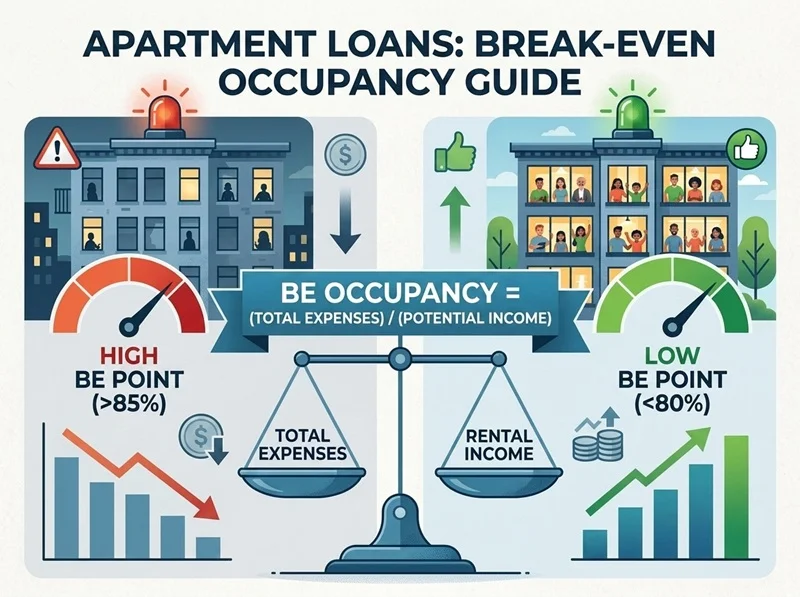
4. Break-Even Occupancy Ratio
This formula shows the minimum physical occupancy your building needs to pay all bills and mortgage payments:
Break-Even Occupancy = ((Operating Expenses + Annual Debt Service) / Gross Potential Rent) x 100
Agency lenders require your break-even occupancy ratio to stay below 80% to 85%.
| Market Tier Level | Max Refinance LTV | Min Market-Rate DSCR | Required Debt Yield |
| Tier 1 (Major Metros: NYC, LA, Chicago, Dallas) | 80.0% | 1.20x to 1.25x | 7.50% to 8.00% |
| Tier 2 (Growth Cities: Tampa, Denver, Austin) | 75.0% to 80.0% | 1.25x to 1.30x | 8.00% to 8.50% |
| Tier 3 (Small Regional Hubs) | 70.0% to 75.0% | 1.30x to 1.35x | 8.50% to 9.00% |
| Tier 4 (Tertiary and Rural Markets) | 65.0% to 70.0% | 1.35x to 1.45x | 9.00% to 10.00% |
Why Insist on Non-Recourse Financing Options from Agency Apartment Lenders?
When you borrow money from a local bank, they almost always require a personal guarantee. If the economy turns down and the property fails, the bank can sue you. They can take your cash, seize your personal investments, and go after your private assets.
This is why experienced commercial investors choose non-recourse financing options from agency apartment lenders. Our full breakdown of non-recourse commercial loan requirements covers this in more depth.
With a non-recourse loan, the apartment building itself is the only collateral securing the debt. If a loan defaults, the lender takes the property. They cannot touch your personal bank accounts, your business assets, or your other real estate holdings.
Non-recourse loans include standard bad-boy carve-out rules. You stay protected as long as you do not commit dishonest acts:
Committing fraud or lying on your loan application.
Filing a fraudulent bankruptcy to stop foreclosure.
Stealing tenant security deposits or pocketing rent money instead of paying property bills.
Selling the property or taking out unauthorized secondary loans without lender approval.
Causing severe environmental contamination through negligence.
Run your property honestly and professionally, and your personal wealth remains safe.
How Specialized Agency Programs Fund Affordable, Senior, and Portfolio Deals
Different commercial properties require specialized financing tools. The agencies provide custom loan divisions for complex real estate assets.
Best Agency Lenders for Affordable Housing Apartments
Affordable housing properties deliver steady occupancy and vital community support.
The best agency lenders for affordable housing apartments include Berkadia, Merchants Capital, and Citi Community Capital.
These lenders structure debt for properties with Low-Income Housing Tax Credits (LIHTC) and Section 8 Housing Assistance Payments (HAP) contracts.
Affordable housing agency loans feature lower DSCR requirements, down to 1.15x, and reduced interest rates.
Agency Lenders Specializing in Senior Housing Apartments
Senior housing properties combine residential units with professional care services.
Top agency lenders specializing in senior housing apartments include Wells Fargo for Freddie Mac Seniors Housing and Greystone for HUD Section 232 healthcare loans.
These loan programs finance independent living, assisted living, and memory care facilities.
Experienced Agency Lenders for Apartment Portfolio Loans
If you manage a large real estate operation, refinancing properties one at a time wastes time and money.
Working with experienced agency lenders for apartment portfolio loans lets you group multiple properties into a single credit facility.
Lenders like JLL, PGIM Real Estate, and Newmark structure Fannie Mae Structured Credit Facilities and Freddie Mac Bulk Transactions.
These credit facilities allow you to add new properties, release sold buildings, and substitute collateral without breaking your mortgage structure.
| Asset Type | Lead Agency Platforms | Key Borrowing Advantages |
| Affordable Housing & LIHTC | Fannie Mae TAH, Freddie TAH, HUD MAP | Lower DSCR floors, discounted pricing, forward commitments |
| Seniors Housing & Care | Freddie Mac Seniors, HUD Section 232 | Supports licensed assisted living and memory care units |
| Multifamily Portfolios | Fannie Structured Credit, Freddie Bulk | Grouped collateral, property releases, asset substitution |
| Manufactured Housing | PGIM, Berkadia, Walker & Dunlop MHC | Long-term amortizations for stabilized mobile home parks |
| Rural Multifamily | Merchants Capital (USDA Section 538) | Direct federal loan guarantees for rural rental assets |
How to Choose an Agency Lender for Apartment Refinancing and Align with the Best Agency Lenders for Apartments
Selecting the right financial partner is a major business decision.
Different lenders offer different credit boxes, approval speeds, and loan terms.
Here is how to choose an agency lender for apartment refinancing to ensure a smooth closing:
Check Direct Agency Licenses: Make sure your lender holds active Fannie Mae DUS, Freddie Mac Optigo, and HUD MAP licenses. Direct licenses ensure you get real institutional pricing without added middleman markups. If you would rather work through a table lender with access to a private network, learn how to find a private commercial table lender for your deal.
Evaluate Bridge-to-Agency Capabilities: If your property needs light renovation or lease-up before securing permanent agency debt, choose a lender that provides in-house bridge loans. A seamless bridge-to-agency setup saves you thousands of dollars in duplicate closing fees.
Confirm Underwriting Flexibility: Ask how the lender handles credit waivers, complex LLC ownership structures, and local market quirks. A flexible underwriter solves problems early before they delay your closing.
Verify In-House Loan Servicing: Choose a lender that services your mortgage after closing. In-house servicing means people you know handle your future repair reserve draws, tax escrows, and building inspections smoothly.
| Lending Institution | Official Licenses | Primary Asset Focus | Industry Rank & Standing |
| Walker & Dunlop | Fannie Mae DUS, Freddie Optigo, HUD MAP | Large conventional deals, acquisitions, portfolios | #1 Fannie Mae DUS Lender; top-tier Freddie Mac Optigo lender |
| Berkadia Commercial | Fannie Mae DUS, Freddie Optigo, HUD MAP | Affordable housing, small balance loans, conventional | #1 Freddie Mac Optigo Lender; backed by Berkshire Hathaway |
| CBRE Multifamily | Fannie Mae DUS, Freddie Optigo, HUD MAP | Small balance loans, large institutional sales | Leading Freddie Mac Small Balance Loan Lender |
| Greystone & Co. | HUD MAP, Fannie Mae DUS, Freddie Optigo | HUD 221(d)(4) construction, HUD 223(f), bridge debt | #1 Overall HUD Multifamily and Healthcare Lender |
| JLL Real Estate Capital | Fannie Mae DUS, Freddie Optigo, HUD MAP | Conventional large-balance assets, institutional deals | Leading Freddie Mac Conventional Multifamily Lender |
| Merchants Capital | Fannie Mae, Freddie TAH, HUD MAP, USDA 538 | Affordable housing, HUD construction, rural housing | Top-ranked HUD/FHA and USDA 538 rural housing lender |
| Arbor Commercial | Fannie Mae DUS, Freddie Optigo, HUD MAP | Small loans, workforce housing preservation | Leader in workforce housing rent preservation |
| Wells Fargo Multifamily | Fannie Mae DUS, Freddie Optigo, HUD MAP | Senior housing, balance sheet banking debt | Leading Freddie Mac Seniors Housing Lender |
| PGIM Real Estate | Fannie Mae DUS, Freddie Optigo, HUD MAP | Manufactured housing communities, life company debt | Leading Freddie Mac Manufactured Housing Lender |
What is the Process for Securing an Agency Apartment Loan?
Closing an agency commercial loan follows a structured, four-phase timeline.
Understanding what the process for securing an agency apartment loan is helps you prepare your files and avoid costly closing delays. A strong multifamily loan application at the start makes every later phase move faster.
Phase 1: Loan Sizing and Term Sheet (Days 1 to 10)
You send your property financials to the lender. This file includes your trailing 12-month operating statements (T12), current rent roll, property photos, and personal financial statement.
The underwriter reviews your NOI, tests your DSCR, and issues a formal loan quote or term sheet.
You sign the term sheet and pay an underwriting deposit to launch third-party inspections.
Phase 2: Third-Party Reports and Due Diligence (Days 10 to 30)
The lender hires independent engineering, environmental, and valuation firms to inspect your apartment property:
Commercial Property Appraisal: A certified appraiser inspects the building and analyzes local market sales and rents to determine fair market value.
Phase I Environmental Site Assessment (ESA): Meets ASTM E1527 standards to verify the property and surrounding lands have no hazardous chemical spills, underground storage tank leaks, or soil contamination.
Property Condition Assessment (PCA / PNA): Meets ASTM E2018 standards to inspect the roof, plumbing, electrical, paving, and foundations. This report sets your annual replacement reserve budget.
Seismic Risk Assessment (SRA): Required for properties in earthquake-prone areas. If the Probable Maximum Loss (PML) is above 20%, you must purchase earthquake insurance.
Phase 3: Credit Underwriting and Loan Approval (Days 25 to 45)
The underwriting team verifies your credit history, reviews your real estate track record, audits property utility bills, and confirms lease terms.
Fannie Mae DUS lenders approve the loan in-house. Freddie Mac and HUD lenders submit the underwriting package to the agency for formal commitment.
Phase 4: Rate Lock, Legal Documents, and Closing (Days 45 to 60)
You execute your final interest rate lock agreement.
Lender attorneys prepare closing documents, review title commitments, and verify property insurance coverage.
You sign final loan papers, wire your equity closing funds, and the lender funds your mortgage.
| Third-Party Report | Industry Standard | What the Report Verifies |
| Phase I Environmental (ESA) | ASTM E1527-21 standard | Checks for soil pollution, underground fuel tanks, and toxic hazards |
| Physical Needs Assessment (PNA) | ASTM E2018-15 standard | Audits building structure, roof life, and sets annual repair escrows |
| Seismic Risk Study (SRA) | ASTM E2026 / E2557 standards | Evaluates earthquake damage risk in Western states and fault zones |
| Commercial Real Estate Appraisal | USPAP and FIRREA rules | Determines stabilized market value using income and sales comps |
Scale Your Commercial Real Estate Portfolio with MultifamilyLender.Net
Finding the right capital partner determines your success as a real estate investor.
Locking in the right mortgage lowers your monthly expenses, boosts your cash flow, and protects your family’s personal wealth.
Partnering with the best agency lenders for apartments gives you institutional capital, high loan proceeds, and non-recourse security.
At MultifamilyLender.Net, we simplify commercial apartment financing.
We bring 30 years of underwriting experience to every transaction. We operate as a correspondent and table lender, providing access to over 200 private lenders and real estate investors.
We only finance commercial investment and income-producing properties. We do not finance primary residences or personal homes.
We finance every stage of your real estate business:
Property Scale: 1-4 unit investment properties, 5-10 units, 11-20 units, 21-30 units, 31-40 units, and large apartment complexes.
Investment Strategies: Ground-up construction, historic rebuilds, property renovations, fix-and-flip, fix-and-hold, and fix-and-rent acquisitions.
Loan Products: Bridge loans, hard money, DSCR loans, USDA B&I loans, SBA loans, FHA commercial investment loans, construction facilities, term debt, no-doc loans, lite-doc loans, and stated income financing. If a maturing loan is the issue rather than a new purchase, see our guide on what to do when a commercial loan reaches its maturity date, or how a private bridge loan can solve maturing CMBS debt.
Broker Partnerships: Generous exclusive and non-exclusive referral programs for both new and experienced commercial real estate brokers.
Stop leaving your deals to chance with local banks that cap your leverage and demand personal liability.
Contact MultifamilyLender.Net today to review your rent rolls, size your property cash flows, and secure the lowest-cost agency financing available for your apartment buildings.
FAQs
Can you assume an existing agency mortgage?
Yes. You can transfer your existing agency mortgage to a qualified buyer when selling your apartment building. This assumption feature protects your property value and saves your buyer money. Call our underwriting team right now to transfer your loan.
Do HUD multifamily loans require tax returns?
No. HUD focuses primarily on your property’s net income, not your personal tax returns. This can lead to faster approvals without intrusive personal income reviews. Contact our loan team today and unlock maximum financing for your commercial apartment building.
Can you finance your primary residence here?
No. We never finance personal homes or primary residences. We fund only commercial, income-producing apartment buildings to help you grow your wealth. Reach out to our lending team right now to fund your next profitable multifamily real estate deal.
Can HUD loan interest rates be reduced?
Yes. HUD permits an official rate reduction modification if interest rates drop in the future. You do not need to pay full refinance closing costs. Call our expert underwriters today to review your rate and start saving cash.
Do agency apartment loans allow cash out?
Yes. You can pull substantial cash out of your stabilized apartment complex up to 80% loan-to-value. You can reinvest that cash immediately into new commercial properties. Contact us right now to tap your locked equity.