

 Google AI
 ChatGPT
 Perplexity
You chose partially amortized financing on your apartment property, which gave you lower monthly payments and better cash flow up front. That short-term relief can be a smart strategy, but it comes with an important trade-off you need to plan for.
This strategy relies on one central assumption: that you can secure new financing when the loan term ends. That end date, known as the maturity date, triggers a single large lump-sum payment called a balloon payment. This is the remaining principal balance that was never fully paid off during the loan’s shorter term.
This is where non banking refinancing for balloon payment becomes a critical solution for multifamily owners. Unlike traditional banks, non-bank lenders often offer more flexible terms, faster approvals, and fewer strict eligibility requirements. That makes them a popular choice for apartment investors who need to refinance a balloon payment quickly and efficiently.
When Your Bank Says No
Imagine a common scenario. You successfully renovated your apartment building and increased its value. But just as your balloon payment comes due, interest rates have risen or the local rental market has slowed. Suddenly, your original bank is hesitant to approve a new loan.
Why the roadblock? Conventional banks are mandated to be highly risk-averse. They often deny refinancing if:
- The property is not perfectly stabilized. Value-add projects, or those that have recently been completed, often don’t meet their rigid Debt Service Coverage Ratio (DSCR) requirements.
- Your financial profile has changed. If you’re a full-time investor who minimizes reported personal income, a traditional bank might not approve you.
- They prefer Class A assets. Banks generally only work with borrowers who have an exceptional financial profile and own highly rated properties in prime locations.
If you are facing a deadline and asking, “What do I do when a balloon payment is due and the bank will not refinance?” the answer is clear: you need a specialized, non-bank exit strategy for your multifamily asset.
The Strategic Shift: Why Non-Banking Refinance for Balloon Payment is Necessary

Moving away from a traditional bank is not a last resort. It is a strategic move toward specialized multifamily finance. Non-bank lenders, including correspondent lenders, private funds, and credit unions, operate with flexible underwriting.
These specialized lenders focus heavily on the apartment asset’s value, the property’s cash flow, and its potential, rather than relying solely on your credit history and personal tax returns. This asset-based focus provides the speed and flexibility that complex multifamily projects need, such as ground-up construction, rebuilds, and value-add repositioning, where the property is still in flux.
A non-bank solution lets you secure funding quickly, avoid defaulting on your loan, and preserve your property’s equity. This is how to refinance a multifamily balloon payment without a bank.
7 Powerful Non-Banking Refinancing for Balloon Payment Options
When seeking non-banking refinancing for a multifamily balloon payment, you are looking for solutions that offer speed, flexible qualification, and terms that match your project’s actual timeline. Here are the seven most effective alternatives available to today’s apartment investor.
1. Utilizing Asset-Based Bridge Loans for Urgent Exits
Bridge loans are one of the most common and effective non-bank tools for time-sensitive multifamily refinances.
A bridge loan is a short-term gap financing solution, typically lasting 12 to 36 months. It is ideal for apartment properties still undergoing renovation or stabilization, buying you time to increase rents, stabilize occupancy, or complete improvements before moving to permanent financing.
- The power of asset focus: Bridge lenders focus on the property’s current or projected value, offering Loan-to-Value (LTV) ratios from 65% to 80% of the appraised value.
- The trade-off: Funding is fast and underwriting is flexible, but bridge loans carry higher interest rates and fees than permanent, long-term debt. That higher cost is manageable because the loan is short-term, and you must have a clear exit strategy, meaning a plan for the next loan, before the bridge loan matures.
2. Hard Money Loans: The Fastest Fix
When your deadline is days away and you face imminent default on your apartment loan, a hard money loan offers the quickest lifeline.
Hard money loans are secured primarily by the value of the multifamily collateral, often bypassing the lengthy creditworthiness checks that traditional finance requires. This makes them viable even if your personal credit profile is compromised.
- Speed is king: These are the fastest loans available, often closing and funding within days.
- The cost of speed: Hard money loans are short-term (six to 36 months) and expensive. Expect interest rates in the range of 8% to 20% and origination fees between 3% and 5%. They are a tactical solution for quick exits or urgent liquidity needs, not a long-term strategy.
Need a hard money refinance fast? See how quickly you can close with tailored options: Hard Money Refinance Lenders
3. DSCR Loans: Refinancing Through Cash Flow
DSCR loans are a powerful non-bank balloon payment solution for stabilized multifamily and investment properties. They are designed for professional apartment investors using their assets to generate income.
DSCR loans are considered lite-doc loans. They eliminate the need for personal tax returns and pay stubs, substituting the property’s demonstrated cash flow instead.
- The key requirement: Eligibility depends on the apartment property’s ability to generate enough income to cover the proposed mortgage payment. Most non-bank lenders require a minimum DSCR of 1.25x, meaning the property’s Net Operating Income covers the debt payment by 125%.
- Investor advantage: Because they focus on the asset’s performance, DSCR loans are ideal for multifamily balloon loan refinancing. That flexibility, along with competitive rates and non-recourse options, makes them a preferred long-term replacement for sophisticated apartment investors.
4. Equity-Based Solutions: Mezzanine and Preferred Equity
For high-level developers and complex, high-leverage apartment projects, such as exiting a construction loan’s balloon payment, Mezzanine loans and Preferred Equity structures are vital. These tools fill a substantial funding gap when senior (primary) debt is insufficient.
- Mezzanine loans: These are second or subordinate loans that sit between the senior mortgage and the common equity. They top up the leverage, allowing the investor to reach higher LTV ratios, often around 80%.
- Preferred equity: This is a debt-like equity investment. It is valuable in a refinance because it can provide the liquidity needed to cover the balloon payment without forcing the primary lender to increase its risk. It offers investors high returns with contractual rights to take control of the asset if the developer defaults.
5. Life Company Financing: Non-Recourse Debt for Stabilized Assets
Life insurance companies, or Life Companies, are major non-bank institutional lenders for multifamily real estate. They offer an excellent permanent exit strategy for an apartment asset that has been successfully stabilized and repositioned.
- High standards, great terms: This financing is highly selective, focusing on strong borrowers and high-quality, stabilized Class A apartment properties.
- The benefits: Life Companies offer non-recourse debt, meaning the borrower is not personally liable, along with competitive rates and long terms, often 25-year fully amortizing structures. They are among the best non-bank options for multifamily balloon-payment exits when asset quality is top-tier, though LTVs are typically conservative at 50% to 70%.
6. Local Flexibility: Credit Union and Regional Bank Alternatives
Do not overlook regional and community institutions. Credit unions and local banks often offer flexibility on apartment loans that large national banks cannot match.
- Relationship focus: These institutions often prioritize local relationships. If you have other accounts or a history in the community, they may offer more flexible underwriting and terms on your multifamily loan.
- Avoiding future balloons: A major benefit is that credit unions often provide fully amortizing multifamily loans, so you never face another balloon payment risk. For apartment owners who want long-term stability, this can be an attractive permanent exit.
7. Correspondent Lending Expertise
The seventh and most reliable option is partnering with an experienced correspondent lender that specializes in multifamily.
A correspondent lender serves as your single point of access to a large capital network. At MultifamilyLender.Net, our 30 years of underwriting experience and vast network of investors, private lenders, brokers, and realtor funds allow us to source and underwrite deals that fall outside the rigid boxes of the other six options.
To be clear, we are a correspondent and broker, not a direct bank lender. We connect you with the right capital source and manage the process. We specialize in financing apartment properties across the entire project life cycle, from value-add to fix-and-hold to ground-up construction. When a multifamily construction balloon payment is due, our ability to transition that debt directly into a permanent loan or long-term DSCR loan provides critical efficiency and continuity. We offer the customized guidance needed for private multifamily balloon loan refinancing.
Strategic Comparison: Guide to Non-Bank Balloon Payment Solutions
Selecting the right solution means carefully analyzing your apartment property’s status and the urgency of your situation. Matching the loan term to your project timeline is crucial. This matrix gives multifamily investors and brokers a scannable summary to quickly determine which path fits best.
| Refinance Option | Key Non-Bank Benefit | Typical Term | LTV Range | Speed/Time to Close | Best for Multifamily Project Type |
| 1. Bridge Loan | Flexible underwriting, Asset-Focus | 1–3 Years | Up to 65% | Fast (Weeks) | Renovation, Stabilization, Repositioning |
| 2. Hard Money Loan | Collateral-Dependent, Least Documentation | 6–36 Months | Up to 50% | Fastest (Days) | Fix & Flip, Urgent Liquidity Needs |
| 3. DSCR Loan | No personal income required (Lite-Doc) | Long-Term (5–10 Yrs Fixed) | Up to 75% | Streamlined | Fix & Hold, Long-Term Investment |
| 4. Mezzanine/P. Equity | Fills high-leverage capital gap | 3–5 Years | Up to 80% combined | Complex | Ground-Up Construction Exit, High-Leverage Deals |
| 5. Life Company | Non-Recourse, Highly Stable Terms | Long-Term (10–25 Yrs) | 50%–70% | Institutional | Class A, Stabilized Portfolio Assets |
| 6. Credit Union/Reg. Bank | Potential for fully amortizing structure | Mid-to-Long (5–15 Yrs) | Up to 80% | Moderate | Local Market, Relationship-Focused Investors |
| 7. Correspondent Lender | Tailored Solutions, Access to 200+ private Lenders and investors, | Varies | Varies | Expert-Driven | Complex Underwriting, Specialty Property Types |
Making the Right Choice: Underwriting Your Non-Bank Exit Strategy
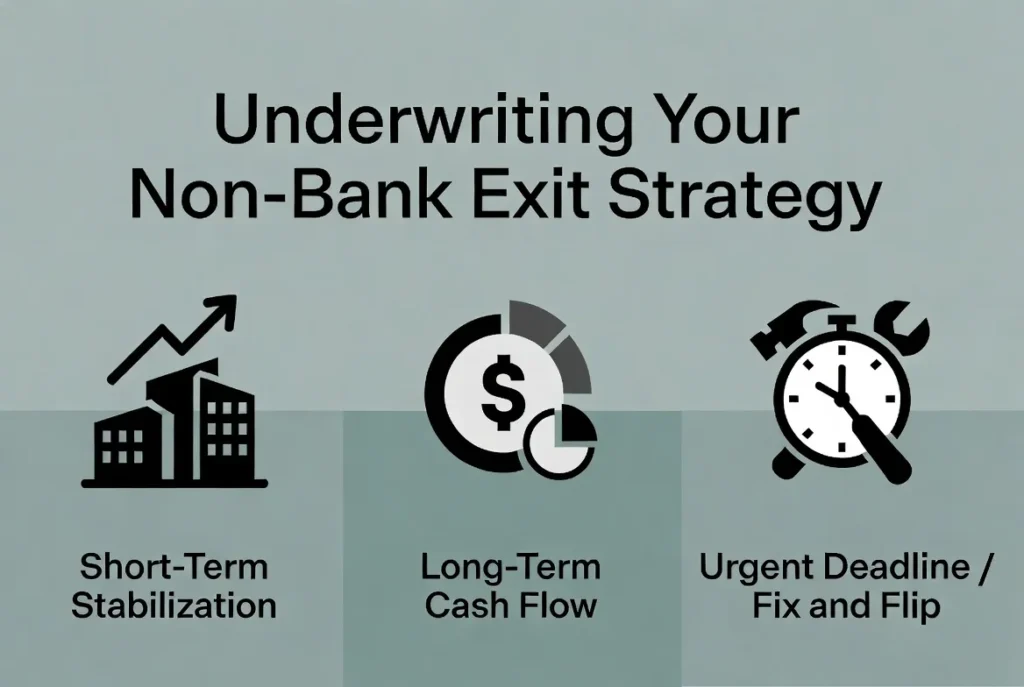
When analyzing your situation, use this simple framework:
- Short-term stabilization: If your apartment property needs one to two more years of seasoning or renovation, a bridge loan is the ideal choice to buy time at a reasonable rate.
- Long-term cash flow: If the property is already generating stable rental income and meets the cash flow criteria, a DSCR loan offers the best long-term, non-bank replacement for traditional financing.
- Urgent deadline or value-add exit: If you need capital within days to avoid default or finalize a quick project, a hard money loan is the necessary, though higher-cost, tactical move.
A key part of the correspondent relationship is planning. Even if you must use high-cost capital now, you need a pre-approved plan for the next step, securing permanent financing, before the short-term loan ends. This forward-looking analysis is where 30 years of multifamily underwriting expertise saves you money and stress.
Conclusion: Your Partner in Non-Banking Multifamily Finance
The uncertainty of a looming balloon payment should never cost you an otherwise successful apartment investment. You do not have to rely on the rigid, unpredictable policies of conventional lenders.
The private capital market, accessible through expert correspondents, offers a powerful array of companies that refinance multifamily balloon loans without banks. These solutions provide flexible underwriting, speed, and specialized products to handle balloon payments across the multifamily spectrum, from smaller 1 to 4-unit investment properties to larger apartment buildings.
We are MultifamilyLender.Net. Our 30 years of underwriting experience and vast network of real estate investors, private lenders, brokers, and realtors are ready to help structure the capital you need. We offer comprehensive guidance to help apartment investors and brokers navigate these complex waters and keep your multifamily strategy secure.
Take the Next Step Today
Your deadline is approaching. Do not risk default by trying to force a conventional bank solution onto a specialized multifamily problem. Click here to schedule a free, no-obligation underwriting consultation with our 30-year experts.
For Real Estate Brokers: Grow Your Multifamily Business
If you are a broker navigating complex multifamily deals, partner with a correspondent lender that can help deliver fast, flexible closings for your clients. We offer both exclusive and non-exclusive referral programs. Join our Commercial Loan Referral Program.
FAQs
1. Are non-banking refinance options like DSCR or bridge loans typically non-recourse for multifamily investors?
Many advanced non-bank balloon payment solutions, especially those used for long-term exits, can be structured as non-recourse debt. Non-recourse means the borrower is generally not personally liable for the balance, and the lender’s security rests solely on the apartment property. This is common with institutional products like Life Company financing and agency loans (Fannie Mae and Freddie Mac), as well as some DSCR products.
2. Why do so many multifamily loans include a balloon payment feature?
Balloon payments are common in partially amortizing multifamily loan structures. Many apartment loans use a shorter term, such as 5 or 10 years, with a longer amortization schedule of 25 or 30 years. That keeps monthly payments lower during the term but leaves a large lump-sum payment due at maturity, which is exactly what a non-bank refinance is designed to solve.
3. How fast can a non-banking refinance option close?
Speed is a major advantage. A hard money loan, which focuses primarily on the apartment property’s collateral, can often close and fund within days. Bridge loans are also fast, generally closing in a matter of weeks, much quicker than the weeks or months traditional bank financing requires.
4. What costs apply to non-bank multifamily balloon payment refinancing besides the interest rate?
Budget for closing costs beyond the rate. These typically include origination fees, which can run 3% to 5% for high-speed options like hard money, plus standard costs such as appraisal fees, lender’s title insurance, and legal fees. This is why partnering with an expert who can streamline closing matters.
What minimum credit score is generally required for options like DSCR loans?
For many of the more stable options, such as DSCR loans, aim for a minimum credit score of 680. Hard money loans are primarily asset-based and may overlook a lower score, but a score above this baseline helps you qualify for the most competitive long-term rates on your multifamily refinance.