

 Google AI
 ChatGPT
 Perplexity
If you own or invest in multifamily properties, whether a small 1–4 unit rental or a large apartment complex, it is important to understand the growing risks in today’s commercial real estate market. Many property owners are facing loan maturity deadlines as loans made during lower interest rate periods come due.
When a commercial mortgage reaches its maturity date, the remaining loan balance must be paid in full. This amount is often substantial and can create significant financial pressure. If you are unable to refinance, sell the property, or repay the balance, you may face a commercial mortgage maturity default. This situation can lead to penalties, foreclosure risks, and limited financing options, making it critical to plan ahead and explore available solutions before the loan matures.
This is not a small problem; it is a significant market challenge. Roughly 20% of all outstanding commercial mortgages in the U.S., or nearly $957 billion, will mature in 2025 alone. This large volume of maturing debt is straining the entire system, making it extremely difficult to secure new long-term financing before your due date.
Multifamily investors are right in the middle of this risk. Industry experts call this widespread problem “maturity drag.” This happens when billions of dollars in loans stall and remain unresolved past their scheduled payoff dates. It is a systemic issue, and you need a specialized strategy to avoid severe penalties.
Why is Commercial Mortgage Maturity Default a Problem Right Now?
The current crisis stems from what we call “interest rate shock.” Many long-term multifamily investment property loans were set up years ago when interest rates were at historic lows.
Today, refinancing means locking in a much higher market rate. This new, higher debt payment often makes the property’s cash flow too weak to meet the strict standards of traditional lenders for a new loan. Lenders measure cash flow using the Debt Service Coverage Ratio (DSCR) or Debt Yield. If the property’s income cannot easily cover the new, higher payments at today’s rates, permanent financing simply becomes unavailable.
A default at maturity is the failure to pay the large, final commercial mortgage balloon payment. This is classified as a monetary default, and the consequences are immediate and severe.
What Happens Immediately After Commercial Mortgage Maturity Default?

The moment a commercial mortgage balloon payment default occurs, the lender gains powerful legal rights.
- Debt Acceleration: The lender can immediately declare the full principal balance due, thereby accelerating the debt. This puts you in a critical legal and financial position.
- Punitive Fees: You face instant, high financial penalties intended to compel a quick resolution. Loan documents often allow the lender to impose high late fees. Critically, these fees may be calculated on the entire balloon principal amount—often up to five percent (5.00%) of that unpaid sum.
- Default Interest Rate: The default triggers a significantly higher default interest rate. This financial threat compounds rapidly, confirming the harsh reality that “time is money” in this scenario.
A commercial mortgage maturity default occurs when the borrower is unable to make the large balloon payment or successfully refinance at the end of the loan term. To fully understand the immediate consequences and the three primary paths investors typically face at maturity, read our detailed guide: What Happens If a Commercial Loan Matures.
To mitigate these accelerating penalties, you need specialized financial consulting before the due date hits.
How Can I Avoid Commercial Mortgage Maturity Default When Refinancing Fails?
When conventional refinancing is off the table, your strategy must pivot. You have two main paths: executing a loan workout with your current lender or securing alternative, short-term financing to bridge the gap.
Success begins with being proactive and transparent.
Why Proactive Financial Reporting is Your Best Defense
Waiting until the default is official to talk to your lender is a costly mistake. Lenders need reassurance that you are honest, competent, and have a clear plan.
Before you approach them, conduct a thorough preliminary loan workout analysis. This involves a deep dive into the loan documents and property finances to identify weaknesses and prepare clean, comprehensive financial statements. This proves the property’s viability and positions you for a successful negotiation. Advance notice and an honest assessment are the key to building the trust needed for any workout plan.
Commercial Mortgage Maturity Default Workout Strategies: CMBS vs. Portfolio Loans
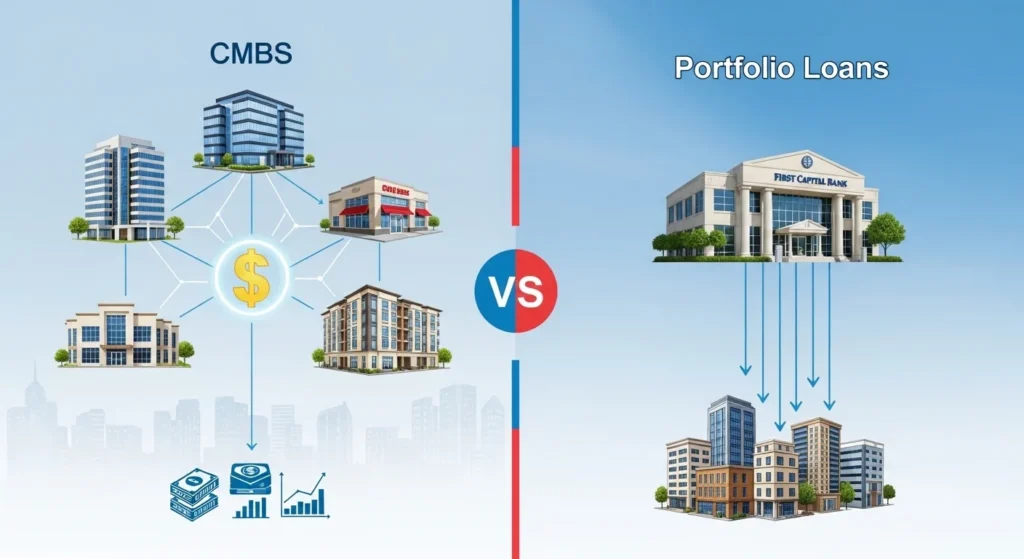
The path you take depends entirely on your loan type.
- Portfolio Lender Advantage: If your loan is held by a bank, credit union, or life insurance company (a portfolio loan), you have the most flexibility. These lenders keep the loan on their balance sheet. They are usually motivated to work directly with you to find a long-term solution.
- The Challenge of CMBS Loans: Commercial Mortgage-Backed Securities (CMBS) loans are fundamentally different. They are pooled with others and sold to investors as bonds, governed by a Pooling and Servicing Agreement (PSA). This structure severely restricts a servicer’s ability to modify the debt, even if it benefits both you and the investors.
CMBS loan maturity default solutions
Failure to pay your balloon payment generally triggers a Servicing Transfer Event. This moves your loan from the Master Servicer to the Special Servicer.
The Special Servicer must adhere to the “servicing standard.” This means their goal is to maximize recovery for the bondholders (investors). Their mandate is objective, meaning they prioritize investors over your relationship with the asset.
A significant issue is that the PSA may restrict Special Servicers from offering the same flexible modifications that a portfolio lender can. Worse, some servicers are only compensated while the loan is in default. This can create a conflict of interest that works against a speedy resolution for you.
For CMBS borrowers, know this: some PSAs allow a grace period (e.g., 60 days) after maturity, if you keep making monthly payments and diligently seek refinancing. Leveraging this grace period is often your best move to secure outside financing before the Special Servicer takes control.
If you want to understand how CMBS loans work, their unique risks at maturity, and what options are realistically available, you can also visit: Understanding CMBS Loans: Requirements and Benefits
The table below highlights the inherent differences in approach:
Workout Environment Comparison for Maturity Default
| Feature | Portfolio Lender (Bank/Life Co) | CMBS Special Servicer |
| Flexibility for Modification | High (Lender keeps the loan on the balance sheet) | Low (Restricted by Pooling and Servicing Agreement) |
| Typical Workout Tools | Forbearance, Extension, Split Interest Rate | Limited Loan Modification, Note Sale, Foreclosure |
| Recourse Implications | Often requires full or partial recourse | Non-recourse with standard “bad act” carve-outs |
| Speed of Resolution | Generally faster; direct relationship | Slower; obligation is to maximize investor recovery |
Working through a distressed loan requires treating it as a strategic financial and legal negotiation.
What Are the Best Options for Commercial Mortgage Maturity Default Resolution?
Resolving a maturity default is a two-step process: formal debt restructuring with the current lender (workout) or securing immediate replacement capital (refinancing).
Restructuring Commercial Mortgage Maturity Default Terms
If the existing lender agrees to a workout, the primary document is the forbearance agreement. This conditional, legal contract gives you temporary relief, deferring the lender’s enforcement rights while setting specific benchmarks you must meet. It’s an exchange of concessions for enhancements.
Can We Negotiate a Split Interest Rate?
Yes, a split interest rate is one of the most effective tools when a property’s cash flow cannot cover the payments at the full, higher interest rate.
Here is how it works: The negotiated contract rate is split into a “pay rate” and a “note rate”.
- Pay Rate: This is the lower interest rate you pay monthly, based on the property’s net cash flow.
- Note Rate: This is the higher, agreed-upon interest rate.
The difference between the lower pay rate and the higher note rate is accrued. This accrued interest is then either due as a lump sum at the new, extended maturity date or, in some cases, forgiven entirely if the principal balance is repaid on time.
To secure this relief, you must agree to key concessions, such as waiving potential legal counterclaims and confirming the full indebtedness. This is why expert representation is vital when negotiating default terms for commercial mortgage maturity.
Any extension must be tied to specific, measurable milestones, such as hitting occupancy targets, completing required renovations (supporting your renovation and rebuild strategies), or securing a commitment to permanent financing.
Finding Capital for Commercial Mortgage Maturity Default Refinancing
When the current lender refuses to restructure, or your property is ready for new debt. Still, it cannot access conventional term loans; specialized, non-bank financing is the solution needed to cure the default.

These fast-closing options are usually provided by private commercial table lenders who underwrite based on the property rather than strict bank guidelines. Learn the proven steps for finding and vetting the right ones in our detailed guide: How to Find a Private Commercial Table Lender.
When Should I Use a Bridge Loan to Cure Maturity Default?
Bridge loans are short-term financing, typically lasting 1 to 3 years, designed to serve as a crucial bridge to permanent debt.
They are ideal when your multifamily apartment buildings are fundamentally sound but require time (seasoning) to stabilize before qualifying for long-term financing. For investors focused on ground-up construction, fix-and-flip, or fix-and-hold strategies, a bridge loan provides the time needed for the property to demonstrate a profitable operating history.
They offer a rapid closing process and can often be structured as a non-recourse loan, protecting your personal liability. At the same time, you race against an imminent deadline.
Is a DSCR Loan a Fast Way to Refinance a Stabilized Multifamily Asset?
Yes. A Debt Service Coverage Ratio (DSCR) loan often offers the fastest non-recourse refinancing solution for stabilized assets, including multifamily (5-10 units) investment property.
The underwriting for a DSCR loan focuses almost entirely on the property’s income stream- the DSCR- rather than the borrower’s personal tax returns. This asset-focused risk assessment closes significantly quicker than most other multifamily loans.
If your property generates strong cash flow (generally a DSCR above 1.30x), you can secure more favorable terms. A significant benefit is the potential for unlimited cash-out funds, which can be critical for funding reserves or injecting equity during a workout.
What is the Risk of Using a Hard Money Loan for a Balloon Payment Default?
Hard money loans offer the quickest access to capital based primarily on the collateral’s value. However, they come with the highest costs and shortest repayment terms (often 3 to 12 months). They are typically reserved for borrowers who need an immediate cure for a commercial mortgage balloon payment default or for funding a high-profit, short-term strategy like fix-and-flipping.
The primary risk is the need for a guaranteed, immediate exit strategy. Given the high interest rates and short timelines, if you cannot meet the new balloon payment, the high debt load increases the probability of a rapid, secondary default and foreclosure. They should only be used as a last resort.
The table below summarizes the short-term financing options available to cure a maturity default:
Short-Term Refinancing Options for Maturity Default
| Loan Type | Best Use Case | Key Benefit | Primary Risk |
| Bridge Loan | Buying 1–3 years for property seasoning or credit repair | Fast closing allows time to execute sthe tabilization plan | Higher cost than permanent debt; requires a clear exit strategy |
| DSCR Loan | Quick refinance for high cash-flow stabilized assets | Asset-focused underwriting, quicker closing, potentially unlimited cash out | Requires strong property cash flow (DSCR > 1.3x) |
| Hard Money Loan | Immediate, very short-term cure (3–12 months fix/flip) | Speed and collateral-based approval (lite-doc/no-doc available) | Very high cost, substantial risk of rapid, secondary default |
Understanding the Legal Implications of Commercial Mortgage Maturity Default
Even with a workout or refinancing strategy, you must understand the legal context of a default to protect your personal assets.
Legal Pathways When Negotiation Fails
If workout negotiations fail, you and the lender must determine how to transfer control of the asset.
- Foreclosure versus Deed in Lieu: Foreclosure is the traditional, adversarial legal proceeding. A Deed instead of Foreclosure is a less conflictive and often less expensive solution. You voluntarily transfer the property title to the lender, avoiding the time and expense of a prolonged legal battle.
- Protecting Personal Assets: You must be aware of specific state laws, such as Single-Action Rules (lender must exhaust the collateral first) and Anti-Deficiency Rules (restricting the lender’s ability to pursue a personal judgment against you if the foreclosure sale proceeds are insufficient). These laws can significantly affect the outcome of a distressed commercial real estate loan.
Why Call for a Commercial Mortgage Default Lawyer Consultation Immediately?
Legal consultation is paramount for protecting your personal wealth. Most commercial loans are non-recourse, meaning you are not personally liable for the debt. However, most documents include “bad-act” carve-outs that trigger full personal recourse if you commit fraud, misrepresentation, or interfere with the lender’s remedies.
Lenders often demand “enhanced guarantees” or expanded personal recourse as a condition for granting a forbearance or modification. You need a legal and financial team to negotiate the financial terms while ensuring your personal liability is strictly safeguarded. A prompt commercial mortgage default consultation with a lawyer is mandatory to review the contract and applicable jurisdictional laws.
Multifamily Lender’s Strategic Advantage in Default Resolution
The complexity of a commercial mortgage maturity default option crisis demands advanced expertise. We are not just a lender; we are your financial consultant and strategic partner.
- The Underwriting Edge: We bring 30 years of underwriting capability to the table. We perform a critical preliminary loan workout analysis that anticipates the lender’s strategy. This deep institutional knowledge helps clients successfully negotiate default terms for commercial mortgage maturities and restructure debt.
- The Network Effect for Capital: When conventional debt fails, you need specialized capital. Our vast network of over 1,000 real estate investors, private lenders, brokers, and realtors gives you unique access to alternative funding sources- including no-doc, lite-doc, and state income loans. This ability to source specialized capital is essential to successfully addressing commercial mortgage maturity defaults.
- Total Solutions: We handle every stage of multifamily investment, from ground-up construction and renovation to fix and flip, fix and hold, and fix and rent [user input]. We offer assistance with a variety of loan types, including bridge loans, hard money loans, DSCR loans, USDA B&I loans, SBA loans, FHA commercial property investment loans, construction loans, and term loans [user input]. Our comprehensive approach ensures your strategy for restructuring commercial mortgage maturity default terms is coordinated, financially sound, and legally protected.
Ready to Resolve Your Multifamily Mortgage Default Crisis?
Don’t Let Maturity Drag Your Portfolio Down
The current environment of massive maturity volumes and high interest rates means that multifamily (21-30 units) investment property owners cannot afford to wait. “Maturity drag” is escalating risk, and waiting ensures that accelerating fees and default interest will rapidly compound your outstanding debt.
Successfully resolving a commercial mortgage maturity default option requires a deliberate, two-pronged strategy:
- Actively negotiating commercial mortgage maturity default terms through precise, documented forbearance agreements.
- Efficiently finding capital for commercial mortgage maturity default through specialized, non-bank financing like Bridge or DSCR loans.
Let Our Expertise Find Your Solution
Do not let the maturity deadline dictate your property’s future. Leveraging three decades of rigorous underwriting expertise and an expansive capital network, our specialized financial consultants provide the straightforward advice and immediate access to capital needed to turn a maturity crisis into a manageable transition.
We specialize in helping investors and brokers- who can benefit from our exclusive and non-exclusive referral programs- execute complex strategies for multifamily (11-20 units) investment property and larger assets [user input].
Explore our best commercial loan referral program to get connected with the right lenders for bridge, DSCR, or other maturity default solutions.
Contact MultifamilyLender.Net today to secure a clear, confidential path forward, whether you need quick alternative financing or a comprehensive restructuring plan for a commercial mortgage maturity default.
The time to resolve your loan’s future is now.
FAQs
1. Does a Commercial Mortgage Maturity Default Directly Harm My Personal Credit Score?
Here’s a simpler, more reader-friendly version:
A commercial mortgage maturity default usually does not affect your personal credit score unless you personally guaranteed the loan. If the loan is non-recourse and secured only by the property, the default is typically reported against the borrowing entity, such as the LLC that owns the property.
However, if you signed a Personal Guarantee (PG), the situation is different. In that case, the lender may pursue your personal assets if the loan is not repaid. The default can also appear on your personal credit report, which may lower your credit score and make it harder to qualify for future financing.
Even if the business files for bankruptcy, a Personal Guarantee may still hold you personally responsible for the debt. As a result, a maturity default can have serious financial consequences for guarantors. Lenders often view recent or unresolved defaults as a major credit risk, which can limit your borrowing options and increase the cost of future loans.
2. How early should I start the refinancing process for a commercial mortgage with a balloon payment?
You should start assessing your options and securing a refinancing commitment at least 9 to 12 months before the maturity date. Unlike residential mortgages, commercial loans frequently include large balloon payments that must be paid in full at maturity, often on a 5/25 or 7/25 structure. Starting early is crucial because:
- Time is required for underwriting: Commercial real estate refinancing, especially for complex multifamily assets, can take months.
- Risk of Negative Equity: If you only paid the minimum payments until maturity, you might have negative equity, which banks will not refinance unless you provide a significant down payment.
- Prepayment Penalty Waivers: Most commercial loans waive prepayment penalties in the last 90 days before maturity, giving you a small, defined window to exit without penalty. By starting the research and application process well in advance, you ensure you are ready to close immediately when this penalty waiver window opens, avoiding the default trap entirely.
3. What steps do lenders take to evaluate a property when considering a loan extension or forbearance?
When a lender is considering granting a loan extension, forbearance, or modification, they will conduct extensive due diligence to reassess the current risk of the collateral and the borrower. This due diligence often includes:
- Property Condition and Compliance: Evaluating the current physical condition of the property and its compliance with all applicable laws.
- Lease Review: Analyzing existing leases and other agreements to ensure the income stream is stable and legally sound.
- Title and Survey Review: Reviewing the property’s title commitment and survey to identify any new liens or undisclosed matters that could affect the property’s value.
- Borrower Status: Confirming the organizational status, good standing, and legal compliance of the borrower entity.
These steps are designed to identify any deficiencies in the loan file, collateral, or documentation that can be corrected as a condition of granting the extension.
4. What is the difference between a Deed instead of Foreclosure and a standard Foreclosure?
Both a Deed instead of Foreclosure and a standard Foreclosure are methods by which a lender recovers the loan balance on a defaulted property. Still, they differ significantly in their processes and benefits.
- Foreclosure: This is an adversarial legal proceeding initiated by the lender after a default to force the sale of the collateral to recover the loan balance. This process is often time-consuming, expensive, and leaves a public record of the legal action.
- Deed-in-Lieu: This is a voluntary, less adversarial solution. The borrower, recognizing that the property equity is lost or insufficient to cure the default, voluntarily transfers the property title (the deed) to the lender. This approach is often quicker and helps both parties avoid the expense and time associated with prolonged litigation.
5. Are there typical fees associated with a commercial mortgage maturity extension?
Extensions or loan modifications are usually not free. The cost depends on the lender, the type of property, and current market conditions.
In exchange for giving the borrower more time or delaying enforcement actions after a default, lenders may charge extension or forbearance fees. They may also require the borrower to pay legal fees, appraisal costs, and other expenses related to resolving the default.
In many cases, the cost increases when the lender takes on greater risk by extending the loan, especially in a high-interest-rate environment.