

 Google AI
 ChatGPT
 Perplexity
Are you tired of watching your best multifamily deals slip through your fingers because a traditional bank took 60 days just to say “no”? In the fast-paced 2026 real estate market, timing is everything. Whether you are looking at a 4-unit fix-and-flip or a 50-unit ground-up construction project, you need capital that moves at the speed of your business.
This guide will show you exactly how to find a private commercial table lender. We will look at why private commercial real estate debt funds are replacing big banks, how you can tap into direct private capital for commercial projects, and the secrets to finding a partner who funds your deal “at the table.”
Why is the Bank Keeping You Waiting on Your Multifamily Dream?
The “Pain” of traditional lending is real. Right now, total commercial and multifamily mortgage debt has hit a record $4.93 trillion. However, even though the debt market is huge, traditional banks are pulling back. Thanks to new regulations like the Basel III Endgame, banks are becoming more cautious and rigid.
If you are an investor, this means longer wait times and more red tape. If you are a broker, it means your clients are getting frustrated. This is where the “Pleasure” of private lending comes in. Private lenders are not just a backup plan, they are now the primary engine for real estate growth. According to Forbes and JPMorgan, the 2026 outlook for multifamily is bright, but it requires creative financing solutions.
The Rise of the Private Commercial Table Lender
Before we dive into the “how,” we must answer a vital question: What is a private commercial table lender?
In simple terms, a table lender is a partner who provides the cash for your loan right at the closing table. Unlike a standard broker who just “finds” a loan and walks away, a table lender (or a correspondent lender) acts as the direct face of the deal. They underwrite the loan using their expertise, and at closing, the funds are wired simultaneously with the signing of the documents.
This model allows for incredible speed. While a bank might take two months, a private commercial table lender can often close in 7 to 14 days.
What Is a Private Commercial Table Lender and Why Do You Need One Now?
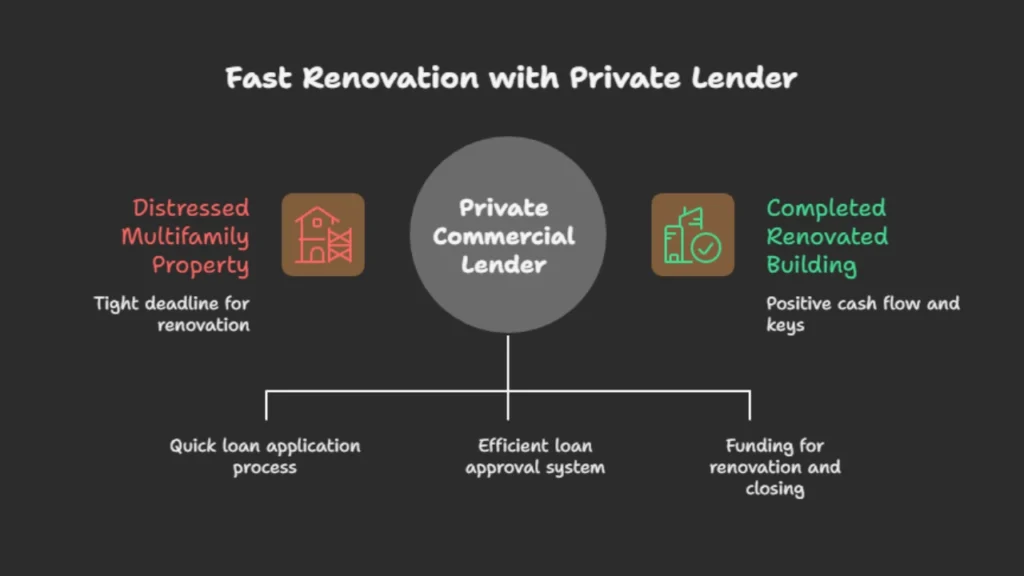
If you are doing a renovation, rebuild, or ground-up construction, you don’t have time for a monthly committee meeting to discuss your file. You need a partner who has “in-house” authority.
Turning Problems into Solutions (The PBS Framework)
- Problem: You found a distressed multifamily property (5–10 units) that needs a rapid renovation. The seller wants to close in three weeks.
- Bridge: You connect with a private commercial table lender who specializes in bridge loans and has 30 years of underwriting experience.
- Solution: You get a 24-hour pre-approval, close on time, and start your “fix and hold” strategy while your competitors are still filling out bank forms.
The shift toward private equity real estate debt financing is not just a trend—it is a survival strategy. Harvard’s Joint Center for Housing Studies notes that home prices have surged 60% since 2019, creating a massive “renter by necessity” class. This means multifamily demand is at an all-time high, but the competition for these assets is fierce. You cannot win a bidding war with slow money.
How to Find a Private Commercial Table Lender Who Actually Delivers?
Finding a lender is easy; finding the right one requires a process. Here is your step-by-step guide to securing the best private commercial bridge lenders and long-term partners.
Step 1: Research Local and National Platforms
Don’t just look for “lenders near me.” The best private commercial real estate lending platforms often operate nationwide but have local expertise.
- Search for Specialists: Look for firms that focus exclusively on multifamily. A lender who does gas stations, car washes, and apartments is rarely an expert in any of them.
- Check the Network: Does the lender have a vast network? At MultifamilyLender.Net, we leverage a network of over 1,000 investors and private lenders to ensure our clients always have a “Yes” waiting for them.
Step 2: Validate Through Industry Directories
Use reputable sources to vet your partner. The American Association of Private Lenders (AAPL) maintains a member directory where you can validate if a lender follows a strict code of ethics.
Step 3: Look for 30-Year “Capability and Expertise”
In a market where new “hard money” shops pop up every day, experience matters. An underwriter with 30 years of experience has seen every type of market crash and boom. They know how to spot a “red flag” in a renovation budget or a ground-up construction timeline before it becomes a disaster.
Step 4: Evaluate the Product Suite
A true table lender should offer a variety of “private commercial real estate financing alternatives.” You should look for assistance with:
- Bridge Loans: For quick acquisitions.
- DSCR Loans: Qualifying based on the property’s cash flow, not your personal tax returns.
- USDA B&I and SBA Loans: For mixed-use or rural multifamily projects.
- FHA/HUD Loans: For long-term, 40-year fixed-rate stability.
- No-Doc and Lite-Doc Loans: For when you need to move fast without the mountain of paperwork.
Can You Really Close a Commercial Deal in Under 10 Days?
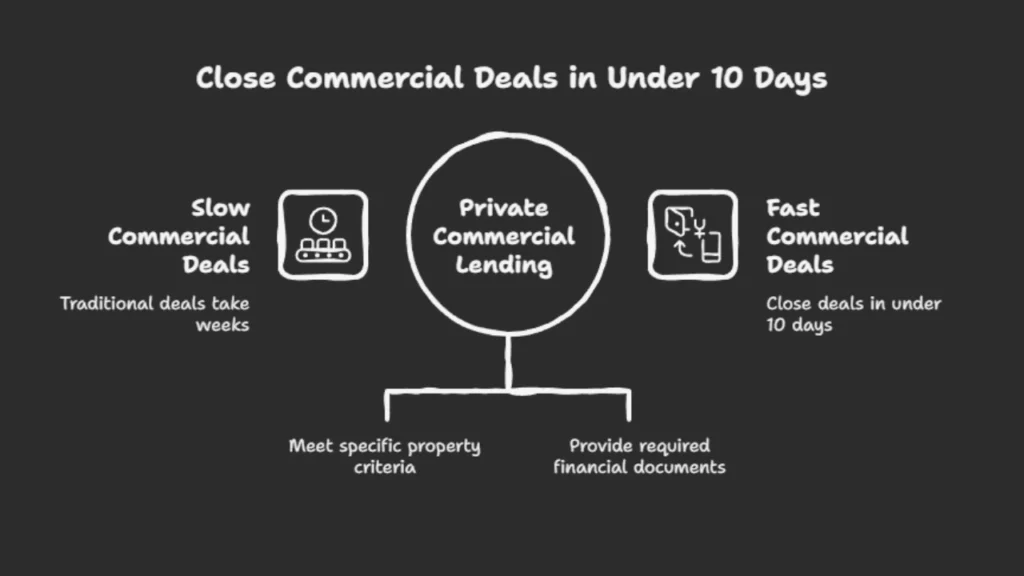
The answer is yes—if you know how to qualify. Understanding the criteria for private commercial loan approval is the key to the fast track.
How to Qualify for Private Commercial Loans
Private lenders are “Asset-Based.” This means they care more about the property’s potential than your personal debt-to-income ratio. Here is what they look for:
- The Property’s Income: For stabilized buildings (5 units and up), lenders look for a Debt Service Coverage Ratio (DSCR) of at least 1.15 to 1.25.
- Occupancy Levels: Most lenders want to see at least 85-90% occupancy for a standard term loan, but bridge lenders are happy to fund “distressed” properties with 0% occupancy if you have a solid renovation plan.
- Your Experience: Have you done a fix-and-flip before? Have you managed a 20-unit building? Experience is the currency of private lending.
- The “Skin in the Game”: Most private lenders for commercial property acquisition will fund 75% to 80% of the value (LTV), meaning you need 20% to 25% equity or a down payment.
Preparing Your “Data Room”
To get a 10-day closing, you must have your paperwork ready on day one. A standard checklist includes:
- Three years of property P&Ls.
- A current rent roll.
- Photos of the interior and exterior.
- A “Schedule of Real Estate Holdings” showing your past successes.
The Loan Product Encyclopedia: Tools for Every Deal
To “do business” in the multifamily sector, you need the right tool for the job. Not all multifamily investment properties are the same. A 1-4 unit duplex is a different beast than a 40-unit apartment complex.
Hard Money Lenders for Commercial Property Acquisition
Hard money is the “speed boat” of real estate finance. It is ideal for:
- Fix and Flip: Buying a run-down 5-10 unit building, renovating it, and selling it within 12 months.
- Rebuild and Renovation: When the building is currently uninhabitable and needs a total overhaul.
- Bidding Wars: When you need to show the seller you have “cash-like” closing power.
Private Commercial Construction Loan Providers
If you are doing ground-up construction, you need a lender who understands “draw schedules.” You don’t want your construction crew sitting idle because the lender is slow to release funds. Look for lenders with “Easy Draw Processes” and no “red tape”.
Private Commercial Real Estate Syndication Financing
Are you looking to close a massive deal by pooling funds from other investors? Syndication is the answer. Finding a lender who understands “real estate syndication financing” is vital. They need to be comfortable with your legal structure (usually an LLC or LP) and have the capacity to fund larger amounts, sometimes up to $25 million or more.
| Loan Type | Best For | Typical Term |
| Bridge Loan | Quick purchase/rehab | 6–24 months |
| DSCR Loan | Long-term rentals | 30 years |
| Construction | Ground-up projects | 12–24 months |
| FHA Commercial | Long-term stability | 35–40 years |
| Hard Money | Distressed assets | 6–18 months |
Strategic Advice for Real Estate Brokers
If you are a real estate broker, your value to your client is your “rolodex.” Being able to point a client toward a reliable private commercial table lender makes you indispensable.
The Broker Referral Program: Exclusive vs. Non-Exclusive
At MultifamilyLender.Net, we offer both exclusive and non-exclusive referral programs.
- For New Brokers: This is your chance to learn from 30 years of underwriting expertise. You bring the deal; we help you package it, underwrite it, and close it.
- For Experienced Brokers: We offer a “relationship-based” model. You get a dedicated lending team that knows your business, allowing you to earn commissions up to 6.5% of the total loan balance.
Understanding the 2026 Multifamily Landscape
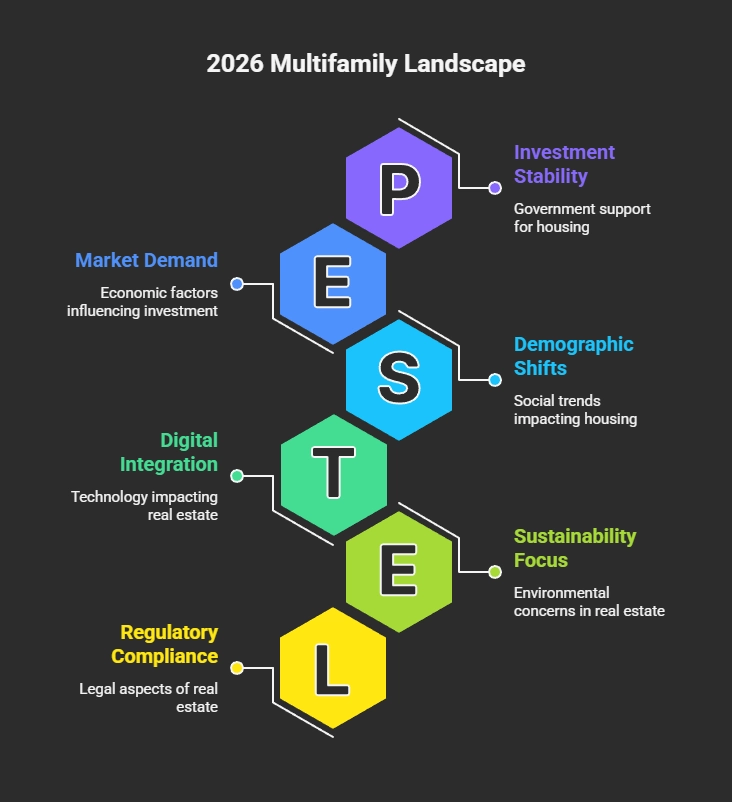
Why should you invest in multifamily right now? The data from business schools and magazines is clear.
- Harvard JCHS Research: The U.S. has a chronic undersupply of housing. We need to build 4.3 million rental homes by 2035 just to keep up with demand.
- Investopedia Insights: While home prices are rising, wage growth is finally starting to catch up in some regions, meaning renters have more “purchasing power” to afford quality Class B and C properties.
- Oxford Economics: The “Living” sector remains the world’s largest investment category. Even in volatile economic times, people still need a place to live.
Regional “Hot Spots” for 2026
The market is no longer a monolith. To succeed, you must pick the right market, not just the right sector.
- The Winners: Cities in the Northeast and Midwest (like Chicago, New York, and Philadelphia) are seeing strong rent gains due to supply constraints.
- The “Younger” Cities —Nashville, Atlanta, and Salt Lake City — continue to attract the Millennial cohort—the largest group of borrowers today.
- The Rebound: Sun Belt cities like Austin and Phoenix are absorbing their massive 2024 development pipelines and are poised for a “rent growth” comeback in late 2026.
Underwriting Secrets: What Lenders See That You Don’t
With 30 years of capability as an underwriter, we see the “hidden” risks in every deal. When you are looking for private lenders for distressed commercial property, keep these diagnostic checks in mind:
- The Interest Gap: If you are refinancing, the new rate should be at least 0.75% to 1.00% lower than your current rate to cover the closing costs.
- The “Exit Strategy”: A private lender for a bridge loan wants to know exactly how you will pay them back. Are you selling the property? Or are you refinancing into a long-term FHA or Fannie Mae loan?.
- The Maintenance Watchlist: Lenders look at “deferred maintenance.” If the roof is 20 years old, they will likely hold back part of the loan until it is replaced.
Conclusion: Turning Your Multifamily Vision into Reality
The search for capital in 2026 is about more than just finding a low interest rate. It is about finding a partner who offers “Speed and Certainty”. Traditional banks are stuck in the past, but private commercial real estate debt funds are the future.
Whether you are a new broker looking to enter the industry or a seasoned investor looking for your next 30-unit complex, MultifamilyLender.Net is here to guide you. With 30 years of underwriting expertise and a network of 1,000+ partners, we provide the financial consulting you need to renovate, rebuild, and scale your rental empire.
Don’t wait for the bank. The best deals in 2026 are going to those who move fast. Contact us today to learn about our referral programs or to get a quote on your next multifamily project. The market is waiting—are you ready to close?
FAQs
Does table funding require an LLC structure?
Yes. Most private commercial table lenders require you to close in the name of an LLC or corporation. This structure protects your personal assets and allows the lender to treat the transaction as a specialized business-purpose commercial loan.
Is table lending legal in every state?
No. While widely accepted, some states have specific regulations or restrictions regarding the simultaneous assignment of notes. You should always verify local compliance with an experienced underwriter to ensure your multifamily closing proceeds smoothly and legally within your target jurisdiction.
Can you get table funding without collateral?
No. Table lending is strictly an asset-based strategy where the property itself serves as the primary security. Lenders focus on the property’s value and income potential to protect their investment, meaning a tangible multifamily asset is mandatory for every transaction.
Can you use table funding for white labeling?
Yes. White-label agreements allow you to issue loans in your own name while a funding partner provides the capital. This arrangement helps you build brand authority and maintain client relationships without using your own limited balance sheet resources.
Are prepayment penalties common with table lenders?
Yes. Many table-funded products include a yield maintenance clause or a step-down prepayment penalty to protect the funding partner’s interest. However, short-term bridge loans often offer no-penalty exits after a brief lock-out period, providing you with essential flexibility during renovations.