

 Google AI
 ChatGPT
 Perplexity
The old “gut feeling” approach to multifamily real estate investing is a fast track to lost profit. In today’s market, where every dollar must be optimized, relying on intuition or back-of-the-napkin math is simply a recipe for error, especially as you scale up to complex deals with 5, 10, 20, or more units.
The problem is real: investors often miss critical, non-obvious costs like increased property taxes after a value-add renovation, or they fail to project vacancy rates based on local economic shifts accurately. For example, according to the U.S. Census Bureau data, authorizations for new housing units in buildings with five units or more were at a rate of 403,000 in August 2025 (seasonally adjusted annual rate), indicating a strong, but highly competitive, market where precision is non-negotiable. Common mistakes like underestimating capital expenses, taking asking rents at face value, or ignoring how property taxes rise with NOI can wipe out your expected returns.
The solution is a non-negotiable step: your first move must be to use a powerful investment property loan calculator. This tool isn’t just for calculating a mortgage; it’s your complete financial blueprint, transforming uncertainty into a clear, data-driven strategy.
At MultifamilyLender.Net, we don’t just offer loans; we offer certainty. As a correspondent and table lender, our mission is to simplify complex financing for your success. We have the institutional knowledge to look beyond the basic numbers and provide tools that address the unique intricacies of multifamily investments from a duplex to a sprawling apartment complex. Our goal is to ensure you have the precise financial data needed to acquire, stabilize, and profit from your investment.
What Readers Will Learn
Mastering the use of our investment property loan calculator 2026 is key to maximizing your profit. Here are the critical financial metrics and calculations you’ll be able to determine quickly:

- Net Operating Income (NOI): The true profitability of the property before debt service.
- Cap Rate (Capitalization Rate): A quick comparison of a property’s expected return on investment.
- Cash-on-Cash Return: The annual before-tax cash flow divided by the total cash invested.
- Debt Service Coverage Ratio (DSCR): A crucial metric for lenders, showing your property’s ability to cover its mortgage payments.
- Loan Amortization Schedule: A detailed breakdown of your mortgage payments, showing principal vs. interest over the loan’s lifetime.
- Pro Forma Analysis: The ability to test different scenarios (e.g., lower rent, higher expenses) to stress-test your investment.
Beyond Monthly Payments: Understanding Investment Property Loan Calculator Results
Your investment property loan calculator is more than a simple mortgage estimator; it’s the cornerstone of adequate due diligence. The goal isn’t just to see if you can afford the monthly payment, but to prove the property can generate a reliable profit even after accounting for every single cost.
More Than an Estimate: How to Use the Calculator for Due Diligence
Forecasting profitability requires you to move beyond basic income and expenses. This is where the rental property loan calculator with cash flow becomes your most powerful tool. It allows you to model future scenarios, test market downturns, and genuinely understand the financial performance of your investment.
Debt Service Coverage Ratio (DSCR)
This is perhaps the most vital metric for commercial and investment property lenders. The Debt Service Coverage Ratio (DSCR) is a figure lenders use to assess a property’s ability to cover its annual debt obligations (principal and interest) from its Net Operating Income (NOI).
DSCR = Net Operating Income (NOI) / Annual Debt Service
- What it means: A DSCR of 1.00 implies the property generates exactly enough NOI to pay its mortgage.
- Lender Target: Most lenders, especially for commercial multifamily loans, look for a minimum DSCR of 1.15 to 1.25 to provide a safety cushion against unexpected expenses or vacancies.
- Calculator Benefit: By adjusting your down payment or loan terms in the calculator, you can instantly see the resulting DSCR, ensuring your proposed financing structure meets the lender’s requirements before you even submit a formal application. This is especially relevant for modern DSCR loan offerings, which often focus almost exclusively on this ratio rather than your personal income.
The Hidden Costs: Investment Property Loan Calculator with Closing Costs
New investors often severely underestimate the amount of cash needed at closing. The purchase price and the down payment are only part of the story; closing costs are a critical outflow that must be factored into your total investment. This is why you need an investment property loan calculator with closing costs built in.

Detailing Fees
Closing costs are the collection of fees paid to various third parties to finalize the loan and property transfer. These can be substantial: nationally, closing costs generally range from 3% to 6% of the loan amount or between 1% and 5% of the home sale price, according to various industry and economic data.
Your calculator must account for these key fees:
- Lender Fees: Origination fees (often 0.5%–1.5% of the loan amount), underwriting, and processing fees.
- Discount Points: Fees paid upfront to lower the interest rate. One point typically equals $1\%$ of the loan amount.
- Third-Party Fees: Appraisal fees, property inspection reports, and environmental review costs.
- Title & Legal: Title insurance, attorney fees (mandatory in some states), and recording fees.
- Taxes & Escrows: Prepaid property taxes, hazard insurance, and transfer taxes.
The Importance of a Total Cash-Needed Calculation
The actual financial question is not “What’s the down payment?” but “What is the total cash needed at closing?”
Total Cash Needed = Down Payment + Closing Costs + Initial Reserves
The calculator lets you answer: “How much down payment for investment property loan calculator” input is required to cover the down payment plus the often-overlooked 3% to 6% in closing costs, ensuring you don’t face a last-minute cash shortfall that could kill the deal.
The Financial Metrics That Really Matter for Multifamily
To evaluate a multifamily deal like a professional underwriter, you must look past simple price and monthly rent. The calculator helps you focus on three metrics that reveal the proper health and value of the investment: Cash-on-Cash Return, Net Operating Income (NOI), and Cap Rate.
Calculate Investment Property Cash-on-Cash Return
The Cash-on-Cash Return (CoC) is the single best measure of how efficiently your initial cash outlay is generating annual cash flow. It’s the “true report card” because it measures the return on the specific cash you invested, not the property’s total value.
Formula Breakdown (Simple Math)
The formula takes the cash the property puts in your pocket each year and divides it by the total cash you initially paid to acquire it:
Cash-on-Cash Return = Annual Before-Tax Cash Flow \ Total Cash Invested (Equity)
Where:
- Annual Before-Tax Cash Flow is the Net Operating Income (NOI) minus the annual debt service (principal and interest mortgage payments).
- Total Cash Invested includes your down payment, all closing costs, and any initial renovation/capital expenditure expenses.
Analogy: Think of the CoC return like the interest rate on a Certificate of Deposit (CD). If you put $100,000 of your own cash into a deal, and it puts 10,000 back into your bank account this year, your CoC return is 10%. A solid return is generally considered to be in the 8% to 12% range, though this varies by market and risk.
Net Operating Income (NOI) and Cap Rate
While CoC shows your personal return, Net Operating Income (NOI) and the Capitalization Rate (Cap Rate) are the two most crucial metrics used by everyone else appraisers, lenders, and buyers to determine the property’s value.
Net Operating Income (NOI)
NOI is the income a property generates after deducting all operating expenses, but before debt service (mortgage payment) and income taxes.
NOI = Total Property Revenue – Total Operating Expenses
Lenders use NOI to calculate the DSCR (as seen in the previous section), and investors use it to calculate the Cap Rate. It tells you the property’s pure operational profit potential, independent of how it’s financed.
Capitalization Rate (Cap Rate)
The Cap Rate is a metric used for property valuation and comparison. It represents the potential rate of return if the property were bought with all cash (no loan):
Cap Rate = Net Operating Income (NOI) \ Property Value (or Purchase Price)
- Crucial for Valuation: This formula can be rearranged to find the property’s value:
Property Value = NOI \ Cap Rate
This is how appraisers value commercial investment properties they take the property’s NOI and divide it by the average Cap Rate for similar properties in the local market.
- Impact of Interest Rates: The general level of market interest rates directly influences the Cap Rate. When commercial investment property loan calculator interest rates rise, investors demand a higher yield to justify the cost of debt, causing Cap Rates to generally increase (expand), which in turn lowers property values (assuming the NOI stays the same). Conversely, when rates fall, Cap Rates tend to fall (compress), pushing property values up. The calculator helps you test these changing market scenarios.
Matching the Tool to the Project: Specialized Loan Calculators
The right investment property loan calculator is a tailored financial model. Different investment strategies require the calculator to prioritize and calculate entirely different cost structures and profit metrics.
The Long-Term Play: Rental Property Loan Calculator with Cash Flow
For investors focused on long-term holding (buy-and-hold), the calculator must provide a precise, multi-year cash flow forecast. The core benefit of using a rental property loan calculator with cash flow is its ability to model financial health over a 10- to 30-year period.
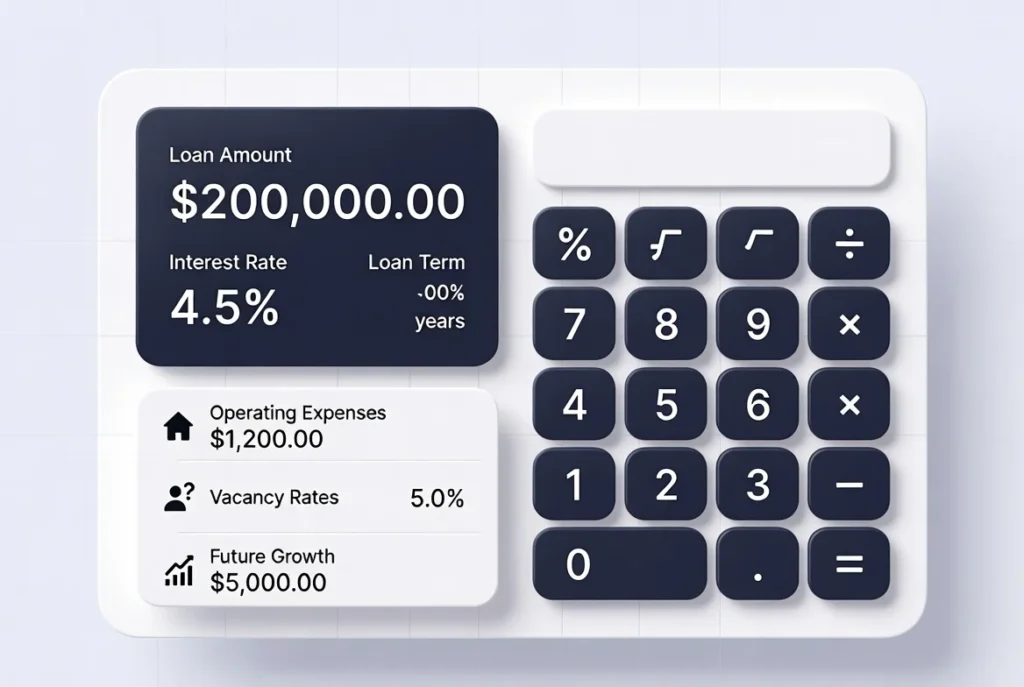
The calculator incorporates key long-term variables:
- Operating Expenses: It moves beyond the mortgage by including expenses like insurance, utilities, and crucial Property Management Fees. These fees typically range from 8% to 12% of the monthly rent collected for multifamily properties.
- Vacancy Rates: It applies a realistic Vacancy Rate to gross rent. National rental vacancy rates for the US generally hover around 7.0% (Q2 2025, U.S. Census Bureau). Still, the calculator should use a conservative local rate (often 5% to 10%).
- Future Growth: It forecasts profit growth by factoring in conservative annual rent increases against potential inflation-driven expense increases.
Expert Tip: The best investment property loan calculator excel template allows for dynamic, ongoing tracking. Once the deal is closed, you can replace the initial projections with actual monthly data to track your real-time Cash-on-Cash Return and financial performance.
The Quick Turnaround: Fix and Flip Investment Property Loan Calculator
The fix-and-flip strategy is short-term and high-interest, requiring a specialized fix and flip investment property loan calculator that prioritizes total cost over monthly payment.
This calculator must accurately model the high cost of Hard Money Loans and Bridge Loans, which typically feature:
- High Interest: Interest rates are often in the double digits ($8\%$ to $15\%$).
- Origination Points: Lenders charge $2$ to $5$ “points” (each point is $1\%$ of the loan amount) as an upfront fee.
- Shorter Terms: Loans are typically for $6$ to $18$ months, making the total interest paid (holding costs) a critical expense.
The “70% Rule” and Maximum Allowable Offer (MAO)
The calculator’s primary function here is to determine the Maximum Allowable Offer (MAO) using the classic 70% Rule:
MAO = {(After Repair Value (ARV)} * 0.70) – {Estimated Repair Costs}
The 30% margin (the 100% ARV minus the 70% purchase price) is the built-in buffer to cover all transactional costs (Hard Money Loan fees, interest, closing costs, sales commissions) and the investor’s profit goal. By inputting a realistic ARV and repair estimate, the calculator instantly tells you the MAO the highest you can bid and still achieve your target profit.
From Zero to Investor: Investment Property Mortgage Calculator for Beginners
For new investors targeting small multifamily properties (like a duplex, triplex, or fourplex, often called 1-4 units), the investment property mortgage calculator for beginners focuses on simple qualification and affordability.
It provides a simple, structured pathway:
- Define Loan: Input the loan program (e.g., FHA, Conventional, portfolio loan) to determine the minimum down payment and typical interest rate for that class of property.
- Qualify Income: Calculate the property’s Gross Rent Multiplier (GRM) to gauge initial value and ensure projected rental income is sufficient to cover the mortgage payment (PITI) plus a safety reserve.
- Stress Test: Run scenarios (e.g., one vacant unit or a $100 increase in taxes) to build confidence and prepare for lender scrutiny.
Decoding Complex Financing: Specialized Loan Calculators
Sophisticated multifamily investing often requires specialized financing that falls outside of traditional bank mortgages. Our calculator is designed to model these unique debt structures, giving you a transparent view of non-conventional costs and qualification methods.

Calculator Scenarios for Non-Traditional Loans
DSCR Loans: Calculating Eligibility Without Personal Income
The DSCR Loan (Debt Service Coverage Ratio Loan) is a game-changer for professional real estate investors, as it qualifies the loan based on the property’s income, not your W-2 or personal tax returns. This is genuinely the investment property loan calculator without personal income.
- Calculator Focus: Instead of calculating your DTI (Debt-to-Income) ratio, the calculator focuses entirely on the property’s ability to generate cash. It needs the Net Operating Income (NOI) and the proposed Annual Debt Service.
- The Key Output: The DSCR is the sole determinant of eligibility. Lenders typically require a minimum DSCR between 1.15 and 1.25 for multifamily assets. Our tool instantly shows you the maximum loan amount you can qualify for while maintaining this ratio.
Construction/Rebuild: Modeling Specialized Financing
For properties that require significant renovation, or ground-up construction, the financing must account for the total project cost not just the purchase price.
- FHA Construction Loans (e.g., FHA 203(k)): While primarily for owner-occupied homes, these programs are crucial for rehabbing small multifamily (1-4 unit) properties. The calculator models the loan based on the After-Improved Value (AIV), factoring in the cost of purchase, the renovation budget, and a mandatory 10% to 20% contingency buffer for unexpected construction costs.
- Ground-Up or Heavy Rehab Loans: For larger commercial projects, the calculator models a draw schedule showing how loan funds are released (in draws) as construction milestones are met to ensure interest is only calculated on the funds that have been disbursed.
Private Money: Using the Private Money Investment Property Loan Calculator
Private Money (or Hard Money) is used for short-term, high-risk, quick-close deals like Fix and Flips or to secure a property before refinancing. The private money investment property loan calculator is essential for understanding the actual, high cost of this speed.
- High Interest & Points: These loans feature significantly higher interest rates, often ranging from 8% to 15% per year, plus upfront fees known as “points” (typically 2 to 5 points, or 2% to 5% of the loan amount).
- Modeling Upfront Cost: The calculator’s primary function here is to accurately calculate the total cash required at closing, which includes the hefty upfront fee (points) and the first few months of interest, ensuring the deal’s tight timeline and high costs still allow for a robust profit margin.
The Multifamily Lender Advantage: From Calculation to Closing
The investment property loan calculator multi-family is a powerful instrument, but it’s just a tool. To navigate the complex waters of multi-family financing and secure your investment, you need a compass and that’s where our expertise comes in.
The Expertise Difference
A simple calculator can process data, but 30 years of underwriting experience is the compass that guides you to profit. We don’t just quote rates; we anticipate property tax increases, advise on optimal reserve accounts, and structure deals to meet the stringent DSCR requirements of institutional lenders. We ensure your calculated projections become realized returns.
- Broker and Investor Network: We leverage a vast proprietary network built over decades, encompassing over 1,000 industry contacts including institutional investors, correspondent lenders, and specialty finance sources. This ensures that no matter how complex your deal (from a simple duplex to a $50 million apartment complex), we can match your project with the perfect capital source.
Are you a broker struggling to place challenging multi-family loans? Stop leaving money on the table. Join our exclusive referral programs and gain access to our extensive lending network and underwriting support. We offer competitive, flexible partnership structures, including exclusive and non-exclusive referral programs, designed to help you close more deals faster.
Don’t DIY Your Loan: Why Expert Financial Consulting is Priceless
Attempting to finance a complex multi-family deal (especially those over 20 units, in the 21-30 unit range) alone is risky. Your financial journey requires tailored solutions, and we provide the full spectrum:
| Loan Category | Examples | Key Benefit |
| Short-Term & Rehab | Bridge, Hard Money, Private Money | Quick funding for value-add or fix-and-flip deals. |
| Asset-Based | DSCR, Lite-Doc, No-Doc Loans | Qualification based on property cash flow, not personal income. |
| Government/Agency | SBA, FHA Commercial, Term Loans | Competitive rates and longer terms for stabilizing and acquiring assets. |
| Portfolio Solutions | State Income Loans | Financing entire investment portfolios under one umbrella. |
The Cost of Miscalculation
The pain of financing a large multi-family deal alone is the high risk of catastrophic error: miscalculating NOI by just 2% on a 25-unit building can translate to tens of thousands of dollars in lost equity or a loan denial. Trying to match your property to the right loan product (Bridge vs. DSCR vs. SBA) without an expert results in delays, higher fees, and missed opportunities.
Confidence and Maximized Profit
The pleasure of partnering with us is the confidence of having a 30-year underwriting expert guiding every step. We don’t just confirm your numbers; we optimize them saving you time, structuring the most advantageous loan possible, and ensuring your deal closes smoothly and profitably. Let our experience multiply your profit.
Read more about 7 Benefits of Joining the Best Commercial Loan Referral Program
Next Steps: Use Our Proprietary Investment Property Loan Calculator
Ready to run the numbers on your next multifamily investment property? You now understand that precision is the difference between a thriving portfolio and lost potential. You know DSCR, Cap Rate, and CoC Return now you need the most powerful tool to put that knowledge into action.
Our proprietary investment property loan calculator is fine-tuned with our decades of underwriting experience, ensuring you analyze every deal with institutional-grade accuracy, from a 5-unit apartment to a 50-unit complex.
Your Financial Confidence Starts Here
Stop guessing your way to profit. Access the tool that professional brokers and seasoned investors rely on.
Do you have a complex deal, or are you ready to discuss financing over $2 million? Don’t DIY your loan get expert guidance.
Call us today for a Free, No-Obligation Financial Consultation.
We are committed to simplifying complex financing for investors across the USA. Whether you’re in a high-growth urban center or a stabilizing secondary market, Let our seasoned expertise be the cornerstone of your financial success.
Conclusion
The era of relying on a “gut feeling” or incomplete data in multifamily investing is over. In the competitive 2026 market, success demands precision.
Here is the core of what you’ve learned:
- Accuracy is Profit: A detailed investment property loan calculator is essential for uncovering hidden costs, accurately predicting Cash-on-Cash Return, and determining a property’s actual value using NOI and Cap Rate.
- Expert Qualification: Specialized metrics like the DSCR are non-negotiable for modern non-QM and commercial loans, allowing you to qualify based on the property’s strength rather than your personal income.
- Risk Mitigation: By modeling scenarios (like high-interest private money or the 70% Rule for flips), you safeguard your capital and structure the deal for maximum profitability.
The best investors move with data and expertise. Don’t simply run the numbers; partner with a firm that has spent 30 years underwriting and closing these exact types of deals.
Let Multifamily Lender be the compass that guides your data-driven strategy. Let’s partner to make your multifamily dreams a profitable reality.
FAQs
Q: What is the risk of using an Interest-Only loan period on an investment property, and does the calculator account for it?
A: The primary risk is the sudden increase in your monthly payment, known as Payment Shock, once the interest-only period ends (typically after one to five years). During the interest-only phase, you build no equity because you aren’t paying down the principal. If the property’s value declines during that time, you risk being “underwater” (owing more than the property is worth). Our advanced calculator handles this risk by allowing you to specify the interest-only term and instantly showing the jump in payment and the remaining principal balance at the end of that period, forcing you to plan for the higher payment phase.
Q: How does the calculator help account for Capital Expenditures (CapEx), since these aren’t part of NOI?
A: Capital Expenditures (CapEx) are significant, non-recurring costs (like replacing a roof or HVAC system) that extend a property’s useful life. Since CapEx is not an operating expense, it is excluded from NOI. However, a good calculator addresses CapEx by:
- Requiring a Reserve Input: It forces you to set aside a monthly or annual CapEx Reserve (typically a fixed amount per unit, like $250 to $400 per door per year, or a percentage of gross income).
- Calculating True Cash Flow: It subtracts this reserve from the Cash Flow Before Tax (NOI minus debt service), giving you the actual, sustainable cash flow you can expect to put in your pocket.
Q: How often should I update the numbers in my investment property loan calculator after I buy the property?
A: You should use the calculator’s template for financial tracking in three key cycles:
- Quarterly Review: Update actual rental income and operating expenses every three months. This helps you catch cost overruns or missed income opportunities immediately.
- Annually (Budgeting): At the end of the year, use the calculator to set the budget for the next year, adjusting rent growth, property taxes, and insurance based on the latest actual data.
- Refinancing/Sale: Update the property value and NOI immediately before pursuing a refinance or a sale (exit), as these new numbers will determine your loan amount or asking price.
Q: Beyond interest, what are the most valuable tax deductions the calculator helps me track for an investment property?
A: The mortgage interest is a huge deduction, but the calculator helps organize other significant items. The most valuable are:
- Depreciation: This is a non-cash deduction where you write off the value of the building (not the land) over 27.5 years. The calculator provides the principal-to-interest breakdown necessary for your tax professional to calculate this accurately.
- Loan Costs: Certain upfront borrowing expenses, like loan origination fees, can often be deducted immediately or amortized over the life of the loan.
- Operating Expenses: The detailed expense fields (insurance, property management fees, property taxes) generate a comprehensive list of all immediately deductible annual costs.
Q: How does positive versus negative leverage impact my investment property deal?
A: Leverage refers to using borrowed money (debt) to finance an investment. Your calculator can highlight this relationship:
- Positive Leverage: Occurs when the property’s Cap Rate is higher than the interest rate of your loan. This means the money you borrow is generating a return greater than its cost, maximizing your CoC return.
Negative Leverage: Occurs when the property’s Cap Rate is lower than the loan’s interest rate. The money you borrow costs more than the asset is generating, and you are relying on rent growth or appreciation to turn a profit, increasing your overall risk.