 Google AI
 ChatGPT
 Perplexity
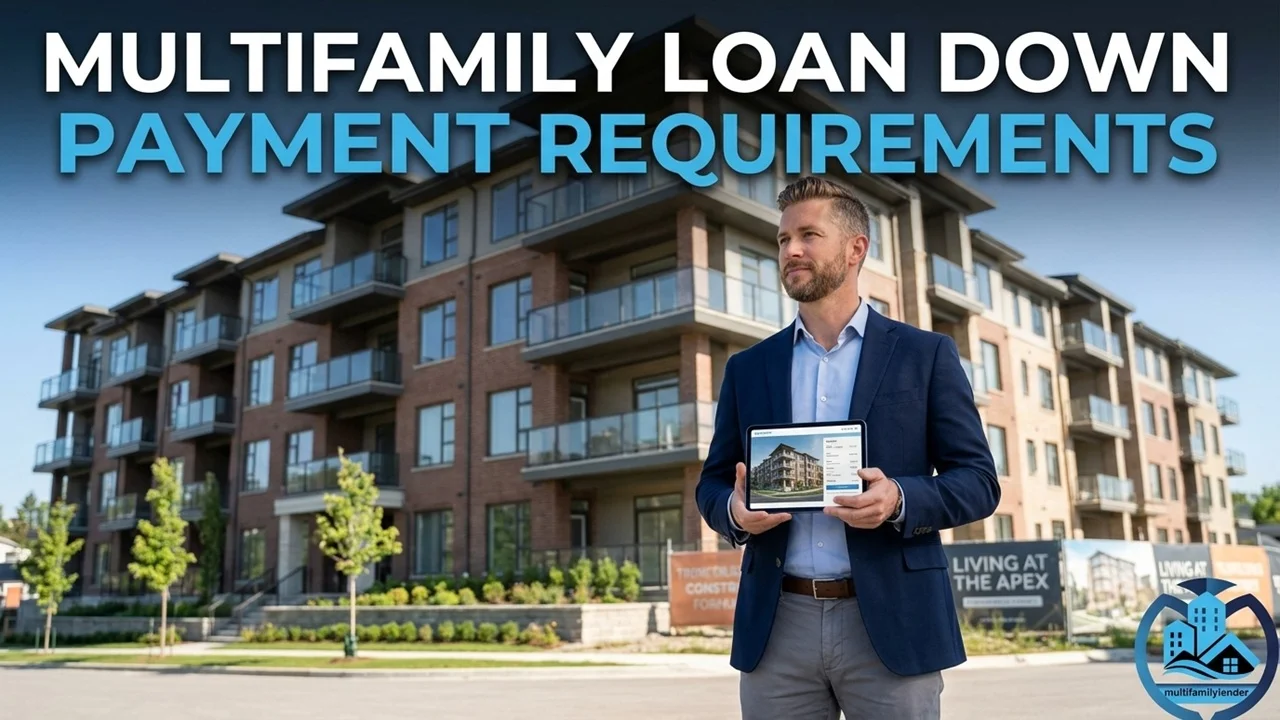
Ask 5 lenders how much down payment a multifamily loan requires and you will get five different answers. That is because multifamily loan down payment requirements are not a single flat number. They shift based on the loan program, the lender type, and the size of the property. Across the market, the realistic range runs from about 10% to 35% of the purchase price.
At the low end, you have a narrow SBA program that only fits a specific ownership structure. At the high end, you have private and bridge lenders pricing in extra risk. Most buyers land somewhere in the middle, and knowing where your deal fits before you talk to a lender saves weeks of back and forth. Here is how the numbers actually break down.
Multifamily Loan Down Payment Requirements and LTV Work Together
Every conversation about down payment eventually turns into a conversation about loan-to-value, or LTV. The two are mirror images of each other. LTV is the portion of the property’s value the lender is willing to finance, and your down payment covers the rest. The Consumer Financial Protection Bureau describes it as a direct measure of how much you are financing against the appraised value, and a bigger multifamily loan down payment requirements always means a lower LTV.
Here is a simple example. Say you are buying a $2,000,000 apartment building and the lender caps its multifamily loan LTV requirements at 75%. That means the loan covers $1,500,000, and you bring the remaining 25%, or $500,000, in cash or equity. Push the LTV to 80% on the same property, and your down payment drops to $400,000. That ten percentage point swing in LTV is the entire ballgame when you are budgeting a deal.
Minimum Down Payment by Loan Type
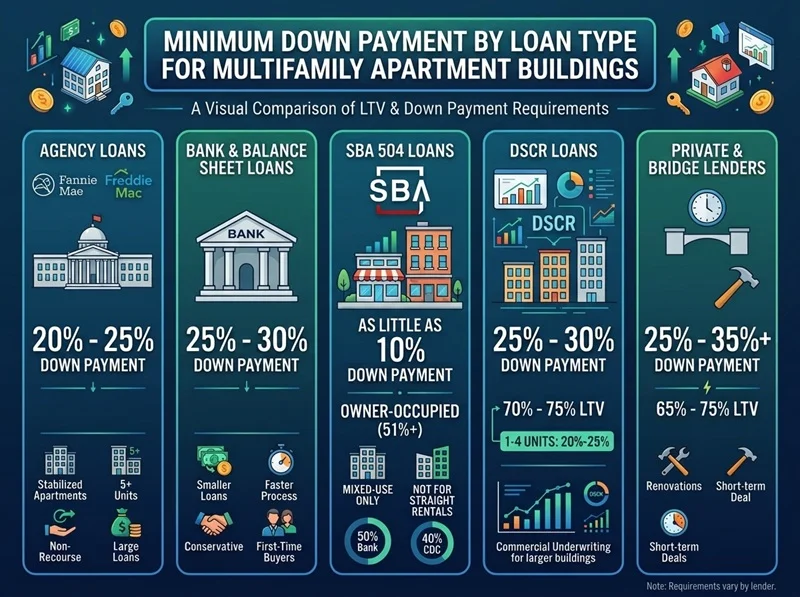
Once you know your target LTV, the next question is which loan programs actually offer it. Minimum down payment for apartment building loans varies widely once you compare programs side by side, and multifamily loan LTV by lender type is really the more useful way to think about it.
Agency Loans (Fannie Mae DUS and Freddie Mac Optigo)
Agency loans through Fannie Mae’s DUS platform and Freddie Mac’s Optigo network are the deepest pool of capital for stabilized apartment buildings with five or more units. Both programs typically cap leverage at 80% LTV for standard conventional deals, which puts the down payment in the 20% to 25% range depending on the property’s debt service coverage and the borrower’s credit profile. These loans are non-recourse and generally require a minimum loan size in the millions, so they fit mid-size and larger deals better than a small five-unit purchase. Our Fannie Mae loan and Freddie Mac loan pages walk through eligibility in more detail.
Bank and Balance Sheet Loans
Local and regional banks that keep loans on their own books tend to be more conservative than the agencies. Balance sheet lenders typically cap LTV around 70% to 75%, which translates to a 25% to 30% down payment. In exchange, banks often move faster and are more willing to work with smaller loan amounts or first-time multifamily buyers. Our breakdown of private versus bank commercial loans covers the tradeoffs in more depth.
SBA 504 Loans
SBA 504 loans get quoted online as requiring just 10% down, and per the SBA’s own 504 loan program page, that structure is real: a bank covers roughly 50%, a Certified Development Company covers roughly 40%, and the borrower puts in as little as 10%. The catch that a lot of articles skip is occupancy. SBA 504 financing is built for owner-occupied commercial real estate, and the borrower’s own business generally has to occupy at least 51% of the building.
That means a straight rental apartment building will not qualify. Where this program does show up in multifamily is on mixed-use properties, where an operating business occupies the ground floor and residential units sit above it. If that describes your deal, our SBA loan for rental property guide explains how the occupancy math works.
DSCR Loans
DSCR loan down payment percentages are usually advertised at 20% to 25%, and that is accurate for 1-4 unit residential DSCR products. The number shifts once a property crosses into true multifamily territory. On 5+ unit buildings, many DSCR lenders move to commercial-style underwriting and cap leverage at 70% to 75% LTV, which pushes the realistic down payment closer to 25% to 30%. It is worth confirming this distinction directly with your lender, since conflating small residential DSCR terms with 5+ unit multifamily DSCR terms is one of the most common pricing surprises buyers run into. Our multifamily DSCR loan article and DSCR loan product page both go into how lenders size these deals.
Private and Bridge Lenders
Private and bridge lenders finance the properties that agencies and banks will not touch yet, usually because the building needs renovation or has not stabilized its occupancy. Forbes Advisor notes that commercial borrowers overall should expect to put down 20% to 35% or more, and bridge deals tend to sit at the higher end of that range, often 25% to 35%, because the lender is pricing in the extra risk of an unstabilized asset. Our bridge loan page covers typical terms for these short-term deals.
Down Payment by Property Size
Unit count changes more than just the loan program. Properties with two to four units are financed under residential lending rules, similar to a single-family home purchase. Once a property hits five units or more, it moves into true commercial multifamily financing, with appraisals based on income and operating expenses rather than comparable home sales.
The dollar difference shows up fast. On a $750,000 five-unit building at a 25% down payment, you are bringing $187,500 in cash to closing. Scale that up to a $1,800,000 ten-unit property at the same 25%, and the down payment jumps to $450,000. How much down payment for a 5 unit apartment building really depends on which loan type you qualify for, so running a few scenarios before you make an offer is worth the time.
Beyond the Down Payment: Reserve Requirements
The down payment is rarely the last check a buyer writes. Multifamily loan down payment requirements typically ask borrowers to hold an additional 3 to 12 months of principal, interest, taxes, and insurance in liquid savings after closing, separate from the down payment itself.
This is where first-time buyers most often get caught off guard. A borrower who saves exactly enough for a 25% down payment, closing costs, and nothing else can find themselves short at the finish line when the lender asks for six months of reserves on top. Budgeting for reserves from the start avoids a last-minute scramble.
Where Your Down Payment Funds Can Come From
Lenders care about the source of your funds almost as much as the amount. Acceptable multifamily loan down payment requirements generally include personal savings, funds from an operating business, and gift funds from a relative, though gift funds usually need to season in your account for a set period before closing.
Whatever the source, expect to document it. Lenders typically request two to three months of bank statements and a paper trail showing where large deposits came from, since unexplained cash into an account is one of the fastest ways to stall an underwriting file.
Ways to Lower Your Required Down Payment
Seller Financing or Seller Carry-Back
A seller willing to carry a second position loan can cover part of the equity gap, letting the buyer bring less cash to the primary lender while the seller collects payments over time. This works best when the seller owns the property free and clear and is motivated to close.
Choosing a Lower-Down-Payment Program
Structuring a deal to fit an SBA 504 mixed-use scenario, or shopping DSCR lenders that price 5+ unit properties more aggressively, can shave several points off the required equity. It takes more upfront legwork, but the savings on a seven-figure purchase can be substantial.
Bringing in a Partner or Co-Sponsor
Splitting the equity requirement with a partner or a co-sponsor with stronger liquidity is one of the most common ways investors scale into larger multifamily deals without stretching their own cash too thin.
How to Know Which Down Payment Requirement Applies to You
The honest answer is that your down payment depends on the specific combination of loan program, lender, unit count, and your own financial profile. A five-unit deal financed through a bank looks nothing like a fifty-unit deal financed through Fannie Mae, even though both fall under the multifamily label. For a broader look at how all these financing paths fit together, our complete guide to financing apartment buildings is a good starting point, and our investment property loan calculator can help you run the numbers on a specific deal.
If you want to walk through what a specific property would require, reach out to our team or submit a loan inquiry and we can help match the numbers to the right program.
FAQs
What is the minimum multifamily loan down payment requirements?
The lowest realistic figure is around 10%, available through SBA 504 financing, but only when the borrower’s own business will occupy at least 51% of the building. For a pure rental apartment purchase, most programs start closer to 20%.
Do multifamily loan down payment requirements change based on the number of units?
Yes. Two to four unit properties are financed under residential lending rules, while five or more units move into commercial multifamily underwriting with different appraisal methods and typically higher down payment expectations.
Can I use gift funds for a multifamily loan down payment requirement?
Many lenders accept gift funds as part of the multifamily loan down payment requirements, but the money usually needs to season in your account for a set period, and you will need to document where it came from.
Are reserves the same thing as the down payment?
No. Reserves are separate liquid funds, often 3 to 12 months of the mortgage payment, that a lender requires you to hold after closing in addition to the down payment.
Is seller financing a realistic way to reduce a multifamily loan down payment requirements?
It can be, particularly with a motivated seller who owns the property outright. A seller carry-back second position loan can cover part of the equity gap, though it requires the seller’s cooperation and careful structuring with your primary lender.