

 Google AI
 ChatGPT
 Perplexity
Think of rush hour traffic. Thousands of cars, all trying to get through the same stretch of highway at the same time. Now replace every car with a commercial real estate loan and every lane with a lender.
That’s the maturity wall.
It happens when a massive volume of loans all come due at the same time. Borrowers are flooding the market seeking refinancing. Lenders get selective. Terms get tighter. Capital gets expensive.
Here’s how we got here.
Between 2018 and 2022, interest rates were near historic lows. Investors borrowed heavily. Five-year and seven-year loan terms were common. Those loans are all coming due now — in a market where rates are nearly double what they were at origination.
According to the Mortgage Bankers Association (MBA), $875 billion, 17% of all outstanding commercial mortgages, is scheduled to mature in 2026. That’s down 9% from $957 billion in 2025, but it’s still a staggering number. And multifamily is right at the center of it.
Multifamily maturities are surging 56% to $162 billion in 2026, up from roughly $104 billion in 2025. The multifamily sector accounts for 32% of all commercial loan maturities through 2026, the largest share of any asset class.
If you own multifamily property, you are in the thick of this. This guide is your action plan. We’ll break down what the maturity wall is, why it matters in 2026, and exactly what you can do to get through it.
The Real Commercial Real Estate Maturity Wall Challenges Multifamily Owners Face

Many owners are just now waking up to how serious this is. Here’s why the challenge runs deeper than just “rates are higher.”
The Math Has Changed Completely
When you borrowed at 3.5%, your property’s income easily covered the debt. Now, refinance at 7%, and the same property might not cash flow at all. That’s negative leverage; your new borrowing cost exceeds your cap rate.
Cap rates for multifamily properties currently range between 5.4% and 5.7%. Average rates on CRE loans originated in 2024 were around 6.2%, compared to 4.3% on loans maturing that same year. That’s nearly a 200-basis-point shock for borrowers taking out a new loan.
Run that math on a $5 million property, and it’s a significant monthly cash drain.
The Extend and Pretend Strategy Is Running Out of Road
Through 2024 and 2025, many lenders and borrowers used extensions to push problems down the road. It worked temporarily.
But lenders are tired of extending. Many have done it twice already. And the debt hasn’t gone away. It’s just piled up. Many of those extended loans are now crowding into the 2026 window, alongside new maturities.
The total amount of CRE loans that matured in 2025 represented nearly triple the 20-year average, creating what analysts call unprecedented refinancing pressure.
Waiting is no longer a strategy.
The Impact of the Maturity Wall on Multifamily Property Values
Higher rates don’t just affect your loan payment. They depress property values, too.
When cap rates rise, valuations fall. A property that appraised at $4 million in 2021 might appraise at $3.2 million today. That means your new loan, even at the worst terms, is also based on a lower value. You get less money, at a higher rate, on a property worth less.
That gap has to come from somewhere. Usually, it comes from you.
Distressed Multifamily Assets: The Numbers Are Rising
Distressed CRE volume reached $126.6 billion in Q3 2025, up 18% year over year. Multifamily accounted for $22.8 billion, of that 18% of all distressed commercial real estate.
The multifamily CMBS delinquency rate hit 6.59% as of late 2025, compared to just 0.51% for life insurance company loans and 0.61% for Fannie Mae-backed debt. That’s a meaningful gap.
Nearly half of apartment properties may struggle to secure refinancing at sustainable terms, according to The Kaplan Group’s State of U.S. Business Debt report.
That is the pain of the maturity wall. Now let’s talk about what you can actually do.
Multifamily Maturity Wall Help: Your 7-Step Action Plan
You don’t have to be a victim of the maturity wall. Thousands of multifamily owners are navigating it successfully right now. The difference between those who make it through and those who don’t comes down to one thing: how early and how smart they act.
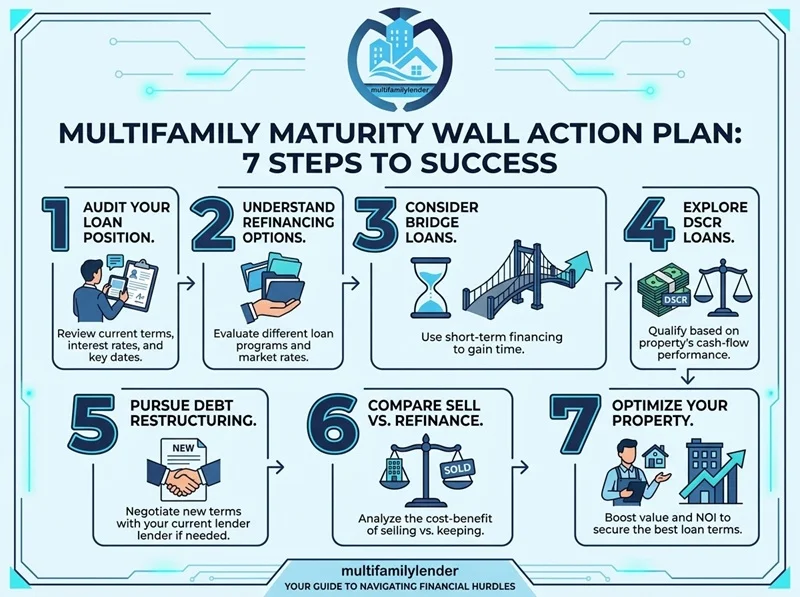
Here’s your roadmap.
Step 1: Audit Your Loan Position Today. Don’t Wait.
Before you call a lender, know your cold numbers. Pull out your loan documents and answer these questions right now:
- When does your loan mature exactly?
- Do you have any extension options left, and what do they cost?
- What is your current DSCR based on today’s actual rent roll and expenses?
- What would your property appraise for today, not in 2021?
- What prepayment penalties apply if you refinance early?
- How much capital do you have in reserves?
If your DSCR is below 1.20×, you need a plan immediately. Lenders get nervous below that threshold. Trepp data show that $115 billion of loans maturing by the end of 2026 carry in-place DSCRs below 1.20×; those are the most at-risk positions in the market.
Start this process at least 12 months before your maturity date. If you’re reading this and your loan matures before then, start today.
Loan Audit Checklist:
- Exact maturity date confirmed
- Extension options and costs reviewed
- DSCR recalculated at current rents and expenses
- Updated appraisal ordered
- Prepayment penalty assessed
- Capital reserve position confirmed
- Existing lender relationship assessed
Step 2: Know Your Refinancing Options for the Multifamily Maturity Wall
Most owners only know one or two loan types. That’s a problem. When the standard agency refinance doesn’t work, you need to know what else is on the table.
Here’s how to prepare for multifamily loan maturities using the right loan tools:
| Loan Type | Best Use Case | Key Benefit | Typical Term |
| Bridge Loan | Transitional or value-add assets | Speed and flexibility | 12–36 months |
| DSCR Loan | Stabilized income properties | No personal income docs required | 30 years |
| Hard Money Loan | Distressed assets, fast closings | Credit-flexible underwriting | 6–24 months |
| FHA Commercial Loan | Affordable housing, larger complexes | Low fixed rate, long amortization | Up to 40 years |
| CMBS Refinance | Larger stabilized properties | Non-recourse, competitive pricing | 5–10 years |
| Construction/Renovation Loan | Value-add repositioning | Funds improvements + carry | 12–24 months |
| No-Doc / Lite-Doc Loan | Non-traditional borrowers | Minimal paperwork | Varies |
| USDA B&I Loan | Rural multifamily properties | Government-backed, favorable terms | Up to 30 years |
| SBA Loan | Owner-occupied mixed-use | Low down payment | Up to 25 years |
| State Income Loan | Self-employed/complex financials | Uses stated rather than verified income | Varies |
Most borrowers facing a maturity wall have more options than they realize. The key is matching your property’s profile to the right program.
Step 3: Can Short-Term Bridge Loans for the Multifamily Maturity Wall Buy You Time?
For many multifamily owners, the answer is yes, but only if you use that time wisely.
A bridge loan is not a permanent solution. It’s a runway. You use it to stabilize your property, improve your finances, and then refinance into a permanent loan.
In 2026, bridge leverage for small-balance multifamily generally falls within the 65%–75% loan-to-cost range, with terms of 12 to 36 months. The strongest deals are priced in the high 5% to mid-6% range.
The path most investors take is the bridge-to-DSCR path. Here’s how it works:
- Get a bridge loan to cover your maturing debt and fund any needed improvements
- Stabilize the property, get rents to market, and reach target occupancy
- Once you have 6–12 months of stabilized income and a DSCR above 1.25×, refinance into a 30-year DSCR loan
The key rule: a bridge loan without a clear exit plan is a time bomb.
Know your exit before you sign. Talk to your lender about what the DSCR refi will look like at stabilization. Build the whole plan upfront.
Step 4: Why DSCR Loans Are One of the Best Multifamily CMBS Maturity Wall Solutions
DSCR loans have become the go-to permanent financing tool for multifamily investors and for good reason.
You qualify based on the property’s income, not your personal tax returns. No W-2s. No pay stubs. If the property cash-flows, you can get the loan.
DSCR-based refinancing works best when your property is stabilized and producing consistent income. Investors use it to improve cash flow, restructure existing debt, and reposition assets within a larger portfolio.
Standard DSCR minimums range from 1.20× to 1.25× for most programs. Fannie Mae and Freddie Mac multifamily programs follow their own underwriting models and typically offer the lowest rates for qualifying properties.
If you’re self-employed, have complex tax returns, or own multiple properties with tricky financials, DSCR loans solve a real problem. The property earns the loan, not your paperwork.
Step 5: Your Guide to Multifamily Debt Restructuring When Refinancing Isn’t Possible
What if the numbers just don’t work for a straight refinance? That’s where debt restructuring comes in.
This is not failure. It’s smart finance.
Here are your main restructuring options:
Loan Modification or Extension: Go back to your existing lender. Ask for a rate reduction, term extension, or interest-only period. You need documentation, current financials, a realistic exit plan, and evidence that you’re managing the property well. Lenders generally prefer modification over foreclosure. But don’t assume they’ll say yes twice.
Preferred Equity or Mezzanine Debt: Bring in rescue capital. A preferred equity investor fills the gap between your existing debt and what a new loan will cover. You give up some return in exchange for the capital to survive and stabilize. Preferred equity and rescue capital offer compelling risk-adjusted returns for investors in the current distressed environment, indicating that such capital exists and is actively looking for deals.
Discounted Payoff (DPO) Negotiate with your lender to retire the loan at less than face value. This works when the lender determines that a discounted resolution is preferable to the time and cost of foreclosure. It requires a skilled negotiator and a willingness from the lender to take a loss. Not always available, but worth exploring.
Note Sale: The lender sells your loan to a new note holder, often an investor who specializes in distressed debt. The new note holder may be far more flexible on terms than the original lender. This can open doors that were previously closed.
JV Recapitalization: Bring in an equity partner. They inject capital in exchange for an ownership stake. You give up some upside, but you keep the property and stabilize the balance sheet.
Step 6: Should You Sell or Refinance? A Multifamily Maturity Wall Decision Guide
This is the question every owner asks. And there’s no single right answer.
Here’s a simple framework:
| Your Situation | Best Path | Why |
| DSCR above 1.20×, LTV below 75% | Refinance | Strong fundamentals, lenders will compete for your deal |
| DSCR between 1.0–1.20×, small equity gap | Bridge Loan + Value-Add Plan | Buy time, improve property, then refi |
| DSCR below 1.0×, high LTV | Debt Restructuring or Recap | Need new capital or lender relief first |
| No realistic path to NOI growth | Sell Now | Capture remaining equity before forced sale erodes it |
| Distressed CMBS position | Engage Special Servicer + Expert Advisor | This requires specialized expertise |
One critical warning: don’t wait for values to come back to 2021 levels before you sell. They may not come back on your timeline. If selling is the right move, move early. Buyers pay more when you’re in control. When a lender forces the sale, you lose.
Step 7: Prepare Your Property to Get the Best Possible Terms
Before you approach any lender, squeeze every dollar of performance out of your property. Lenders price based on what they see, not what you know it could be.
Boost your NOI before you apply:
- Raise rents to current market rates and document it with rent comparables
- Fill vacant units and show at least 90% occupancy for 60–90 days before applying
- Cut controllable expenses: vendor contracts, utilities, management fees
- Add ancillary income: laundry, covered parking, storage units, pet fees
- Renegotiate insurance; many multifamily owners are overpaying significantly
Clean up your documentation:
- Two to three years of rent rolls, up to date and reconciled
- Current operating statements with clear line items
- Lease abstracts for all units
- Capital improvement records
Order your own appraisal first. Know your number before the lender’s appraiser does. If the number is lower than expected, you can challenge it with data. If you walk in blind, you can’t.
The Multifamily Market Outlook for the Maturity Wall in 2026: Is There Good News?
Yes. But it comes with context.
The MBA data shows the maturity wall is beginning to shrink. The $875 billion maturing in 2026 is down 9% from 2025. By 2027, that number drops to $652 billion. The peak of the wave appears to be behind us.
The Federal Reserve shifted its benchmark rate from a 5.25% peak in 2023 to the mid-3% range by late 2025. That’s a real relief. But it’s a partial relief. Borrowers today are still refinancing into structurally higher rates than in the 2010s, and many will be for years to come.
Private lending is filling the gap left by banks. MBA data from Q3 2025 shows that investor-driven lender originations were up 83% year over year, the largest gain of any lending category. Capital is coming back to the market.
Here’s the real picture of who wins and who struggles:
Who navigates the maturity wall successfully:
- Owners with stabilized, cash-flowing properties above 1.25× DSCR
- Investors who locked in early advisory relationships
- Borrowers with capital reserves to bridge small gaps
- Properties in high-demand, supply-constrained markets
Who faces the most pain:
- Over-leveraged owners who bought at peak 2021 prices
- Operators who extended once and are now out of options
- Properties in oversupplied Sunbelt markets where rent growth has stalled
- Anyone still waiting for rates to return to 2021 levels
The market is not broken. But it is unforgiving to those who don’t plan
Is Your Lender Actually Working For You? Advisory Services for the Multifamily Maturity Wall

Here’s something most borrowers don’t realize. Your existing lender’s job is to protect the bank, not your equity.
When your loan matures, your lender will offer you their best available product, at their current terms, based on their current appetite. That might be fine. Or it might be a terrible deal for you.
An expert advisor, especially one who is both a correspondent and table lender with 30 years of underwriting experience, knows what every lender in the market is offering right now. They can negotiate on your behalf, match your property profile to the right capital source, and access programs you wouldn’t find on your own.
That’s the core value of advisory services for the multifamily maturity wall. And the refinancing strategies for multifamily maturity wall challenges they bring aren’t off-the-shelf. They’re built around your specific property, DSCR, timeline, and goals.
We’ve been underwriting multifamily deals for 30 years. We’ve seen every market cycle: the savings-and-loan crisis, the 2008 meltdown, COVID, and now this. We know how lenders think because we are lenders.
Our network spans over 200 private lenders and real estate investors. When you submit to us, you’re not talking to one bank. You’re accessing capital from across the country, matched to your specific deal.
We work with:
- Multifamily properties from 1 unit to 40+ units
- Ground-up construction, renovation, rebuild, fix and flip, fix and hold, and fix and rent
- Bridge loans, hard money loans, DSCR loans, FHA commercial loans, CMBS, SBA, USDA B&I, construction loans, term loans, no-doc loans, lite-doc loans, and state income loans
Whether you’re an experienced investor with a complex restructuring situation or a newer borrower facing your first maturity, we work through the numbers with you and find the path forward.
We also offer exclusive and non-exclusive referral programs for brokers. If you’re a broker whose client is staring down a maturity date, bring the deal to us. We’ll underwrite it, find the capital, and close it.
Read more about 7 Benefits of Joining the Best Commercial Loan Referral Program
Avoiding Default on Your Multifamily Loan Maturity: The Bottom Line
Avoiding default on a multifamily loan maturity wall situation isn’t about hoping rates drop. It’s about acting early, knowing your options, and building a real plan.
Most defaults happen not because there was no solution but because the owner waited too long to look for one.
Owners who plan early and align their refinancing strategies now will be best positioned when maturities hit, according to capital markets experts. That’s not optimism. That’s the data.
Start with your audit. Then talk to an advisor. Then move.
Don’t Wait for the Wall to Hit You
Marcus, the investor we opened with, didn’t wait. He called Multifamily Lender six months before his maturity date. We audited his loan. We identified a bridge-to-DSCR path. We connected him with a private lender from our network who understood his asset and his market. He closed in 26 days.
His property is cash-flowing again. He’s already looking at his next acquisition.
That could be your story.
Multifamily maturity wall help isn’t about luck. It’s about having the right plan, the right partners, and the discipline to act before the clock runs out.
Your maturity date doesn’t have to be a crisis. With the right guidance, it can become a reset, a chance to clean up your capital stack, reposition your asset, and move forward stronger.
📞 Contact us today for a free loan consultation.
Whether you’re facing a bridge loan maturity, a CMBS refinancing challenge, a distressed asset situation, or just want to know where you stand, we have the network, underwriting experience, and lending solutions to help you get through the wall and come out the other side.
30 years of expertise. 200+ lenders in our network. Your deal deserves both.
MultifamilyLender.Net is a correspondent and table lender specializing in multifamily real estate finance. We serve investors across the United States with loans for multifamily properties from 1 to 40+ units. Contact us today to discuss your loan needs.
FAQs
What Is the Multifamily Maturity Wall?
The multifamily maturity wall is the buildup of commercial real estate loans, many of which were originated during the low-rate period from 2018 to 2022, all coming due at the same time. This creates intense competition for refinancing capital in a market with much higher rates than when those loans were made.
How Do I Avoid Default When My Multifamily Loan Matures?
Start your audit 12 months before maturity. Know your DSCR, your LTV, and your extension options. Engage an experienced multifamily lender or advisor, not just your current bank, to explore all available refinancing options. The sooner you act, the more options you have.
What Refinancing Options for Multifamily Maturity Wall CMBS Situations Are Available?
Bridge loans, DSCR loans, hard-money loans, FHA commercial loans, CMBS refinancings, USDA B&I loans, SBA loans, and no-doc or lite-doc loans. The right option depends on your property’s financials, occupancy, and how much time you have before maturity.
Should I Sell or Refinance When Facing the Multifamily Maturity Wall?
If your DSCR is above 1.20× and your LTV is under 75%, refinancing is typically the right move. If your DSCR is below 1.0× with no clear path to improvement, selling early while you control the timing is smarter than waiting for a forced sale. Use the decision table in Step 6 above as your guide.
How Early Should I Start Preparing for My Multifamily Loan Maturity?
12 to 18 months is the ideal window. It gives you time to improve your NOI, order an appraisal, explore multiple lenders, and execute without pressure. If you have less time than that, start today and move fast.
What Is the Multifamily Market Outlook for the Maturity Wall in 2026?
The MBA reports the maturity wave is beginning to ease from $957 billion in 2025 to $875 billion in 2026, with further declines expected in 2027. Private lending is surging, with investor-driven originations up 83% year over year. The market is not shut, but terms are tighter, and preparation matters more than ever.