
 Google AI
 ChatGPT
 Perplexity
The commercial real estate world is facing a massive shift. As we move through 2025 and look toward 2026, a Maturity Wall is fast approaching. About $957 billion in commercial mortgages are coming due this year alone. This is nearly triple the 20-year average of $350 billion. If you own a multifamily property, you might feel the pressure of high interest rates and looming balloon payments.
But here is the good news: the multifamily sector remains a bright spot. While other sectors struggle, multifamily transactions grew by nearly 40% year over year in early 2026. People always need a place to live, and with home prices hitting record highs of $412,500, renting is often the only choice for millions of Americans. At Multifamily Lender, we have spent 30 years as underwriters. We have seen these cycles before. This report will show you the smart way to navigate these waters using high interest commercial loan refinancing strategies that protect your equity and fuel your growth.
Best Strategies to Refinance High Interest Commercial Loans in 2026
Refinancing is not just about finding a lower number on a page. It is a strategic move to realign your debt with your long-term goals. Whether you want to lower your monthly payments, pull out cash for a new project, or move from a high-risk bridge loan to stable, long-term debt, the strategy you choose matters.
How to Lower Interest Rates on Business Loans and Boost Cash Flow
The most common goal for property owners is to improve their bottom line. High interest rates eat into your profits and make it harder to maintain your property. One of the best strategies to refinance high interest commercial loans is to focus on your Debt Service Coverage Ratio (DSCR). Lenders look at how much income your property makes compared to the loan payment.
In the current market, stabilized assets are winning. If you have spent the last year renovating units and raising rents, your property is now more valuable. By showing a strong Trailing-12 (T-12) financial statement which is just a fancy way of saying your last 12 months of profit and loss you can prove to a new lender that the risk is low. This often leads to “spread compression,” where the lender charges you a lower premium over the base interest rate.
Steps to Qualify for Lower Commercial Loan Rates for Small Businesses
If you want the best rates, you have to do your homework. Lenders in 2026 are more selective than they used to be. They want to see skin in the game and a solid track record. Here are the steps we recommend:
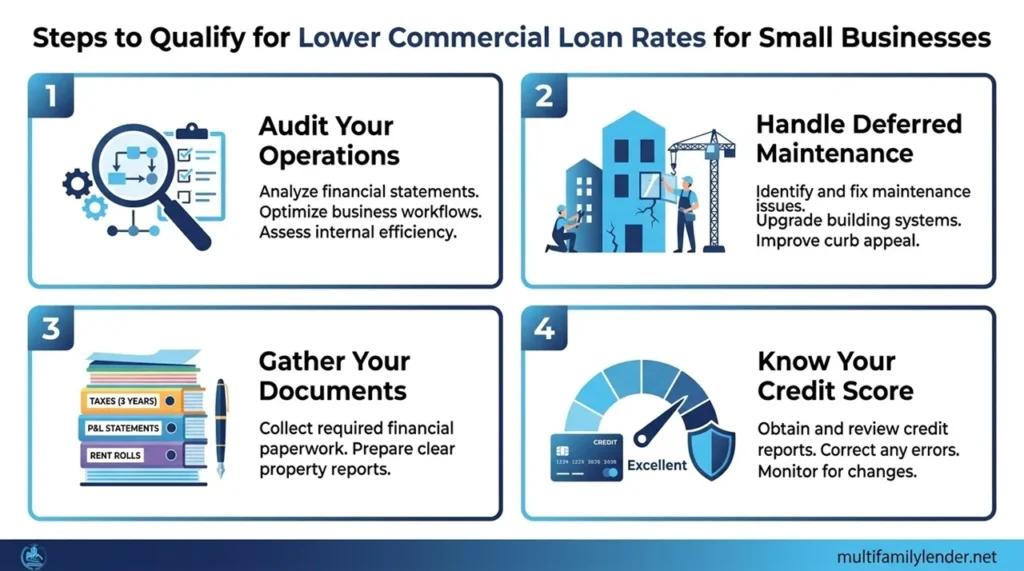
- Audit Your Operations: Clean up your rent rolls. Ensure your tenants pay on time and that your vacancies are low.
- Handle Deferred Maintenance: A property that looks good appraises for more. Fix the roof or the parking lot before the appraiser arrives.
- Gather Your Documents: You will need three years of tax returns, a Personal Financial Statement (PFS), and a Schedule of Real Estate Owned (SREO).
- Know Your Credit Score: Your personal and business credit scores still matter. A score above 720 can significantly impact the interest rate a lender offers you.
| Financial Factor | Standard Requirement (2025) | Impact on Refinancing |
| DSCR | 1.15x to 1.25x | Higher ratio unlocks lower interest rates 9 |
| LTV (Loan-to-Value) | 65% to 80% | Lower LTV reduces lender risk and fees 11 |
| Credit Score | 680 – 740+ | Essential for non-recourse and best spreads 13 |
| Liquidity | 7.5% to 10% of loan amount | Ensures you can handle unexpected repairs 5 |
High Interest Commercial Loan Refinancing Strategies for Every Property Size
The smart way to refinance depends heavily on how many units you own. A strategy that works for a fourplex might not work for a 40-unit apartment building.
Refinancing Multifamily (1-4 Units) Investment Property
For small properties (1-4 units), you are often playing by residential rules. These properties are valued based on comps, what the property next door sold for, rather than just the income they generate.
The benefit here is access to 30-year fixed-rate financing. In 2025, these rates have hovered between 6.5% and 7.1%. If you currently have a high-interest hard money loan from a fix and flip project, moving into a 30-year fixed loan is a great way to fix and rent for long-term wealth.
The Strategic Sweet Spot: Multifamily (5-10 Units) Investment Property
We call the 5-10 unit segment the “gray zone”. These properties are too big for most residential lenders but too small for giant institutional banks. This is where DSCR loans truly shine.
A DSCR loan qualifies the property based on its own cash flow, not your personal W-2 income. For an 8-unit building, a lender will look at your gross rental income and subtract expenses like taxes and insurance. If the property pays for itself with a little extra left over, you can often secure a 30-year fixed term that traditional commercial loans don’t offer. Harvard research shows that these small multifamily assets usually have higher occupancy rates than large complexes, making them a favorite for smart lenders.
Scaling Up: Multifamily (11-40+ Units) Investment Property
As you move into 20, 30, or 40 units, you enter the world of Agency and HUD lending. These are government-backed programs like Fannie Mae, Freddie Mac, and FHA/HUD.
- Fannie Mae & Freddie Mac: These are great for stabilized properties. They offer non-recourse debt, meaning the lender cannot come after your personal assets if the deal goes south (outside of bad boy acts).
- HUD 223(f): This is often considered the gold standard for refinancing. It offers a 35-year fixed rate and is fully amortizing. In 2025, HUD updated its rules to allow for even higher leverage up to 87% for market-rate properties and 90% for affordable housing.
Commercial Loan Refinancing Options for Small Businesses in 2026
If you are looking for alternatives to traditional commercial loan refinancing, there are several paths you can take depending on your property’s condition and your timeline.
Bridge Loans and Hard Money Loans for “Fix and Hold” Strategies
Sometimes, your property isn’t ready for a 35-year HUD loan. Maybe you just finished a rebuild or renovation, and you need time to get new tenants in at higher rents. This is where bridge loans come in.
A bridge loan is a short-term (1-3 years) solution that bridges the gap between your current situation and your long-term goal. While the interest rates are higher, they are flexible. They allow you to finish your fix and flip or fix and rent strategy without being locked into a long-term contract with high prepayment penalties.
DSCR, SBA, and USDA B&I Loans
- SBA 504 Loans: If you have a mixed-use building where your own business occupies at least 51% of the space, an SBA loan can offer incredibly low down payments and fixed rates for up to 25 years.
- USDA B&I Loans: For multifamily properties in rural areas, the USDA provides guarantees that help you get better terms from local banks. This is part of a government push to improve housing in smaller towns.
- No-Doc and Lite-Doc Loans: For experienced investors with 30 years of expertise like our partners, these loans skip the mountain of paperwork. They focus on the property’s value and your credit score, making the process much faster.
Negotiating Better Terms for High Interest Business Loans
Don’t assume the first offer is the only offer. With a network of over 1,000 real estate investors, private lenders, brokers, and realtors, Multifamily Lender knows that shopping the deal is key.
Understanding Commercial Loan Refinancing Fees
Before you sign a new loan, you must understand the costs. Refinancing isn’t free. You will likely face:
- Application Fees: Usually between $12,000 and $15,000 for Agency loans.
- Origination Fees: Often 0.5% to 1% of the total loan amount.
- Appraisal and Legal Fees: These can range from $5,000 to $25,000, depending on the property size.
Calculate your “break-even point.” If a new loan saves you $2,000 a month but costs $40,000 to close, it will take you 20 months to start seeing a real profit. A savvy investor looks for the “pleasure” of long-term savings over the “pain” of upfront costs.
Prepayment Penalties: The Hidden Hurdle
Many high-interest loans have prepayment penalties. Some use a declining scale (like 5-4-3-2-1%), while others use Yield Maintenance. Yield Maintenance ensures the lender gets the same profit they would have made if you stayed in the loan until the end. Always have an underwriter check these numbers before you try to exit your current loan.
The Impact of Credit Score on Commercial Loan Refinancing

While commercial loans focus on the property, the sponsor (that’s you) still matters. Your credit score is a signal of how you handle your obligations. According to data from Forbes and Investopedia, a sponsor with a credit score above 740 can often secure an interest rate that is 0.5% to 1% lower than someone with a score of 620. Over 30 years, that 1% difference can save you hundreds of thousands of dollars.
If your score is lower, consider a stated income or no-doc loan. These focus more on the property’s cash flow and your equity, though they may come with slightly higher rates to offset the risk.
Alternatives to Traditional Commercial Loan Refinancing
If the numbers for a full refinance don’t work, don’t give up. You can use strategies often taught at business schools like Harvard and Oxford to manage your debt.
- The Debt Avalanche Method: Focus on paying down your highest-interest debt first. This saves you the most money on interest over time.
- The Debt Snowball Method: Pay off your smallest debts first. This gives you “quick wins” and builds momentum, which Harvard researchers say helps you stay motivated.
- Renovation Loans: Instead of a full refinance, you might get a long-term construction loan to improve the property. This increases the property’s value, making a future refinance much easier and more profitable.
Why Multifamily Lender is the Smart Choice for 2026
Navigating the High Interest Commercial Loan Refinancing Strategies of today requires more than just a calculator. It requires a network. We offer both exclusive and non-exclusive referral programs to brokers, and we work with everyone from new investors to industry veterans.
Our vast network of over 1,000 private lenders, realtors, and investors gives us an “inside track.” When you work with us, we don’t just look at your property; we look at your whole strategy. Are you doing ground-up construction? Or a simple “fix and hold”? We match your goals with the right loan type, whether it is a Lite-Doc, an FHA commercial property investment loan, or a standard term loan.
Conclusion: Your Path to Refinancing Success
The $957 billion maturity wall in 2025 is a challenge, but for the prepared investor, it is an opportunity. By using the innovative strategies outlined here focusing on DSCR, choosing the right loan for your unit count, and leveraging expert underwriting you can protect your multifamily investment property for years to come.
Do not wait until your balloon payment is 30 days away. The most successful refinances start six to nine months before the maturity date. Take the time to gather your documents, improve your property’s cash flow, and shop for the best terms. With 30 years of capability and expertise, we are here to help you move from high-interest pain to long-term financial pleasure.
FAQs
Can I buy homes with commercial loans?
No. Commercial real estate loans are strictly for business purposes. You cannot use them to buy a personal primary residence. Lenders require that you use at least 51% of the property for commercial activities or rental income.
Does remote work affect my property value?
Yes. The rise of remote work has shifted renters’ preferences toward units with dedicated office spaces. Highlighting these features can increase your property’s appeal and occupancy rates, thereby directly impacting your Net Operating Income and overall building valuation.
Can I refinance during a cash-flow crisis?
Yes. If you face short-term cash flow problems, you may negotiate a forbearance agreement or refinance to restructure payments. This allows you to stabilize operations and rebuild financial strength while protecting your asset from immediate legal actions or foreclosure threats.
Do green certifications improve my refinancing terms?
Yes. Sustainable design and green building certifications are increasingly central to competitive positioning. Lenders reward energy-efficient properties with better terms, as these features meet modern regulatory requirements and attract environmentally conscious tenants who are willing to pay higher monthly rents.
Will multifamily lending volume increase in 2026?
Yes. Market experts predict that multifamily loan volume will grow by sixteen percent in 2026. This rebound is expected as interest rates stabilize and the persistent national housing shortage continues to drive high demand for quality rental apartments across regions.