

 Google AI
 ChatGPT
 Perplexity
In the fast-paced world of multifamily real estate investment, you often use long-term financing like Commercial Mortgage-Backed Securities (CMBS) loans to secure your assets. These loans can remain outstanding for years, offering low rates and non-recourse terms. But what happens when that 5- or 10-year term ends, and you face a massive balloon payment right when the credit market is frozen?
This is the exact high-stakes challenge multifamily owners are facing today.
The U.S. commercial real estate (CRE) market is approaching a critical maturity wall, with $957 billion of outstanding commercial mortgages scheduled to mature in 2025 alone. While structural distress in the office sector gets the most headlines, the multifamily industry is quietly experiencing sharp increases in delinquency, reaching 4.7% in late 2025.
This isn’t just a market trend; it’s a direct threat to your equity and your investment portfolio. Suppose you own an apartment building with a CMBS loan coming due. In that case, you need an immediate, flexible solution to avoid the special servicer and, ultimately, foreclosure.
We are MultifamilyLender.Net, a correspondent and table lender with 30 years of expertise [Client Profile]. We specialize in providing the swift, asset-focused private capital needed to bridge this precise moment of crisis.
This report reveals how a Private bridge loan for maturing CMBS debt serves as a crucial lifeline, turning a potential disaster into a strategic opportunity for a long-term hold, fix-and-flip, or renovation and stabilization of your multifamily property.
The Crisis Point: Why CMBS Debt is Maturing Now
The current challenge stems from the fact that many long-term CMBS loans were originated during a period of low interest rates and high property valuations. The expected exit strategy refinancing into a new, low-rate CMBS loan is now failing due to dramatic market shifts.
The Looming Commercial Mortgage Balloon Payment Default
A CMBS loan, often called a conduit loan, typically has a 5- to 10-year term but is amortized over 25 to 30 years. This structure requires a massive commercial mortgage balloon payment default the final principal balance to be paid in full at maturity.
Few investors have the cash on hand to cover this balloon payment themselves. Repayment traditionally relies entirely on refinancing.
The Problem: Today, traditional sources for that refinancing large banks and the CMBS securitization market are experiencing a credit freeze. They lack the necessary liquidity or are simply unwilling to lend due to massive market uncertainty surrounding commercial asset values. This leaves even fully performing loans those where the borrower was current on all payments at severe risk of a technical maturity default.
The Impact of Interest Rates on Commercial Mortgage Maturity Default
The dramatic rise and sustained elevation of interest rates create two critical financial hurdles that directly cause these defaults:
Increased Borrowing Costs: The 30-year mortgage rate is projected to remain elevated, nearing 6.3% to 6.5% through 2026. This elevation makes any attempt to refinance prohibitively expensive, crushing the economics of the deal.
Conservative Underwriting: In response to market volatility, the rules for commercial real estate lending have fundamentally changed. Lenders now demand much lower leverage and greater borrower equity. It is now common for new loan terms to require:
- Loan-to-Value (LTV) ratios of just 60% to 65%.
- Debt Service Coverage Ratios (DSCRs) between 1.30x and 1.35x.
Suppose your original CMBS loan was underwritten at a higher leverage point (e.g., 75% LTV). In that case, the impact of interest rates on commercial mortgage maturity default means you must now inject a significant amount of new cash (equity) just to qualify for the smaller, more conservative loan amount available today. For many owners, this required cash infusion is impossible, accelerating the default path.
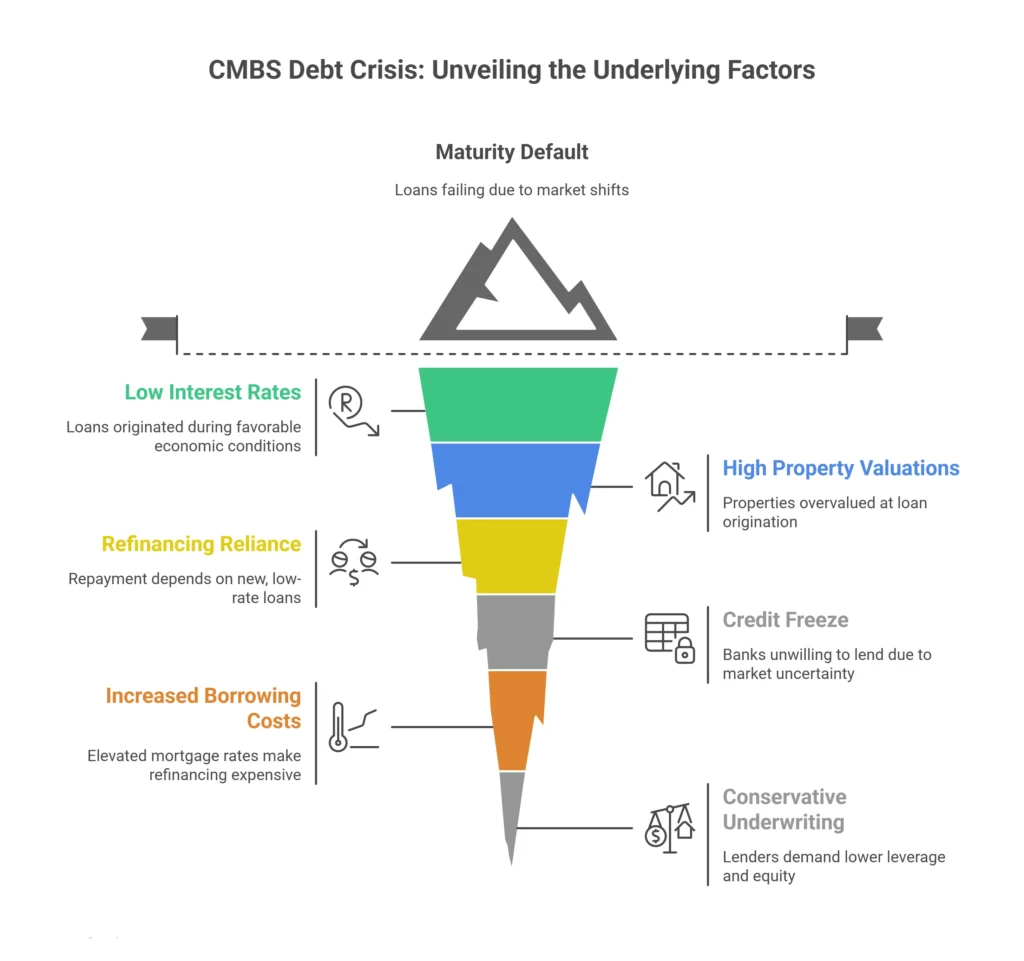
Image: Why CMBS Debt is Maturing Now
What Happens After Commercial Mortgage Maturity Default?
Once a CMBS loan fails to pay off at maturity, the property enters a complex and costly legal process that requires immediate, expert intervention.
The Special Servicing Process and What to Expect
When a loan fails to pay its balloon payment, it is transferred from the Master Servicer (who handles healthy loans) to the Special Servicer (who handles troubled loans).
The transfer to special servicing can be triggered by various forms of financial distress, including a maturity default, a covenant breach, or an imminent default. Once the loan is in special servicing, the borrower loses crucial operational flexibility.
The Key Takeaway: The Special Servicer’s only job is to maximize recovery for the bondholders. They are tasked with resolving the loan through refinancing, a property sale, foreclosure, or loan modification. Historically, the resolution process has been slow; a loan can spend over 3 years (43 months) in special servicing, imposing high soft costs and uncertainty on the asset.
Legal Implications of Commercial Mortgage Maturity Default: Avoiding Foreclosure Risk
The biggest fear of any borrower is foreclosure. When a maturity default occurs, the lender must take affirmative action to accelerate the loan (making the entire principal balance immediately due) before it can begin the foreclosure process.
To navigate this process and avoid total loss, owners must understand the legal implications of commercial mortgage maturity default and act decisively.
Common Borrower Mistakes to Avoid:
- Delaying Discussion: Waiting until a payment is missed or a covenant is violated drastically limits your options. Plan early.
- Informal Communication: Do not call the servicer informally. All discussions should be followed up with a formal, written proposal and a comprehensive business plan.
- Going It Alone: This is a specialized legal and financial battle. You must assemble a professional commercial mortgage default lawyer consultation and a “Workout Team”.
Refinancing Commercial Mortgage Maturity Default: Private Capital as the Answer
When traditional financing options evaporate, private lending steps in to fill the urgent liquidity gap. Private capital is often the only viable choice for refinancing commercial mortgage maturity default assets because it offers speed and flexibility that CMBS loans simply cannot match.
Why Private Bridge Loans are the Best CMBS Loan Maturity Default Solutions
A Private bridge loan for maturing CMBS debt is a specialized, short-term financial tool (typically 6 to 24 months) explicitly designed to buy you time. It is the critical “bridge-to-bridge” financing needed when the long-term market is closed.
Key Advantages of Hard Money and Bridge Loans:
| Feature | Private Bridge/Hard Money Loan | Traditional Bank/CMBS Loan |
| Speed | Closes in days or a few weeks. Crucial for imminent default. | Takes 30 to 60 days or longer. |
| Underwriting Focus | Focuses on the asset’s value and the borrower’s exit plan. | Focuses heavily on borrower credit history and income documentation. |
| Flexibility | Highly flexible terms; easily negotiable; can include funds for improvements. | Highly rigid and restrictive loan documents. |
| Use Case | Transitional assets, time-sensitive refinancing, finding capital for commercial mortgage maturity default. | Stable, long-term investments with no urgent capital need. |
For owners struggling to find a solution, bridge loans are ideal CMBS loan maturity default solutions because they provide the immediate liquidity needed to pay off the balloon payment and stabilize the property. This specialized funding allows you to exit the costly special servicing process and prepare the asset for permanent financing down the line.
DSCR Loans: A Strategic Option for Stabilized Multifamily
For multifamily investors with fundamentally sound properties generating stable rental income but lacking the personal documentation or time required by traditional banks the Debt Service Coverage Ratio (DSCR) loan offers another strategic path.
DSCR loans are based primarily on the property’s expected earnings, not your personal financial strength. This asset-focused risk assessment dramatically speeds up the approval and closing process.
DSCR Loans are ideal for:
- Fast Refinancing: They offer quick refinancing for existing debt.
- High Cash Flow: A strong DSCR (e.g., 1.5x) secures highly competitive terms.
- Accessing Equity: DSCR loans often allow for unlimited cash-out. This is critical for distressed commercial real estate loan options, allowing you to cover the mandatory equity injection required under new, conservative LTV requirements (gap financing).
Commercial Mortgage Maturity Default Workout Strategies
Successfully resolving a CMBS maturity default requires strategic planning and sophisticated negotiation often involving the very restructuring commercial mortgage maturity default techniques we specialize in.
Negotiating Commercial Mortgage Maturity Default Terms
When working with a Special Servicer, the goal is to negotiate a solution that is better for the CMBS bondholders than a lengthy, drawn-out foreclosure. Your leverage is your willingness to cooperate and present a realistic, pressure-tested business plan for the asset.
How to Strengthen Your Negotiation Position:
- Plan Scenarios: Develop optimistic, moderate, and pessimistic scenarios for your property’s performance. Do not use “sky-high rent growth” in your assumptions; the servicer will scrutinize it.
- Know Your Documents: Understand every clause and guarantee in your original loan documents.
- Proactive Proposal: Submit a formal, written proposal for a loan modification or forbearance before the maturity date.
This proactive approach to negotiating commercial mortgage maturity default terms significantly increases your chances of securing a favorable outcome, such as an extension or one of the more advanced restructuring options below.
Advanced Restructuring Commercial Mortgage Maturity Default Techniques
For assets where refinancing the entire debt is simply not possible, specialized structures can resolve the maturity crisis:
1. Discounted Payoff (DPO)
A DPO is a strategy used when the current property value no longer supports the original loan balance.
- How it Works: The borrower pays off the loan at a price below full par value, reflecting the current market impairment.
- The Clawback: Most DPOs include a “clawback” provision. This mandates that if you sell the property above the discounted payoff amount within a set period (typically 2-3 years), you must return a portion of the discount to the servicer. This minimizes the CMBS trust’s risk.
2. A/B Note Split
This complex technique splits the debt into two pieces :
- The A Note: This is the performing piece, based on the property’s current, sustainable market value. This note continues to be serviced.
- The B Note: This is the junior, non-performing piece (sometimes called a “Hope Note”). It is tied to the property’s future recovery. This allows the lender to defer immediate loss recognition while keeping a stake in the asset’s potential turnaround.
By leveraging a Private bridge loan for maturing CMBS debt to cover the immediate cash shortfall and combining it with one of these specialized workout strategies, we can create a clear pathway out of distress.
Your Partner in Avoiding Commercial Mortgage Maturity Default
The current market is unforgiving, but it is not without solutions. The key to how to avoid commercial mortgage maturity default is acting quickly with the right capital and the right strategy.
At MultifamilyLender.Net, we bring 30 years of underwriting experience and a vast network of over 1,000 private lenders and investors [Client Profile]. We do not just process loans; we provide the financial consulting and strategic guidance necessary to navigate CMBS workouts, restructuring commercial mortgage maturity default terms, and securing the flexible, rapid capital you need for ground-up construction, renovation, or stabilization.
Whether you need a private bridge loan for maturing CMBS debt to quickly pay off a balloon payment, a Hard Money Loan for a fast fix and flip, or a DSCR loan for a stable fix and hold apartment building, we provide the best options for commercial mortgage maturity default resolution.
Don’t wait for chaos to hit. The moment your CMBS maturity date is on the horizon is the moment to act.
Contact MultifamilyLender.Net today for a confidential consultation and start structuring your exit strategy.
FAQ
What is the primary cause of CMBS maturity default?
Maturity default occurs when a borrower is unable to refinance their loan at maturity to cover the required final commercial mortgage balloon payment. The leading cause today is the high-interest-rate environment and the credit freeze, which prevent traditional lenders from offering new loans at a high enough leverage ratio to pay off existing debt.
What is the difference between a term default and a maturity default?
A term default occurs when a borrower cannot make their scheduled monthly interest and principal payments due to insufficient property cash flow. A maturity default occurs when the loan is due in full at the end of the term (the balloon payment). Still, the borrower cannot secure refinancing commercial mortgage maturity default proceeds to pay it off, even if they were current on all prior payments.
How fast can a Private bridge loan for maturing CMBS debt close?
Private bridge loans and Hard Money Loans prioritize the value of the underlying real estate asset over the borrower’s personal credit history. This asset-centric focus enables a speedy underwriting process, often closing within a few weeks, which is invaluable for time-sensitive situations like refinancing a commercial mortgage maturity default.
Should I contact a commercial mortgage default lawyer consultation immediately?
Yes. Once your loan is flagged as being at risk of default, or as soon as you know refinancing is problematic, you should immediately engage both a financial consultant and a specialized commercial mortgage default lawyer consultation to help you assemble a professional “Workout Team” and develop a formal, written resolution proposal. This proactive approach is key to how to avoid commercial mortgage maturity default and protecting your equity.
Are DSCR loans a viable option for distressed commercial real estate loan options?
Yes, DSCR loans are excellent distressed commercial real estate loan options, particularly for multifamily properties that are underperforming or transitional but have strong cash flow potential. Since the loan is qualified primarily on the property’s ability to cover debt service (DSCR) rather than the borrower’s personal tax returns, they offer a fast and flexible way to access capital for refinancing or cash-out needs.