 Google AI
 ChatGPT
 Perplexity
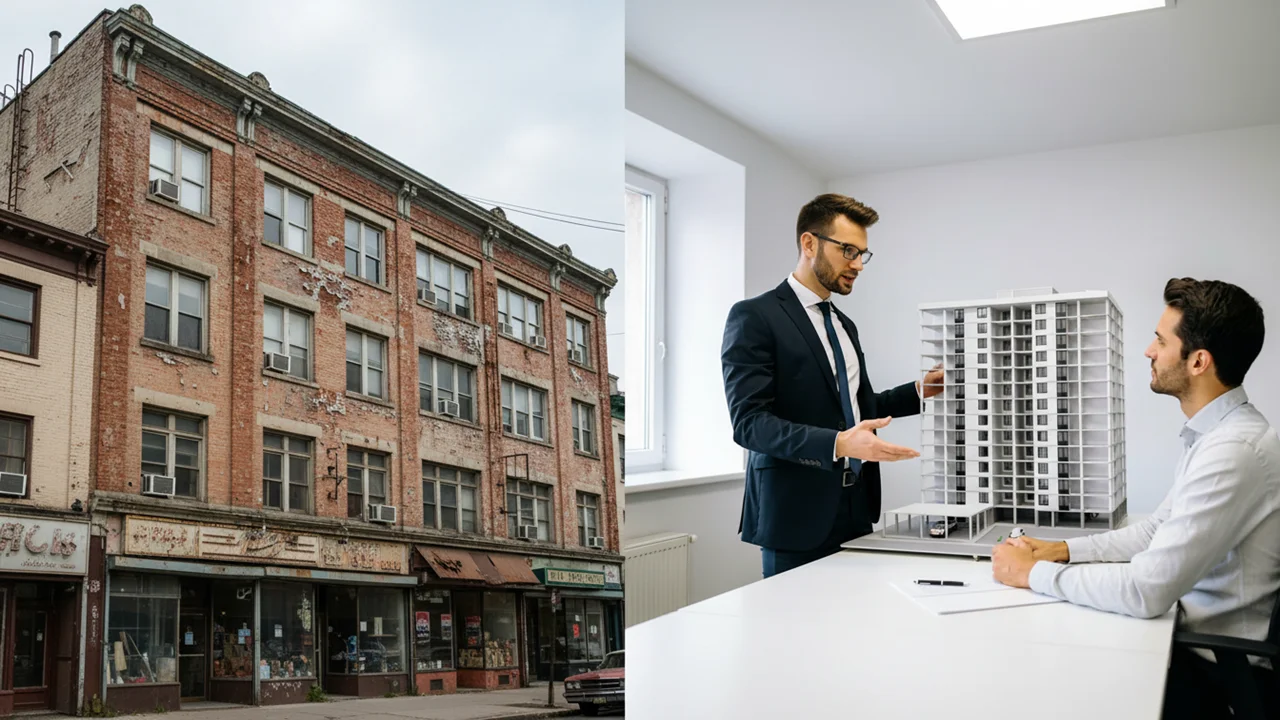
The commercial real estate landscape is witnessing a historic pivot. What was once the “urban doom loop” is being replaced by a residential renaissance. As of early 2026, the volume of planned office-to-apartment projects has reached a record 90,300 units- a 28% increase year-over-year. For property owners and investors, this shift represents more than just a trend; it is a structural necessity driven by a 20% national office vacancy rate and a desperate need for millions of new housing units.
MultifamilyLender.Net stands at the forefront of this transformation. With 30 years of underwriting abilities and a network of over 200 real estate investors and private lenders, the company provides the sophisticated financial consulting needed to navigate this complex sector. Whether you are looking at ground-up construction, renovation, or a “fix and rent” strategy for a 5-50-unit building, understanding the nuances of private financing for office to multifamily conversion is key to unlocking value in underutilized assets.
Can Bridge Loans Office to Residential Conversion Close the Gap?
In the current market, traditional depository banks have pulled back, with lending volume plummeting by over 60%. This has left a $300 billion funding gap that only specialized private debt funds and alternative lenders can bridge. Bridge loans Private Financing for Office to Multifamily Conversion are the most popular tool for this transition. These are short-term, interest-only solutions designed to fund the acquisition and heavy renovation phase before a property can be refinanced into permanent debt.

Current 2026 market data shows that bridge loan rates typically range from 10% to 12%. However, they can go as low as 5.75% for lower-risk “light” value-add projects. These loans provide the speed and flexibility that traditional institutions lack, often closing in a matter of weeks rather than months.
Typical Bridge Loan Parameters for 2026
| Feature | Standard Bridge Loan | High-Leverage Private Debt |
| Interest Rate | 10.75% – 12.5% | 10.0% – 12.75% |
| Loan-to-Cost (LTC) | 65% – 75% | Up to 85% |
| Term Length | 12 – 36 Months | 6 – 24 Months |
| Recourse | Often Non-Recourse | Full Recourse Likely |
Is Your Building Actually a Smart Candidate for Conversion?
Physical suitability is the first hurdle in any conversion project. Research from The Economist suggests that while 24% of office inventory is rated suitable for conversion, only about 11% of properties truly meet the rigorous financial and architectural standards required for a successful exit.
Our underwriting process evaluates five critical pillars to determine if a project qualifies for the Private Financing for Office to Multifamily Conversion.
- Structural Grid and Floorplate Depth: Residential units require natural light. Buildings with sprawling footprints often require drilling “light wells” into the core, which can increase hard costs by $50 to $100 per square foot.
- MEP Overhaul: Office HVAC and plumbing systems are centralized near the core. Residential layouts require individual kitchens and baths in every unit, necessitating a total repositioning of these systems.
- Zoning and Permitting: While many cities are creating expedited permitting-such as California’s Assembly Bill 1490, which caps review periods at 60 days-zoning remains a significant risk factor for lenders.
- Amenity Opportunities: High-end tenants in 2026 expect gyms, pet spas, and remote-work lounges. Converting excess mechanical space from the 1920s and 30s into these amenities is a key value-add strategy.
- Local Demand: Location is vital. An office building in a walkable neighborhood with cultural activities is a far better candidate than an isolated office park.
What is the True Cost of Private Financing For Office to Multifamily Conversion?
Every conversion is a “spreadsheet” project. According to Investopedia and industry benchmarks, hard costs for conversion construction in 2026 land between $300 and $375 per square foot for quality apartment finishes. When you add soft costs (design, permits, fees) and acquisition, all-in costs can reach $500 to $685 per square foot in tight markets like New York City.
To make these numbers pencil,” developers often use alternative financing office to apartment reuse to fill the gaps in their capital stack. One of the most transformative tools is C-PACE (Commercial Property Assessed Clean Energy).
The C-PACE Advantage for Conversions
C-PACE allows owners to fund energy-efficient upgrades- such as new HVAC, building envelopes, and solar—through a voluntary property tax assessment.
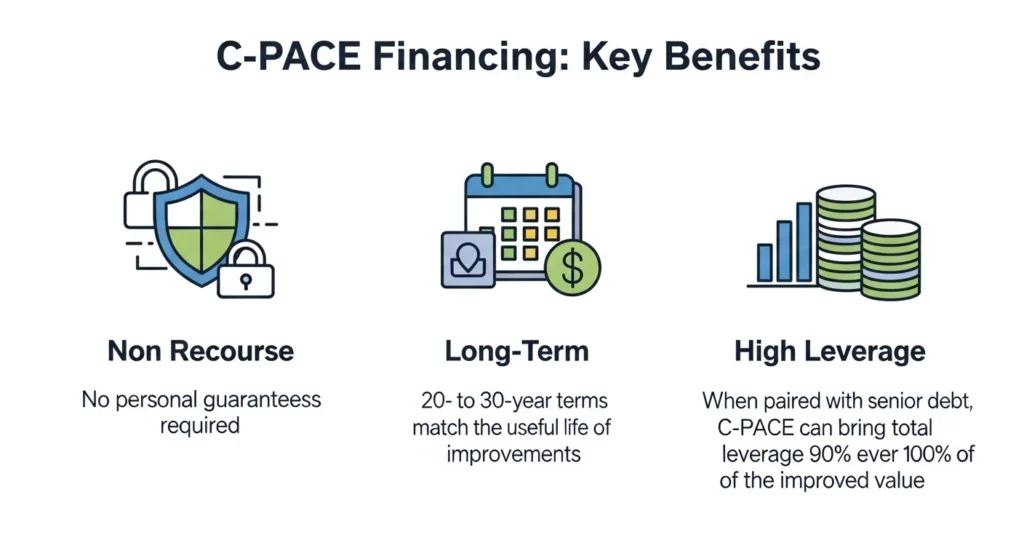
- Non-Recourse: No personal guarantees are required.
- Long-Term: 20- to 30-year terms match the useful life of improvements.
- High Leverage: When paired with senior debt, C-PACE can bring total leverage to 90% or even 100% of the improved value.
Furthermore, the Historic Tax Credit (HTC) remains a primary tool for closing capital stack gaps. This federal program provides a 20% tax credit for the rehabilitation of historic income-producing buildings, effectively reducing equity requirements by 20% of eligible costs.
How Can Syndication for Office to Residential Conversion Boost Your Capital?
Syndication for office to residential conversion allows multiple investors to pool their resources to tackle large-scale projects. This is particularly effective for “Class B” and “Class C” buildings that have seen valuations decline by as much as 70%. By aggregating capital, syndicates can acquire these assets at a favorable basis, often below replacement cost.
Equity from private investors typically makes up 35% of the capital stack in these deals. To attract this capital, local leaders and sponsors must demonstrate projected annual returns of 15% to 20%. Multifamily Lender specializes in advising syndicates on how to structure these deals to satisfy Private Financing for Office to Multifamily Conversion, ensuring a clear exit strategy to permanent debt once the property is stabilized.
Navigating Private Financing Challenges Office Conversion
Underwriting a conversion is an exercise in uncertainty management. One of the most pressing concerns for 2026 is the “maturity wall.” Approximately $213 billion in office loans are set to mature by the end of 2026, many on properties that have lost significant value.
Lenders have also tightened their requirements for the Debt Service Coverage Ratio (DSCR). While 1.25x was once the standard, many private debt funds office to multi-family now look for 1.30x to 1.35x.
The DSCR Calculus
The formula used in our underwriting is:
DSCR = {Net Operating Income (NOI)}/{Annual Debt Service}
If a property has an NOI of $1,000,000 and the lender requires a 1.35x DSCR, the maximum annual debt service supported is:
Max Debt Service = {1,000,000}{1.35} x $740,740
If current interest rates push the debt service higher, the borrower must bring more equity to the table. This “negative leverage” environment makes how to get private funding office conversion a matter of finding creative gaps and alternative subsidies.
Utilizing Hard Money Loans Office to Apartment Conversion for Speed
When an acquisition opportunity arises in a competitive urban core, speed often beats rate. Hard money loans office to apartment conversion focuses primarily on the After Repair Value (ARV) rather than the borrower’s personal credit.
- Speed to Close: Can be as fast as 10 to 21 business days.
- Interest Rates: Starting around 7.99% for qualified deals, but frequently landing in the 10% to 13% range for high-leverage conversions.
- Agility: Ideal for “fix and flip” or quick stabilization of 5-100 unit buildings.
Case Studies Private Financing Office Conversions in Action
Seeing the “capital stack” in action provides a blueprint for future success.
- New York City – The Pearl House: Gensler and Vanbarton Group converted a 1970s office tower into a thriving residential community. This project utilized the NYC 467-m program, which offers 30-year property tax exemptions for conversions that include affordable units.
- Houston – Elev8: This conversion of a 20-story former office tower into 372 luxury apartments was purely market-driven. It utilized traditional developer equity and a senior construction loan without government incentives, proving that high-growth markets can support conversions on their own merits.
- St. Louis – Railway Exchange Building: To address a massive vacancy, developers utilized a mix of State Historic Preservation Tax Credits and city property tax abatements. This reduced construction costs from $360/sf to a manageable $208/sf.
Your Partner in the Multifamily Sector
At Multifamily Lender, we offer more than just loans; we offer a 30-year legacy of underwriting expertise. Our financial advice covers the full spectrum of multifamily investment properties-from 1-4-unit buildings to massive 40+ unit high-rises.
We offer assistance with a variety of loan types, including:
- Bridge and Hard Money Loans
- DSCR and SBA Loans
- USDA B&I and FHA Commercial Property Loans
- Private construction loans office to condo conversion
- Light or No-doc and state income loans
We also offer both exclusive and non-exclusive referral programs to brokers, whether you are new to the industry or a seasoned professional. Our vast network of over 200 investors and private lenders ensures that your project-no matter how complex-finds the right capital.
Are you ready to turn a vacant shadow into a vibrant community?
The buildings of yesterday are the homes of tomorrow. Let’s build them together.
Underwriting Note: Rates and terms, such as those for SBA 504 (6.55% – 6.93%) or CMBS (5.88% – 7.49%), are subject to current market index rates and property appraisal. Consult your representative for the most up-to-date SOFR spreads and LTV caps.
FAQs
Can foreign nationals qualify for conversion loans?
Yes. Foreign national investors can secure DSCR or bridge loans for conversions without a U.S. credit history. Lenders typically require a valid passport, proof of funds for a 25% down payment, and six months of liquid cash reserves.
Does property age affect conversion loan eligibility?
Yes. Older buildings often qualify for lucrative federal and state Historic Tax Credits, which bridge capital gaps. Newer buildings are eligible for bridge financing but may lack the deep subsidies reserved for the rehabilitation of certified historic structures.
Are energy efficiency upgrades eligible for financing?
Yes. Programs like C-PACE fund energy-efficient retrofits, including HVAC systems and building envelopes. These non-recourse loans can cover 100% of improvement costs and are repaid through a voluntary property tax assessment over 20 to 30 years.
Do lenders require minimum local population sizes?
Yes. Many private lenders prioritize properties in Metropolitan Statistical Areas with populations exceeding 50,000. This ensures high rental demand and a viable exit strategy through traditional refinancing once the conversion project reaches stabilization or is ready for sale.
Can conversion loans cover retail space components?
Yes. Mixed-use DSCR and bridge loans allow for a commercial component, typically capped at 50% of the total square footage. This flexibility supports “destination workplaces” that integrate ground-floor retail or cafes into the broader multifamily residential conversion project.