
 Google AI
 ChatGPT
 Perplexity
The multifamily real estate market in 2026 is standing at a historic crossroads. For many owners, the “dream” of property ownership has suddenly met the “nightmare” of the 2026 maturity wall. Approximately $936 billion in commercial mortgages are scheduled to mature this year. This massive wave of expiring debt is hitting just as traditional banks are tightening their belts. If you are an owner of a multifamily apartment building or an investment property, you may feel the pressure of rising interest rates and falling valuations.
According to the Harvard Joint Center for Housing Studies, home prices have surged 60% since 2019. Still, the affordability crisis for tenants has capped how much rent you can actually collect. This “pincer movement” is causing a spike in defaults. In late 2025, foreclosure activity across the U.S. jumped 21% year over year. If your property is facing a notice of default, you need a solution that moves faster than a traditional bank. Utilizing a private loan to avoid commercial foreclosure is no longer just an alternative; it is often the only way to save your equity.
Are You Ready for the $936 Billion Maturity Wall?
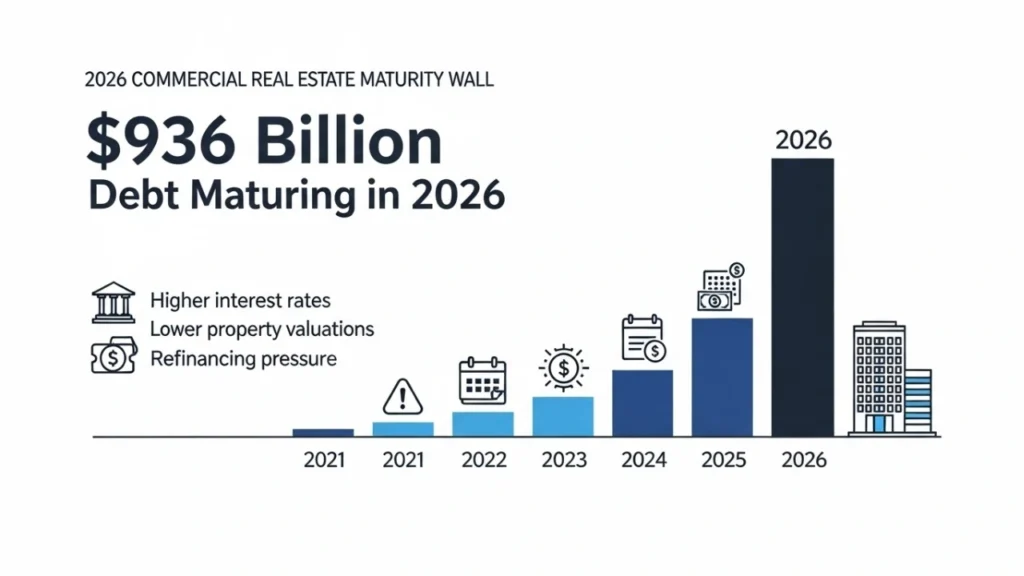
The biggest threat to your portfolio isn’t necessarily your occupancy rate; it is your loan expiration date. We are currently facing a “maturity wall,” with nearly $1 trillion in debt set to be refinanced in a high-interest-rate environment. Many owners who took out low-interest loans in 2021 are finding that their properties no longer “pencil out” under 2026 bank standards.
Oxford Economics predicts that the U.S. will see a “sluggish” GDP growth of only 2% through 2026. This slow growth, combined with property insurance premiums jumping 57% between 2019 and 2024, has left many cash-flow-positive buildings in technical default. When the bank says “no” to your refinance, the foreclosure clock starts ticking.
Why Conventional and FHA Lenders Are Pulling Back
You might wonder why your current lender isn’t more helpful. The truth is in the data. FHA loan delinquencies hit a staggering 10.78% in late 2025. Banks are scared of these rising numbers, so they are raising their requirements. If your property has a high debt-to-income ratio or if you have seen a slight dip in your credit score, a traditional bank might view you as too risky. This is where private lenders for commercial foreclosure avoidance step in to bridge the gap.
What is a Private Loan to Avoid Commercial Foreclosure?
A private loan for foreclosure avoidance is a specialized mortgage, usually provided by non-bank entities or private investment groups. Unlike a bank, which reviews your tax returns and credit history over months, a private lender focuses on your “protective equity.”
If you have a multifamily complex, whether it is a 1-4 unit property, 5-10 units, or a large 40+ unit building, the lender focuses on the asset’s value. They provide urgent private financing commercial property foreclosure relief by paying off your existing delinquent mortgage and stopping the auction. This gives you a “breathing room” of 12 to 24 months to stabilize the property or wait for better market conditions.
The Mechanics of Fast Private Capital
| Feature | Traditional Bank Loan | Fast Private Loan |
| Approval Time | 45 – 90 Days | 5 – 14 Days |
| Primary Focus | Borrower Credit/Income | Property Equity/Value |
| Paperwork | Full Documentation | “Lite-Doc” or “No-Doc” |
| Flexibility | Rigid Terms | High (Customizable) |
For most owners, the most essential feature of a bridge loan to stop commercial property foreclosure is speed. You cannot wait 60 days for a bank committee when your auction is in three weeks.
How Can Urgent Private Financing Save Your Real Estate Equity?
Think about the years of work you have put into your multifamily investment. If the bank forecloses, you lose everything. A hard money loan to prevent business foreclosure acts as a strategic bailout. It allows you to:
- Cure the Default: Pay off the arrears and legal fees immediately.
- Protect Your Credit: Stop the foreclosure before it leaves a permanent scar on your credit report.
- Preserve Your Equity: Keep ownership of the asset and benefit from future appreciation.
Harvard Business School research suggests that “strategic leverage management” is the key to surviving this cycle.9 This means using short-term private debt to “bridge” your way out of a crisis until you can secure long-term, low-interest financing.
Understanding Your Property Type: From 1-4 Units to Institutional Complexes
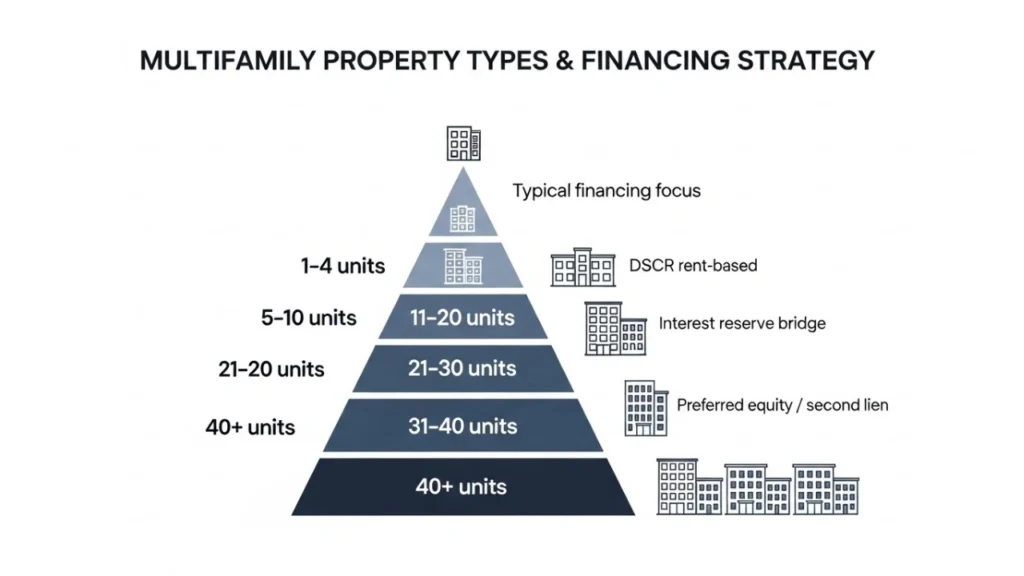
The risk factors and loan requirements vary depending on the size of your multifamily asset. At MultifamilyLender.Net, we leverage our 30 years of underwriting expertise to tailor solutions for every market tier.
Multifamily (1-4 Units) Investment Property
These are often treated similarly to residential properties, but they are commercial in spirit. Foreclosures here are rising because of “stretched affordability” among first-time investors. For these assets, we often use a DSCR (Debt Service Coverage Ratio) loan.
The formula for qualifying is simple:
DSCR = Gross Rental Income / PITIA
(PITIA = Principal + Interest + Taxes + Insurance + Association Fees). If your property generates enough rent to cover the debt, you can often get a private mortgage to save commercial property from auction with no personal income verification.
Small to Mid-Size (5-10 and 11-20 Units)
These properties are the “missing middle.” They are too big for residential loans and too small for many institutional lenders. Owners here often struggle with “operating cost creep,” the steady rise in taxes and maintenance that eats your profits.11 Private capital for distressed commercial real estate can provide an “interest reserve,” meaning the loan pays for itself for several months while you find new tenants or finish renovations.
Large-Scale (21-30, 31-40, and 40+ Units)
For these large apartment buildings, the primary issue is the “refinancing gap.” If your property was valued at $10 million in 2021 but is only worth $8.5 million today due to higher cap rates, a bank will only lend you about $5.5 million. If you owe $7 million, you have a $1.5 million gap. Private equity investment to avoid commercial property loss can fill that gap through “preferred equity” or a “second lien” position, saving the asset from a total loss.
What Are the Private Loan Requirements to Avoid Commercial Foreclosure?
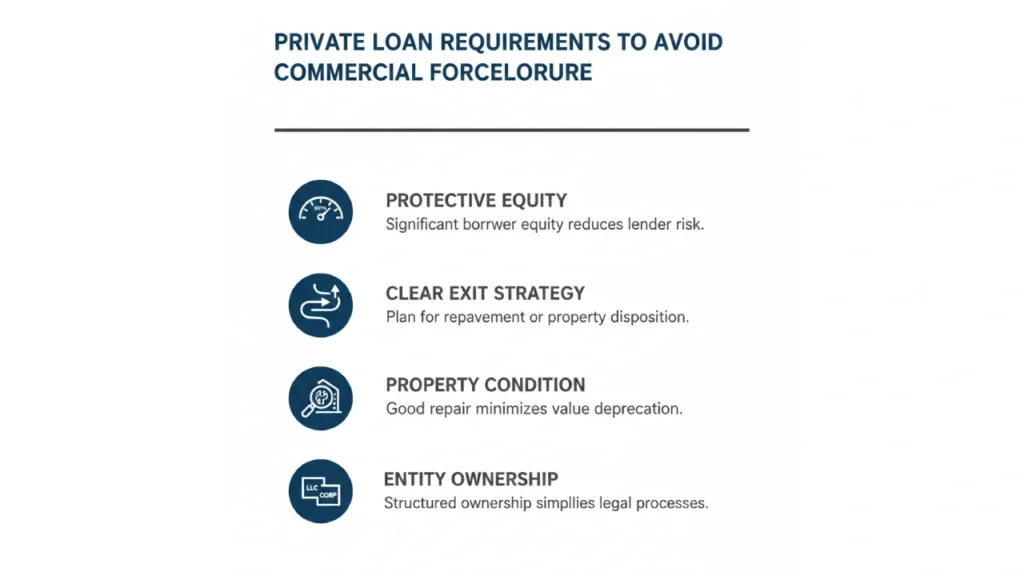
Because private lenders take on more risk, they have different requirements than your local bank. However, these requirements are often much easier to meet during a crisis.
- Protective Equity: Most lenders prefer a Loan-to-Value (LTV) ratio between 65% and 75%.14 This means if your building is worth $1,000,000, the total debt should be around $700,000.
- A Clear Exit Strategy: This is the most important part. How will you pay back the private loan? Will you sell the property, refinance into an SBA or FHA loan later, or increase rents to qualify for a traditional term loan?
- Property Condition: While “fix and flip” or “fix and rent” projects are welcomed, the property must have a clear path to being “stabilized.”
- Entity Ownership: Private loans are almost always made to a business entity (such as an LLC or Corp), which helps expedite the legal process.
Why Speed is Your Greatest Ally in a Commercial Building Default
In the world of fast private loans for commercial building default, time is measured in hours, not weeks. The “foreclosure velocity” has increased as banks look to clear non-performing loans off their books. According to ATTOM, some states, like Delaware and New Jersey, are seeing foreclosure increases of 48% to 150%.
When you apply for a quick private loan approval commercial foreclosure solution, you are paying for the lender’s ability to “table fund,” meaning they have the cash ready to wire to the title company as soon as the paperwork is signed. This can stop a sheriff’s sale even if it is scheduled for next week.
A Closer Look at Multifamily Loan Types for 2026
When you consult with us, we look at a wide range of products to find the one that fits your specific “pain point.”
1. Bridge and Hard Money Loans
These are the most common for “urgent private financing.” They are short-term (1-3 years) and interest-only. They are designed for speed and to bridge the gap until you can get a better long-term deal.
2. DSCR Loans
These are based entirely on the property’s rental income. If the building is “stabilized” and has a DSCR of 1.15 or higher, you can get competitive rates without showing personal tax returns.
3. FHA Commercial and Construction Loans
While these take a long time to close, they are excellent “exit strategies.” You might use a private loan to stop the foreclosure today, and then use that time to apply for a 35-year FHA fixed-rate loan.
4. No-Doc and Lite-Doc Loans
Ideal for entrepreneurs and investors who have complex finances. These loans focus on bank statements and the asset’s performance rather than a traditional “P&L” statement.
5. SBA and USDA B&I Loans
If your multifamily property is in a rural area or provides a specific community benefit, these government-guaranteed loans can offer incredibly low rates once the property is no longer in default.
Are There Alternatives to Commercial Foreclosure Private Funding?
Before you commit to a loan, it is vital to understand all your options. At MultifamilyLender.Net, we believe in educating our clients so they make the best financial choice.
- Mortgage Forbearance: This is when the lender agrees to pause your payments. However, as of late 2025, the forbearance rate is rising, and many banks are becoming less willing to offer it.
- Loan Modification: You can try to get a lower interest rate with your current bank. But be warned: banks often take months to decide, and if they say “no” at the last minute, it may be too late to get a private loan.
- Deed-in-Lieu of Foreclosure: This is essentially giving the keys to the bank. You walk away with nothing.
- Short Sale: Selling the property for less than what you owe. The bank must agree to forgive the difference.
- Guaranteed Cash Offer: Selling your property “as-is” to an investor for an immediate payout. This is a great way to save your credit and walk away with some equity before the bank takes it all.
How to Get Private Financing for Commercial Property in Foreclosure: A Step-by-Step Guide
If you are ready to take action, the process is more straightforward than you think.
| Step | Action | Why It Matters |
| 1 | Initial Consultation | We analyze your property and the foreclosure timeline. |
| 2 | Submit Basic Docs | Rent roll, recent mortgage statement, and an appraisal or BPO. |
| 3 | Letter of Intent (LOI) | You receive a clear offer with the rate, term, and fees. |
| 4 | Underwriting | Our team verifies the property’s value and your exit strategy. |
| 5 | Closing & Funding | The default is cured, the foreclosure stops, and you keep your property. |
Why MultifamilyLender.Net is Your Strategic Partner
With 30 years of expertise as an underwriter, we don’t just “find” loans; we “build” them. Our network of over 1,000 real estate investors, private lenders, and brokers gives us access to capital that others simply don’t have.
Whether you are looking to do ground-up construction, a complex rebuild, or a simple “fix and rent” project, we provide the financial consulting you need to succeed. We offer both exclusive and non-exclusive referral programs to brokers, helping the entire multifamily ecosystem stay healthy during these “sluggish” economic times.
What Does the Future Hold for Your Multifamily Investment?
Forbes predicts that while the market is volatile now, the long-term demand for multifamily housing will remain strong due to the ongoing housing shortage. Harvard data shows that 80% of households currently show a momentum for renting over buying. This means your building is a valuable asset, it just needs to survive the current credit crunch.
Successful investors are those who can “pivot” when traditional markets fail. By using private funding options for commercial real estate owners facing foreclosure, you are not just “paying a higher rate,” you are buying time. And in 2026, time is the most valuable commodity in real estate.
Conclusion: Take Action Before the Auction
The threat of commercial foreclosure is real, but it is not the end of the road. If you are facing a default or your loan is approaching the 2026 maturity wall, the time to act is now. Delaying even a few days can mean the difference between keeping your property and losing a decade of hard work.
Connect with MultifamilyLender.Net today. Let our 30 years of underwriting experience and our vast network of 1,000+ lenders work for you. Whether it is a bridge loan, a DSCR loan, or a “lite-doc” bailout, we have the tools to stop the foreclosure and secure your financial future.
FAQs
Can private loans stop a scheduled auction?
Yes. Private lenders focus on property equity, allowing them to fund quickly, often in 5 to 14 days, to cure defaults. This rapid capital can stop a sheriff’s sale even if your auction is only days away.
Do I need good credit for bailout loans?
No. Private lenders prioritize the value of your collateral and existing equity rather than your personal credit score. This flexibility makes them a viable option for owners who cannot obtain traditional bank financing due to recent missed payments.
Are these rescue loans expensive to obtain?
Yes. These short-term loans carry higher interest rates, often ranging from 8% to 15%, to reflect the lender’s increased risk. Despite the cost, they provide vital time to stabilize your property before seeking a lower-rate permanent mortgage.
Will a private loan save my equity?
Yes. By using private capital to pay off a delinquent mortgage, you prevent your property from being sold at auction and losing it all. This strategy preserves your ownership and protects the equity you have built over years of investment.
Is a short sale better than borrowing?
No. A short sale requires you to sell for less than you owe, often resulting in a total loss of equity. Conversely, a private loan allows you to keep the asset and benefit from future market appreciation.