

 Google AI
 ChatGPT
 Perplexity
The multifamily landscape in 2026 is defined by a shift toward stability after several years of economic adjustment. For investors, the cost of capital is the most critical factor in determining whether a deal pencils out. Understanding how Freddie Mac multifamily loan rates are determined is the first step toward building a resilient portfolio. As the market moves into a period of normalization, the government-sponsored enterprises, or GSEs, remain the primary source of liquidity for apartment owners.
Recent data suggests that the sector is entering a more competitive phase. According to a 2026 Forbes report, performance now depends more on operational execution than on market tailwinds alone. This means that securing the right financing is more important than ever. Whether you are looking at a 10-unit building or a large complex, the benchmarks and spreads used by lenders will dictate your long-term success.
The Economic Benchmarks Driving Capital Costs
To understand where Freddie Mac multifamily loan rates stand today, we have to look at the broader economy. In early 2026, economic signals have been mixed. The advance estimate for the fourth quarter of 2025 showed that real gross domestic product grew at a slower 1.4 percent annual increase. This was a sharp moderation from the 5.4 percent that many economists at places like Yale and Oxford had forecasted earlier in the cycle.
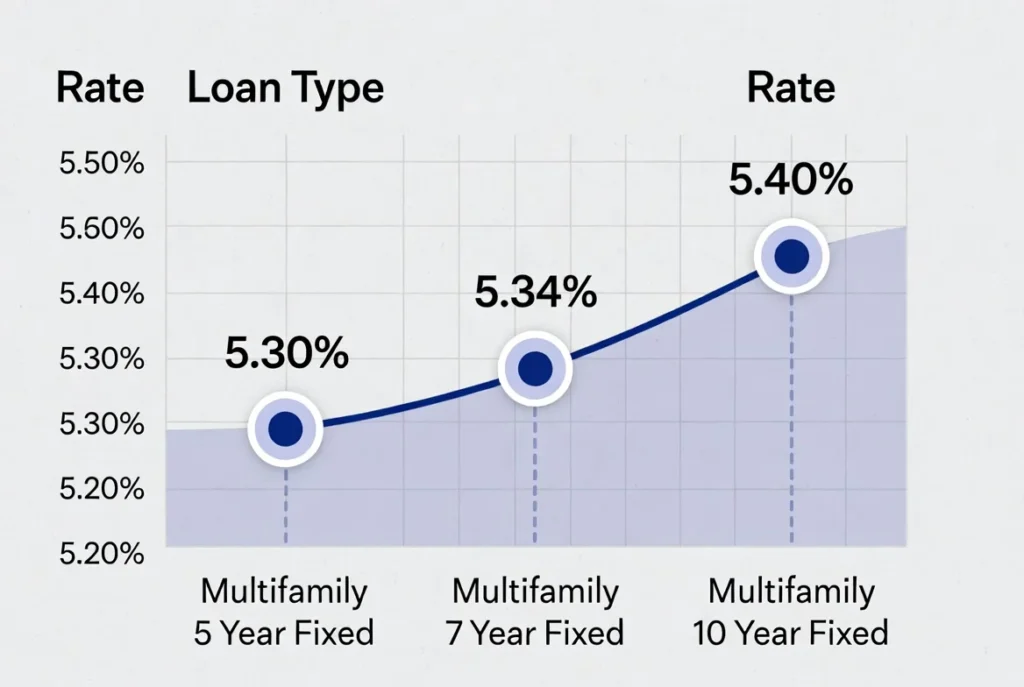
When economic growth slows, it often leads to a pullback in consumer spending. This influences the Federal Reserve and the bond market. For fixed-rate multifamily financing, the 10 Year Treasury yield is the essential benchmark. During April 2026, the 10 Year Treasury glided toward 4.0 percent. Investors are watching this closely because the interest rate on a Freddie Mac multifamily loan is typically expressed as the Treasury yield plus a “spread” that accounts for risk.
| Loan Type | Rate | LTV |
| Multifamily 5 Year Fixed | 5.30% | Up to 80% |
| Multifamily 7 Year Fixed | 5.34% | Up to 80% |
| Multifamily 10 Year Fixed | 5.40% | Up to 80% |
These rates, updated as of late April 2026, indicate a market stabilizing. While the 30-year fixed rate for residential mortgages has hovered around 5.98 percent, commercial apartment financing remains slightly more competitive for high-quality assets.
These rates are only available to deals that meet strong underwriting standards, most importantly a solid Debt Service Coverage Ratio (DSCR).
Is Now the Right Time to Secure Freddie Mac Multifamily Loan Rates?
Many investors are asking if they should lock in rates now or wait for the Federal Reserve to act. Current sentiment from a Berkadia investor survey shows that most respondents expect the 10 Year Treasury to stay between 3.5 percent and 4.0 percent through the end of the year. With at least two rate cuts anticipated by many market analysts, there is a sense that the volatility peak has passed.
However, waiting for the “perfect” rate can be a risky strategy. The inventory of homes for sale remains 17 percent below pre-pandemic levels. This structural housing shortage, estimated at 3.7 million units by Freddie Mac researchers, keeps rental demand high. If you find a property with strong fundamentals, first make sure you meet the requirements, then secure a Freddie Mac Multifamily loan today to capture that demand while competitors are still sitting on the sidelines.
Understanding the New “Conventional Small” Platform
In April 2026, Freddie Mac made a major change to how it handles smaller properties. The previous Small Balance Loan program was replaced by the “Conventional Small” lending product. This new platform targets loans between $2 million and $10 million. It is a vital tool for those investing in workforce housing.
The goal of this shift was to make the process more efficient. By using the same documents and underwriting teams as the larger conventional loans, Freddie Mac has reduced the friction for smaller investors. For you, this means more predictable execution and competitive pricing on Freddie Mac Apartment Loans. These smaller assets are the backbone of the rental market, often providing the “naturally occurring” affordable housing that the country desperately needs.
Why Are Freddie Mac Multifamily Rates Diverging from Traditional Mortgages?
It is common for investors to confuse residential mortgage trends with commercial apartment rates. While they both follow the Treasury market, they serve different purposes. Residential rates are driven by consumer credit and housing demand. In contrast, Freddie Mac Multifamily rates are driven by property income and debt service coverage.

In 2026, the cost to buy a home is roughly 41 percent higher than the cost of renting a similar unit. This gap has created a “renter by necessity” pool, keeping apartment occupancy high. Because the risk of default is lower in a well-managed apartment building than in a single-family home during economic shifts, the spreads on multifamily debt can sometimes be more favorable. Freddie Mac reported a multifamily delinquency rate of only 0.44 percent in early 2026, underscoring the asset class’s incredible resilience.
How Underwriting Determines Your Final Rate
When you apply for a loan, the lender looks at more than just your credit score. They focus on the property’s ability to pay its own bills. The most important metric is the Debt Service Coverage Ratio, or DSCR. This ratio compares the net operating income to the annual debt service.
The formula for Net Operating Income is:
NOI = (Gross Potential Rent + Other Income) – (Vacancy Loss + Operating Expenses)
To get the best Freddie Mac multifamily loan rates, most lenders require a minimum DSCR of 1.25x. This means the property must earn 25 percent more than the mortgage payments cost. In an environment where insurance and labor costs are rising, managing your operating expenses is the only way to keep your NOI high enough to qualify for maximum leverage.
Can Your Property Actually Qualify for the Lowest Freddie Mac Apartment Loans?
Qualification is a two-part process involving both the property and the borrower. For the borrower, you generally need a credit score between 660 and 680. Your net worth should be at least 100 percent of the loan amount, and you should have liquid assets equal to 10 percent of the loan.
Experience also matters. Freddie Mac prefers to lend to those who have a track record of success. If you are new to the industry, you might consider working with a consultant. Firms like MultifamilyLender.Net are professional and dedicated to smooth loan approval, helping you navigate these requirements and present your case to the GSEs effectively. Having an expert who understands underwriting can be the difference between a rejection and a competitive quote.
Leveraging the Green Advantage Program
One of the best ways to lower your interest rate is to go green. The Green Advantage program offers discounted pricing for properties that meet specific energy or water efficiency standards. If you can reduce energy or water consumption by at least 30 percent, you could unlock lower Freddie Mac multifamily rates.
This program is not just about the environment; it is about the bottom line. By reducing utility costs, you increase your NOI and thereby improve your property’s value. Freddie Mac even offers rebates for energy audits, helping you offset the cost of the initial assessment. In a competitive market, these small basis point discounts can add up to thousands of dollars in savings over the life of the loan.
Regional Market Trends: Where to Invest in 2026
Not all markets are performing the same this year. While the Sun Belt and Mountain West saw a massive surge in new construction over the last two years, they are now dealing with an oversupply of units. This has pushed the national vacancy rate to around 7.3 percent.
In contrast, the Midwest and Northeast have remained very stable. Cities like Chicago, New York, and Philadelphia are seeing strong rent growth because they have limited new apartment supply. If you are seeking a Freddie Mac multifamily loan, lenders may offer better terms in these “supply-constrained” markets because the cash flow is seen as more predictable.
| Region | Expected Growth 2026 | Sentiment |
| South | +37% | High Supply |
| West | +36% | Rebalancing |
| Midwest | +31% | Strong/Stable |
| Northeast | +23% | High Demand |
Will the Supply Cliff Impact Your Freddie Mac Multifamily Loan Strategy?
A major theme for the next few years is the “supply cliff.” Because interest rates were high in 2024 and 2025, fewer developers started new projects. This means that by 2027 and 2028, there will be very few new apartments delivered to the market.

For an investor today, this is an opportunity. If you acquire or renovate a property in 2026, you will be positioned to benefit from the lack of competition in a few years. This supply-demand imbalance is expected to drive rents higher, allowing you to “grow out” of your current debt. When planning your Freddie Mac multifamily loan strategy, think about the long-term horizon. The projects breaking ground today are likely to be very profitable when they hit the market in a supply-starved environment.
Operational Excellence and Renter Expectations
In 2026, simply owning a building is not enough. You must be an excellent operator. Renter expectations have evolved, with a focus on convenience and digital workflows. According to MRI Software and other industry reports, residents now expect mobile access, automated payments, and self-guided tours.
Properties that use technology to reduce friction are outperforming those that rely on old-fashioned management. This operational efficiency helps you manage rising labor and insurance costs. By keeping your expenses low, you protect your DSCR and stay in good standing with your lender. Freddie Mac monitors these metrics through its “watchlist,” and maintaining a strong relationship with your servicer is key to future financing opportunities.
The Importance of Affordable Housing Goals
Freddie Mac has a mission to support affordable housing. For 2026, the Federal Housing Finance Agency has set clear goals for the GSEs. A large portion of their lending must go to properties where units are affordable to residents earning 80 percent or less of the Area Median Income.
If your property fits these criteria, you may have access to the Targeted Affordable Freddie Mac Housing program. This program offers specialized solutions for Section 8 housing, LIHTC properties, and senior living. These loans often offer the most competitive Freddie Mac Multifamily loan rates because they fulfill the agency’s primary mission of providing housing for low and moderate-income families.
Prepayment Options and Exit Strategies
When you sign a loan, you must consider how you will eventually repay it. Freddie Mac offers several prepayment structures, including yield maintenance and step-down premiums. Yield maintenance protects the lender’s return if you pay off the loan early. At the same time, a step-down structure, like 5-4-3-2-1, gives you more flexibility at a slightly higher initial cost.
If you plan to sell or refinance in a few years, a step-down structure is usually the better choice. It makes the exit cost predictable. On the other hand, if you are a long-term “buy and hold” investor, yield maintenance might offer you a lower starting rate. Always discuss these options with your consultant to ensure your debt matches your investment timeline.
Managing the Risks of 2026
While the outlook is positive, there are still risks to watch. Insurance costs remain a major concern for many operators, especially in coastal areas. Additionally, some markets are seeing debates over rent control, which can limit your ability to increase revenue.
Thorough due diligence is the best way to mitigate these risks. Before you commit to a Freddie Mac multifamily loan, make sure you understand the local regulatory environment and the specific insurance requirements for your area. A professional, dedicated team at Multifamily Lender, focused on smooth loan approval, can provide the market insights needed to avoid these pitfalls.
Conclusion
Navigating the world of Freddie Mac multifamily loan rates in 2026 requires a mix of economic knowledge and property-level discipline. With the 10 Year Treasury stabilizing and new supply beginning to fade, the window for strategic acquisition is opening. By focusing on benchmarks like the DSCR and programs like Green Advantage, you can secure financing that supports long-term growth.
The multifamily sector remains one of the most durable asset classes in the United States. Despite the challenges of the last few years, the fundamental need for quality housing remains. As you look toward your next investment, remember that the right partner and the right debt structure are just as important as the property itself. Whether you are a seasoned broker or a new investor, the tools provided by Freddie Mac are designed to help you succeed in this evolving market.
Explore Best Commercial Loan Referral Program to connect with experienced professionals who can help you secure competitive Freddie Mac financing.
FAQs
Can a borrower transfer their existing loan?
Yes. Most Freddie Mac multifamily products are fully assumable with lender approval and a 1% fee. The incoming borrower must qualify under current standards for capacity, capital, and experience to ensure the property continues performing at high levels.
Can I get more capital without refinancing?
Yes. Supplemental loans allow you to access equity without a full refinance. These are available twelve months after your first loan closes. They must be coterminous with your existing debt and require the property to remain in good standing.
Do they fund buildings with retail space?
Yes. Mixed-use properties are eligible for financing if the commercial component is minor. Generally, retail or office income should not exceed 20% of the total property revenue. The lender must grant an exception for these specific apartment building structures.
Is there a new 2026 refinance test?
Yes. A new test became effective in April 2026 for most loan products. It uses an implied 10-year forward rate of 5.46%. This calculation ensures that your property can safely manage future interest rate risks when the current term expires.
Is non-recourse debt always fully protected?
No. While these loans limit liability, they contain “bad boy” carve-outs. You stay personally responsible for the balance if you commit fraud or gross negligence. These provisions protect the lender against intentional mismanagement or the illegal diversion of property funds.