
 Google AI
 ChatGPT
 Perplexity
The multifamily real estate landscape in 2026 is a study in contrasts. On one hand, the national multifamily vacancy rate hit a record high of 7.3% in early 2026. On contrary, The United States is facing a housing shortage. It needs 3.7 million more homes. For the savvy investor, this “gap” is where the money is made.
Currently, property values are sitting roughly 28% below their 2022 peaks. We are seeing a massive “thaw” in the transaction market because the “bid-ask spread” which is the distance between what sellers want and what buyers can afford, is finally closing. However, traditional banks are still moving at a snail’s pace, often taking 90 to 120 days to underwrite a single deal. In a market where a distressed asset can be snatched up in days, waiting three months for a bank is a recipe for a missed opportunity.
At MultifamilyLender.Net, we have 30 years of underwriting abilities. We operate as a correspondent and table lender, often acting as a “super broker” with a network of over 200 real estate investors and private lenders. Whether you are looking at a small 4-unit building or a 300-unit complex, the bridge loan for distressed multifamily acquisition is the tool that lets you close quickly and stabilize your investment.
Is Now Really the Best Time for a Bridge Loan for Distressed Multifamily Acquisition?
Many investors are asking if they should wait for interest rates to drop further. As of the March 2026 Federal Open Market Committee meeting, the Fed held rates steady at a target range of 3.5% to 3.75%. While we aren’t seeing the double-digit rent growth of the post-pandemic boom, we are seeing a sustainable 3% to 4% growth in high-demand markets.

The “distressed” part of the equation isn’t always about a broken building; often, it’s about a broken capital stack. Many owners who used excessive leverage in 2021 are now facing maturing debt they cannot refinance. This creates a “vintage opportunity” to acquire assets at a discount. Private bridge loans for maturing CMBS debt can help buyers step in quickly or allow current owners to bridge to stabilization. If you wait for “perfect” conditions, the 28% discount currently available in the market will likely have vanished as institutional capital floods back in.
Distressed Multifamily Acquisition Financing Options Bridge Loans: Why Speed is Your Only Real Advantage
When you find a foreclosure property or a motivated seller facing a balloon payment, they don’t care about your long-term FHA application. They care about the certainty of closure. This is where distressed multifamily acquisition financing options bridge loans outshine every other product.
The Benefits of Rapid Deployment
Bridge loans are asset-based, meaning lenders focus more on the property’s potential value and your exit strategy than your personal tax returns.
- Quick Closing: We can often close in as little as 4 to 6 weeks.
- Interest-Only Payments: Most bridge products allow for interest-only payments, preserving your cash flow for renovations.
- High Leverage: You can often secure up to 60% to 75% Loan-to-Cost (LTC), meaning you keep more of your own capital for other deals.
How to Get a Bridge Loan for Distressed Apartment Buildings: A Step-by-Step Roadmap
If you are new to the industry or an experienced broker looking to help a client, the process of getting a bridge loan for distressed apartment buildings is more about the “story” than the paperwork.
- Identify the Distressed Asset: Look for properties with high vacancy, deferred maintenance, or “underperforming” management.
- Define the Exit Strategy: Lenders want to know exactly how you will repay them. Will you sell the property in 18 months, or refinance into a 30-year agency loan?
- Prepare the Business Plan: You need a clear renovation budget and a timeline to increase Net Operating Income (NOI). An Investment Property Loan Calculator can also help to test different scenarios and show lenders your projected cash flow.
- Partner with a Specialized Consultant: With 75 different loan products, we can match your specific deal—whether it’s a 5-10 unit fix-and-flip or a 50+ unit “rebuild”—to the right private lender.
Bridge Loan Requirements for Value-Add Multifamily Investment
To qualify for the best terms, you need to understand what the underwriter is looking for. While requirements are more flexible than traditional mortgages, bridge loan requirements for value-add multifamily investment in 2026 focus on “skin in the game” and track record.
| Requirement | Industry Standard (2026) | Our Capability |
| Minimum FICO | 650 – 680 | 580-680 |
| Max LTC | 75% – 85% | Up to 75% of rehab costs |
| Liquidity | 6 – 12 months debt service | Flexible based on project scope |
| Experience | 2-3 previous projects | Programs for new investors |
Lenders typically want to see that the “After Repair Value” (ARV) supports the total loan amount. In 2026, institutional bridge lenders have standardized on a 70% to 75% LTV range for residential assets, but aggressive private programs can go higher if the sponsor is experienced.
Why Do Most Investors Fail at Closing a Distressed Multifamily Deal with Bridge Financing?
The biggest pitfall isn’t the interest rate—it’s the timeline. A bridge loan is a “ticking clock,” usually lasting 12 to 36 months. If your renovation plan hits a snag or the local municipality delays your permits, you could face a “refinancing crisis”.
Investors often fail because they don’t negotiate “extension options” up front. We advise our clients to secure at least one, and preferably two, 6-month extensions. It is better to have it and not need it than to be forced into a “fire sale” because your loan matured while your units were still vacant.
Bridge Loan Interest Rates Distressed Multifamily: Navigating the 2026 Pricing Tiers
While rates have stabilized, they remain higher than conventional debt. In early 2026, bridge loan interest rates for distressed multifamily typically range between 8.5% and 14.5%.
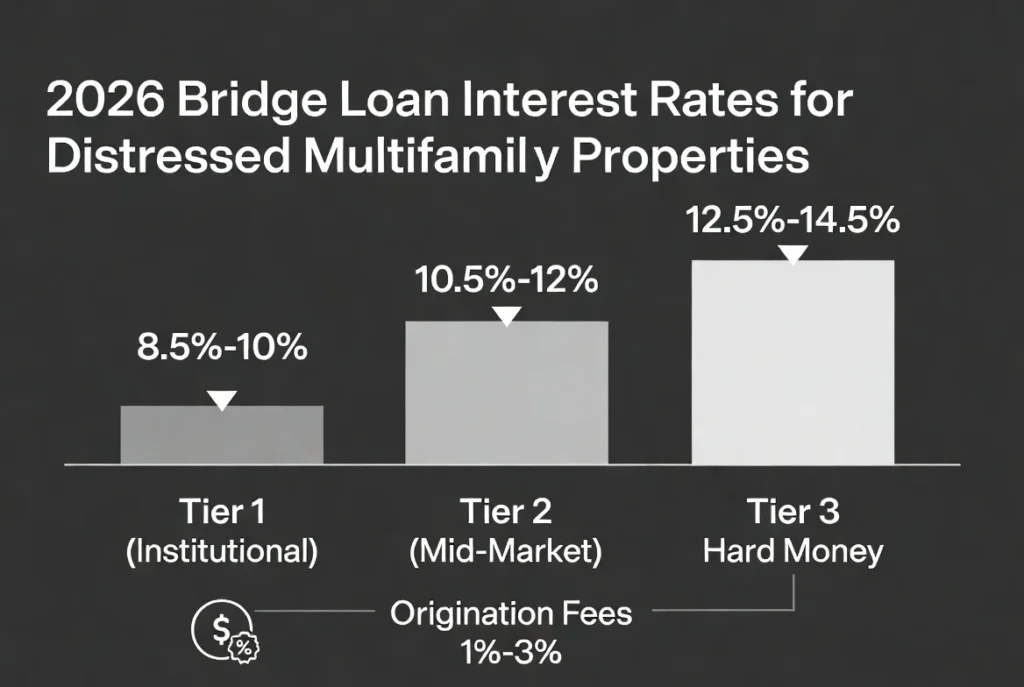
The pricing is generally split into three tiers:
- Tier 1 (Institutional): 8.5% – 10%. Reserved for experienced sponsors with an LTV of 70% or lower.
- Tier 2 (Mid-Market): 10.5% – 12%. Typical for “missing middle” (5-50 units) value-add projects.
- Tier 3 (Hard Money): 12.5% – 14.5%. For heavy rehabs, 100% vacant properties, or first-time investors.
You must also factor in origination fees (points), which range from 1% to 3%. On a $5 million acquisition, this could mean $50,000 to $150,000 in upfront costs.
Bridge Loan vs. Conventional Loan for Distressed Apartments: Which One Wins?
The comparison of bridge loan vs conventional loan for distressed apartments is essentially a choice between “opportunity” and “safety.”
Conventional Loans: These are for stabilized properties. They require a minimum DSCR (Debt Service Coverage Ratio) of 1.25x and usually 90% occupancy. If your building is 40% vacant, a bank will reject you on the spot.
Bridge Loans: These are for “transitional” assets. They don’t require in-place cash flow because the lender is looking at the building’s intended use.
| Feature | Bridge Loan | Conventional Loan |
| Basis | Forward-looking Pro-forma | Historical T-12 Performance |
| Occupancy | Up to 80% Acceptable | 90%+ Required |
| Draw for Rehab | Included in LTC | Not available |
| Closing Speed | 4 – 6 Weeks | 3 – 4 Months |
The smart move is the “bridge-to-permanent” strategy. You use the bridge loan to buy and renovate the property. Once the building is stabilized, refinance into a lower-rate permanent loan.
Are You Overpaying for Your Quick Closing Bridge Loans for Distressed Multifamily Assets?
Many “big box” brokers charge hidden fees that eat into your IRR (Internal Rate of Return). When shopping for quick closing bridge loans for distressed multifamily assets, you need to look at the “fine print” of the term sheet.
- Exit Fees: Does the lender charge you 1% just to pay them back?
- Interest Reserves: Will the lender require you to “pre-pay” 12 months of interest upfront?
- Future Advances: In a value-add deal, you want a lender that offers “earn-out” structures or future advances that fund capital improvements as you hit milestones.
Our Private Commercial Loan Underwriting Checklist can help you review term sheets, spot hidden fees, and avoid costly mistakes.
We specialize in “lite-doc” and “no-doc” loans that cut through the red tape. Our 30 years of underwriting abilities allow us to see the value in your project that a generic AI algorithm might miss.
Understanding Bridge Loan Terms for Distressed Multifamily: The Language of Leverage
To play in the big leagues, you need to master the vocabulary. Understanding bridge loan terms for distressed multifamily will help you negotiate like a pro.
- LTC (Loan-to-Cost): This is the total loan amount divided by the purchase price plus renovation costs.
- ARV (After Repair Value): The projected value of the property once it is fully renovated and leased up.
- Recourse vs. Non-Recourse: In non-recourse loans, the lender’s only collateral is the property itself. Most small-balance bridge loans are “recourse,” meaning you personally guarantee the debt.
- Bad Boy Carve-outs: Even in non-recourse loans, if you commit fraud or environmental negligence, you become personally liable.
Best Bridge Loan Lenders for Distressed Multifamily Properties: Competitor Breakdown 2026
The market is fragmented. Depending on your deal size, different players emerge as the best bridge loan lenders for distressed multifamily properties.
- Small Balance ($250k – $5M): Lenders like New Silver and Lima One Capital are great for 5-65 unit buildings.
- Mid-Market ($5M – $15M): Arbor Realty Trust and Ready Capital specialize in “bridge-to-agency” and “bridge-to-bond” executions.
- Institutional ($15M+): Berkadia and Walker & Dunlop dominate this space, often handling the entire capital stack from debt to equity.
As a correspondent lender, we can often access “wholesale” pricing from these giants that an individual investor cannot get on their own.
Private Bridge Lenders for Distressed Commercial Real Estate Multifamily: The “Super Broker” Secret
Why work with private bridge lenders for distressed commercial real estate multifamily? Because they are “story lenders.” If your property has a “clouded title,” environmental issues, or a history of mismanagement, a private lender will listen to your plan to fix it.

Private lenders use their own capital, enabling “creative” structuring. For example, if you lack the down payment for a new acquisition, we can often “cross-collateralize” another property in your portfolio to provide 100% financing for the new deal.
Risks of Using Bridge Loans for Distressed Multifamily: What Could Go Wrong?
We wouldn’t be experts if we didn’t talk about the downsides. The risks of using bridge loans for distressed multifamily are largely centered on execution.
- Market Volatility: If interest rates spike while you are renovating, your “exit” loan might be more expensive than you planned.
- Construction Delays: Every month your units are vacant is a month you are paying interest out of pocket.
- Regulatory Changes: Markets like New York and Seattle are closely monitoring rent-control initiatives, which could affect your projected NOI.
The best defense is a “sensitivity analysis.” We help you stress-test your deal for 10% lower rents or 20% higher construction costs to ensure you still have a path to profit.
Rehab Bridge Loans for Distressed Multifamily Units: Managing the Construction Draw
The “draw” process is how you get your renovation money. Rehab bridge loans for distressed multifamily units don’t give you the full budget on day one. Instead, the money is held in escrow.
As you finish work—say, the new roof or the first five kitchens—you request a “draw.” An inspector will verify the work, and the funds will be released. It’s a bit of a dance, but it ensures that the lender’s collateral is actually increasing in value as you spend the money.
Due Diligence for Distressed Multifamily Acquisition with Bridge Loan: A Professional Checklist
Before you sign on the dotted line, you need to do your homework. The due diligence for a distressed multifamily acquisition with a bridge loan should be exhaustive.
- Audit the Rent Roll: Are the tenants actually paying, or is the seller hiding delinquencies?
- Property Condition Assessment (PCA): You need to know the exact cost of the “deferred maintenance” before you close.
- Utility & Tax Liens: Distressed properties often have unpaid bills that “attach” to the property.
Short-Term Financing for Distressed Apartment Complex Purchase: The “Missing Middle” Opportunity
In 2026, the “missing middle”—properties with 2 to 4 units or 5 to 50 units—is where the biggest opportunities lie. While 50+ unit buildings accounted for 54% of completions in 2024, the smaller segment has been neglected. This scarcity makes short-term financing for distressed apartment complex purchases in this segment very lucrative for those who can execute a “fix-and-hold” strategy.
Conclusion: Turning Distress into Dominance
The current market, with high vacancies and a 28% valuation drop, isn’t a crisis; it’s a reset. By utilizing a bridge loan for distressed multifamily acquisition, you are positioning yourself to buy low and stabilize high.
Whether you are looking for ground-up construction, a simple fix-and-flip, or a complex portfolio rebuild, Multifamily Lender is your partner. With 30 years of underwriting experience, 75 different loan products, and a network of 200+ private lenders and investors, we provide the financial advice and liquidity you need to win in 2026.
Ready to close your next deal in 6 weeks? Contact us now and Let’s get to work.
FAQs
Can bridge loans fund mixed-use multifamily buildings?
Yes. Most private lenders approve mixed-use assets if the residential component comprises at least 51 percent of the total square footage. This flexibility allows you to stabilize retail space while renovating apartment units, thereby maximizing the property’s potential.
Do bridge loans work for auction property purchases?
Yes. Specialized lenders provide rapid capital for auction acquisitions, provided the venue allows for title insurance and escrow. This speed is essential for securing distressed foreclosures at deep discounts before other bidders can even coordinate their initial financing.
Will a bridge loan cover delinquent property taxes?
Yes. You can use bridge loan proceeds to settle outstanding tax liens or municipal judgments that threaten ownership. By clearing these financial hurdles, you protect your equity and prepare the asset for a clean transition into permanent financing.
Are non-recourse bridge loans available for investors?
Yes. Large-scale projects or experienced sponsors often qualify for non-recourse debt, which protects personal assets if the project fails. While these require lower leverage, they offer risk mitigation for sophisticated partnerships and high-net-worth real estate investment groups.
Is there a minimum unit count required?
No. While many funds prefer large complexes, we offer products for everything from small duplexes to massive unit portfolios. This approach ensures that both boutique renovators and institutional developers can access the vital short-term capital they need.